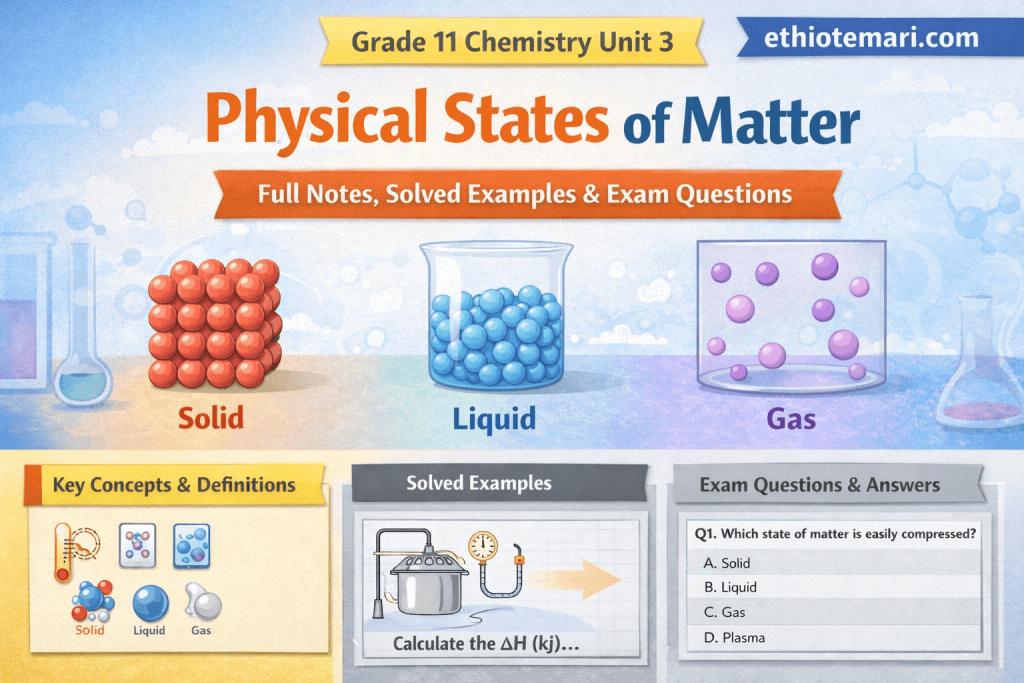
Hello dear student! Welcome to Unit 3. In this unit, we will study the three physical states of matter — solid, liquid, and gas — and understand why substances behave differently in each state. We will learn about the kinetic theory, gas laws (with many calculations!), and properties of liquids and solids. This unit has a lot of problem-solving, so let’s build a strong foundation step by step.
3.1 Introduction
Matter exists in three common physical states: solid, liquid, and gas. Have you ever asked yourself: why is a rock hard, water flows, and air is invisible? The answer lies in how the particles are arranged and how they move.
Let’s compare the three states:
| Property | Solid | Liquid | Gas |
|---|---|---|---|
| Shape | Fixed shape | Takes shape of container | Takes shape of container |
| Volume | Fixed volume | Fixed volume | Fills entire container |
| Particle arrangement | Ordered, closely packed | Disordered, close | Very far apart, random |
| Particle motion | Vibrate in fixed positions | Slide past each other | Move freely at high speed |
| Compressibility | Nearly incompressible | Slightly compressible | Highly compressible |
| Intermolecular forces | Very strong | Moderate | Very weak |
3.2 Kinetic Theory and Properties of Matter
3.2.1 The Kinetic Theory of Matter
The kinetic theory of matter states that all matter is made of tiny particles (atoms or molecules) that are in constant motion. The amount of motion (kinetic energy) depends on temperature.
Main postulates of the kinetic theory:
- All matter consists of tiny particles (atoms, molecules, or ions).
- These particles are in continuous random motion.
- The kinetic energy of particles increases with temperature.
- There are forces of attraction between particles. In solids these are very strong; in liquids, moderate; in gases, very weak.
- When particles collide with each other or with the walls of the container, the collisions are perfectly elastic (no net loss of kinetic energy).
The kinetic theory beautifully explains why heating a solid turns it into liquid, and further heating turns the liquid into gas: as temperature increases, particles gain more kinetic energy and can overcome the intermolecular forces holding them together.
3.2.2 Properties of Matter
Key measurable properties include:
- Mass (m): Amount of matter in a substance, measured in kg or g.
- Volume (V): Space occupied, measured in m³, L, or mL.
- Density (ρ): Mass per unit volume: $$\rho = \frac{m}{V}$$
- Temperature (T): Measure of average kinetic energy, measured in °C, K (Kelvin).
- Pressure (P): Force per unit area: $$P = \frac{F}{A}$$
Important: Kelvin and Celsius are related by: $$T(\text{K}) = T(°\text{C}) + 273.15$$
Never use Celsius in gas law calculations — always convert to Kelvin!
• All matter has particles in continuous motion — even in solids (vibration).
• Higher temperature = greater kinetic energy = faster particle movement.
• State changes occur when particles gain/lose enough energy to overcome/establish intermolecular forces.
• Always convert °C to K for gas law calculations: K = °C + 273.15.
• Standard Temperature and Pressure (STP): T = 273 K (0 °C), P = 1 atm (101.325 kPa).
1. Convert 37 °C and −40 °C to Kelvin.
2. A block of metal has a mass of 150 g and a volume of 20 cm³. Calculate its density.
37 °C = 37 + 273.15 = 310.15 K
−40 °C = −40 + 273.15 = 233.15 K
Answer 2:
$$\rho = \frac{m}{V} = \frac{150 \text{ g}}{20 \text{ cm}^3} = 7.5 \text{ g/cm}^3$$
3.3 The Gaseous State
Gases are the simplest state to study mathematically because gas particles are far apart and intermolecular forces are negligible. Let’s start with the theory behind gases, then learn each gas law one by one with worked examples.
3.3.1 The Kinetic Molecular Theory of Gases
This is a more detailed version of the kinetic theory, specifically for gases. It has five postulates:
- Gases consist of many tiny particles (atoms or molecules) that are far apart relative to their size. The volume of the particles themselves is negligible compared to the volume of the container.
- Gas particles are in constant random, straight-line motion. They change direction only when they collide with each other or with the container walls.
- Collisions are perfectly elastic. No kinetic energy is lost during collisions — total kinetic energy remains constant.
- There are no intermolecular forces between gas particles (except during collisions). Particles do not attract or repel each other.
- The average kinetic energy of gas particles is proportional to the absolute temperature (in Kelvin). KE ∝ T. At a given temperature, all gases have the same average kinetic energy regardless of the gas identity.
From postulate 5, since KE = ½mv² and KE ∝ T:
where k = Boltzmann constant (1.38 × 10⁻²³ J/K) and R = gas constant (8.314 J/(mol·K)).
An important consequence: at the same temperature, lighter gas molecules move faster than heavier ones (since KE is the same but KE = ½mv²).
• “Ideal gas” behavior follows all five postulates exactly. Real gases deviate slightly.
• Real gases behave most like ideal gases at HIGH temperature and LOW pressure.
• At high P or low T, gas particles are closer together → intermolecular forces matter → deviation from ideal behavior.
• Heavier gases move more slowly at the same temperature (same KE, but larger m).
1. At the same temperature, which moves faster: O₂ molecules or H₂ molecules? Explain.
2. Why do real gases deviate from ideal behavior at high pressure?
H₂ molecules move faster. At the same temperature, both gases have the same average kinetic energy (KE = 3/2 kT). Since KE = ½mv², if KE is the same and m is smaller for H₂ (2 g/mol vs 32 g/mol for O₂), then v must be larger for H₂.
Answer 2:
At high pressure, gas particles are forced very close together. This means: (a) the volume of the particles themselves is no longer negligible compared to the container volume (violating postulate 1), and (b) intermolecular forces become significant because particles are close together (violating postulate 4). Both effects cause real gases to deviate from ideal behavior.
3.3.2 The Gas Laws
Now we come to the most important part of this unit. The gas laws describe how the volume of a gas changes when pressure, temperature, or amount of gas changes. Let’s learn each one carefully.
There is a very useful tool called the gas law variables triangle — just remember that for a fixed amount of gas, changing one variable affects another:
A. Boyle’s Law (Pressure-Volume Relationship)
In 1662, Robert Boyle discovered that at constant temperature, the volume of a fixed mass of gas is inversely proportional to its pressure.
This means if you double the pressure, the volume halves. If you triple the volume, the pressure becomes one-third.
Solution:
$$P_1 V_1 = P_2 V_2$$
$$(1.5 \text{ atm})(250 \text{ mL}) = (3.0 \text{ atm})(V_2)$$
$$V_2 = \frac{(1.5)(250)}{3.0} = 125 \text{ mL}$$
The volume halved because the pressure doubled. This makes sense!
Solution:
$$P_1 V_1 = P_2 V_2$$
$$(95 \text{ kPa})(60 \text{ mL}) = P_2(40 \text{ mL})$$
$$P_2 = \frac{95 \times 60}{40} = 142.5 \text{ kPa}$$
• P₁V₁ = P₂V₂ (T and n must be constant).
• Inverse relationship: P goes up → V goes down.
• Any pressure units work as long as they are the SAME on both sides.
• Graphically: P vs 1/V is a straight line through the origin; P vs V is a hyperbola.
1. A gas at 2.5 atm occupies 400 mL. What volume will it occupy at 1.0 atm (constant T)?
2. A sample of gas is compressed from 800 mL to 200 mL. If the original pressure was 1.2 atm, what is the final pressure?
$$P_1 V_1 = P_2 V_2$$
$$(2.5)(400) = (1.0)(V_2)$$
$$V_2 = 1000 \text{ mL}$$
Answer 2:
$$(1.2)(800) = P_2(200)$$
$$P_2 = \frac{1.2 \times 800}{200} = 4.8 \text{ atm}$$
B. Charles’s Law (Volume-Temperature Relationship)
In 1787, Jacques Charles discovered that at constant pressure, the volume of a fixed mass of gas is directly proportional to its absolute temperature (in Kelvin).
Warning: Temperature MUST be in Kelvin! If you use Celsius, you will get wrong answers.
Solution:
Convert to Kelvin first!
$$T_1 = 27 + 273 = 300 \text{ K}$$
$$T_2 = 127 + 273 = 400 \text{ K}$$
$$\frac{V_1}{T_1} = \frac{V_2}{T_2}$$
$$\frac{300}{300} = \frac{V_2}{400}$$
$$V_2 = 400 \text{ mL}$$
Solution:
$$T_1 = 25 + 273 = 298 \text{ K}$$
$$T_2 = -15 + 273 = 258 \text{ K}$$
$$\frac{2.0}{298} = \frac{V_2}{258}$$
$$V_2 = \frac{2.0 \times 258}{298} = 1.73 \text{ L}$$
• V₁/T₁ = V₂/T₂ (P and n must be constant).
• Direct relationship: T goes up → V goes up.
• Temperature MUST be in Kelvin. Always convert first!
• Graphically: V vs T (in K) is a straight line through the origin. Extrapolating to V = 0 gives T = −273.15 °C (absolute zero).
1. At 300 K, a gas has a volume of 500 mL. At what temperature (in K and °C) will the volume be 600 mL?
2. Why can’t you use Celsius directly in Charles’s Law?
$$\frac{500}{300} = \frac{600}{T_2}$$
$$T_2 = \frac{600 \times 300}{500} = 360 \text{ K}$$
In °C: 360 − 273 = 87 °C
Answer 2:
If you use Celsius, you would get V/T not being a constant. For example, at 0 °C a gas has some volume V, but V/0 is undefined. The relationship V ∝ T only works with absolute temperature (Kelvin), which starts at absolute zero where particle motion theoretically stops. The Kelvin scale shifts the zero point correctly.
C. Gay-Lussac’s Law (Pressure-Temperature Relationship)
At constant volume, the pressure of a fixed mass of gas is directly proportional to its absolute temperature.
This explains why aerosol cans warn you not to incinerate them — heating increases pressure in a fixed volume, which can cause explosion!
Solution:
$$T_1 = 27 + 273 = 300 \text{ K}; \quad T_2 = 127 + 273 = 400 \text{ K}$$
$$\frac{1.0}{300} = \frac{P_2}{400}$$
$$P_2 = \frac{1.0 \times 400}{300} = 1.33 \text{ atm}$$
• P₁/T₁ = P₂/T₂ (V and n must be constant).
• Direct relationship: T goes up → P goes up.
• Must use Kelvin temperature.
• This law applies to rigid containers (fixed volume).
1. A gas in a rigid container has a pressure of 2.5 atm at 30 °C. At what temperature will the pressure be 3.0 atm?
$$T_1 = 30 + 273 = 303 \text{ K}$$
$$\frac{2.5}{303} = \frac{3.0}{T_2}$$
$$T_2 = \frac{3.0 \times 303}{2.5} = 363.6 \text{ K} = 90.6 °C$$
D. The Combined Gas Law
What if temperature AND pressure both change? We combine Boyle’s and Charles’s laws:
This is very powerful — it works even if only one variable changes (just keep the others the same on both sides).
Solution:
$$T_1 = 27 + 273 = 300 \text{ K}; \quad T_2 = 77 + 273 = 350 \text{ K}$$
$$\frac{P_1 V_1}{T_1} = \frac{P_2 V_2}{T_2}$$
$$\frac{(1.0)(500)}{300} = \frac{(0.8)(V_2)}{350}$$
$$V_2 = \frac{(1.0)(500)(350)}{(300)(0.8)} = 729.2 \text{ mL}$$
Solution:
$$T_1 = 45 + 273 = 318 \text{ K}; \quad T_2 = 25 + 273 = 298 \text{ K}$$
$$\frac{(1.2)(350)}{318} = \frac{P_2(250)}{298}$$
$$P_2 = \frac{(1.2)(350)(298)}{(318)(250)} = 1.57 \text{ atm}$$
• P₁V₁/T₁ = P₂V₂/T₂ (n must be constant).
• Must use Kelvin for temperature.
• Pressure and volume units must match on both sides.
• This equation reduces to Boyle’s, Charles’s, or Gay-Lussac’s law when one variable is held constant.
1. A gas at 100 °C and 760 mmHg occupies 1.50 L. What volume at 0 °C and 760 mmHg?
2. A 600 mL sample of gas at 25 °C and 1.5 atm is compressed to 400 mL and heated to 50 °C. Find the new pressure.
Since P₁ = P₂ = 760 mmHg, this reduces to Charles’s Law.
$$T_1 = 100 + 273 = 373 \text{ K}; \quad T_2 = 0 + 273 = 273 \text{ K}$$
$$\frac{1.50}{373} = \frac{V_2}{273}$$
$$V_2 = \frac{1.50 \times 273}{373} = 1.10 \text{ L}$$
Answer 2:
$$T_1 = 298 \text{ K}; \quad T_2 = 323 \text{ K}$$
$$\frac{(1.5)(600)}{298} = \frac{P_2(400)}{323}$$
$$P_2 = \frac{(1.5)(600)(323)}{(298)(400)} = 2.44 \text{ atm}$$
E. Avogadro’s Law
In 1811, Amedeo Avogadro proposed that equal volumes of all gases at the same temperature and pressure contain equal numbers of particles (molecules).
One mole of any ideal gas at STP occupies 22.4 L. This is called the molar volume of a gas.
Solution:
At STP, 1 mol = 22.4 L
$$V = 0.5 \times 22.4 = 11.2 \text{ L}$$
Solution:
$$\frac{V_1}{n_1} = \frac{V_2}{n_2}$$
$$\frac{44.8}{2.0} = \frac{V_2}{5.0}$$
$$V_2 = \frac{44.8 \times 5.0}{2.0} = 112 \text{ L}$$
• V₁/n₁ = V₂/n₂ (T and P must be constant).
• At STP: 1 mol of any gas = 22.4 L.
• STP = 273 K (0 °C) and 1 atm (101.325 kPa).
• This law explains why the molar volume is the same for all gases — it depends only on the number of particles, not their identity.
1. How many moles of gas are in 67.2 L at STP?
2. A gas sample occupies 15.0 L and contains 0.75 mol. If 0.50 more mol is added at the same T and P, what is the new volume?
$$n = \frac{V}{22.4} = \frac{67.2}{22.4} = 3.0 \text{ mol}$$
Answer 2:
New amount = 0.75 + 0.50 = 1.25 mol
$$\frac{15.0}{0.75} = \frac{V_2}{1.25}$$
$$V_2 = \frac{15.0 \times 1.25}{0.75} = 25.0 \text{ L}$$
F. The Ideal Gas Equation
We can combine all four gas laws into one powerful equation — the Ideal Gas Law:
where:
P = pressure
V = volume
n = number of moles
R = universal gas constant
T = absolute temperature (Kelvin)
Values of R (choose based on your units):
| R Value | P Units | V Units | T Units |
|---|---|---|---|
| 0.0821 L·atm/(mol·K) | atm | L | K |
| 8.314 J/(mol·K) | Pa | m³ | K |
| 8.314 kPa·L/(mol·K) | kPa | L | K |
| 62.36 L·mmHg/(mol·K) | mmHg | L | K |
The most commonly used value in problems is R = 0.0821 L·atm/(mol·K).
Solution:
$$PV = nRT$$
$$V = \frac{nRT}{P} = \frac{(2.5)(0.0821)(300)}{3.0} = 20.5 \text{ L}$$
Solution:
$$T = 25 + 273 = 298 \text{ K}$$
$$P = \frac{nRT}{V} = \frac{(0.10)(0.0821)(298)}{5.0} = 0.489 \text{ atm}$$
Solution:
Convert: V = 250 mL = 0.250 L; T = 300 K; Use R = 62.36 L·mmHg/(mol·K)
$$n = \frac{PV}{RT} = \frac{(750)(0.250)}{(62.36)(300)} = 0.0100 \text{ mol}$$
• PV = nRT — choose R to match your pressure and volume units!
• Most common: R = 0.0821 when P is in atm and V is in L.
• Temperature MUST be in Kelvin.
• If mass (m) is given instead of moles: n = m/M (M = molar mass).
• This equation contains ALL four gas laws within it.
1. What volume does 4.0 g of O₂ (M = 32 g/mol) occupy at 1.0 atm and 27 °C?
2. A 10.0 L tank contains 0.50 mol of N₂ at 25 °C. What is the pressure in kPa?
$$n = \frac{4.0}{32} = 0.125 \text{ mol}; \quad T = 300 \text{ K}$$
$$V = \frac{nRT}{P} = \frac{(0.125)(0.0821)(300)}{1.0} = 3.08 \text{ L}$$
Answer 2:
$$T = 298 \text{ K}; \quad \text{Use } R = 8.314 \text{ kPa·L/(mol·K)}$$
$$P = \frac{nRT}{V} = \frac{(0.50)(8.314)(298)}{10.0} = 123.9 \text{ kPa}$$
G. Gas Density and Molar Mass from the Ideal Gas Law
We can rearrange the ideal gas law to find the density of a gas or its molar mass.
Since n = m/M, substituting into PV = nRT:
So we get two very useful equations:
Solution:
At STP: P = 1 atm, T = 273 K, R = 0.0821
$$\rho = \frac{PM}{RT} = \frac{(1)(32)}{(0.0821)(273)} = 1.43 \text{ g/L}$$
Solution:
$$T = 300 \text{ K}$$
$$M = \frac{\rho RT}{P} = \frac{(1.96)(0.0821)(300)}{1.0} = 48.3 \text{ g/mol}$$
This molar mass (≈ 48) is close to O₃ (ozone, 48 g/mol).
Solution:
V = 0.250 L; T = 373 K; R = 62.36 L·mmHg/(mol·K)
$$M = \frac{mRT}{PV} = \frac{(0.582)(62.36)(373)}{(740)(0.250)} = 73.8 \text{ g/mol}$$
• ρ = PM/(RT) — heavier gases are denser at the same T and P.
• M = mRT/(PV) — very common exam question type!
• Gas density is usually in g/L (not g/mL or g/cm³).
• At STP, all gases have the same molar volume (22.4 L/mol) but different densities (heavier gases are denser).
1. Which is denser at STP: CO₂ (44 g/mol) or N₂ (28 g/mol)? Calculate both densities.
2. 1.20 g of an unknown gas occupies 500 mL at 27 °C and 1.5 atm. Find the molar mass.
CO₂: ρ = (1)(44)/((0.0821)(273)) = 1.96 g/L
N₂: ρ = (1)(28)/((0.0821)(273)) = 1.25 g/L
CO₂ is denser because it has a higher molar mass.
Answer 2:
$$M = \frac{(1.20)(0.0821)(300)}{(1.5)(0.500)} = \frac{29.56}{0.75} = 39.4 \text{ g/mol}$$
H. Dalton’s Law of Partial Pressures
In a mixture of non-reacting gases, each gas exerts its own pressure independently. The partial pressure of a gas in a mixture is the pressure that gas would exert if it alone occupied the entire container.
The partial pressure of each gas is related to its mole fraction (X):
Solution:
Total moles = 0.5 + 0.3 + 0.2 = 1.0 mol
$$P_{N_2} = \frac{0.5}{1.0} \times 2.0 = 1.0 \text{ atm}$$
$$P_{O_2} = \frac{0.3}{1.0} \times 2.0 = 0.6 \text{ atm}$$
$$P_{He} = \frac{0.2}{1.0} \times 2.0 = 0.4 \text{ atm}$$
Check: 1.0 + 0.6 + 0.4 = 2.0 atm ✓
Collecting gases over water: When a gas is collected over water, it is mixed with water vapor. The total pressure = pressure of dry gas + vapor pressure of water.
Solution:
$$P_{O_2} = P_{\text{total}} – P_{H_2O} = 755 – 23.8 = 731.2 \text{ mmHg}$$
• P_total = P₁ + P₂ + P₃ + … (gases must not react with each other).
• Partial pressure = mole fraction × total pressure.
• Gas collected over water: P_dry = P_total − P_water vapor.
• Vapor pressure of water increases with temperature (given in tables).
1. A mixture has 2.0 mol H₂ and 3.0 mol Ar at total pressure 5.0 atm. Find P_H₂ and P_Ar.
2. H₂ gas is collected over water at 30 °C. Total pressure = 780 mmHg. Vapor pressure of water at 30 °C = 31.8 mmHg. Find P_H₂ (dry).
Total moles = 5.0 mol
$$P_{H_2} = \frac{2.0}{5.0} \times 5.0 = 2.0 \text{ atm}$$
$$P_{Ar} = \frac{3.0}{5.0} \times 5.0 = 3.0 \text{ atm}$$
Answer 2:
$$P_{H_2} = 780 – 31.8 = 748.2 \text{ mmHg}$$
I. Graham’s Law of Diffusion and Effusion
Diffusion is the gradual mixing of gases. Effusion is the escape of gas molecules through a tiny hole.
Thomas Graham found that the rate of diffusion/effusion of a gas is inversely proportional to the square root of its molar mass:
Lighter gases diffuse faster. For example, NH₃ (17 g/mol) diffuses faster than HCl (36.5 g/mol).
Solution:
$$\frac{\text{Rate}_{H_2}}{\text{Rate}_{O_2}} = \sqrt{\frac{32}{2}} = \sqrt{16} = 4$$
H₂ diffuses 4 times faster than O₂.
Solution:
$$\frac{\text{Rate}_{\text{unknown}}}{\text{Rate}_{O_2}} = \frac{1}{1.5}$$
$$\frac{1}{1.5} = \sqrt{\frac{32}{M_{\text{unknown}}}}$$
$$\left(\frac{1}{1.5}\right)^2 = \frac{32}{M_{\text{unknown}}}$$
$$\frac{1}{2.25} = \frac{32}{M_{\text{unknown}}}$$
$$M_{\text{unknown}} = 32 \times 2.25 = 72 \text{ g/mol}$$
• Rate₁/Rate₂ = √(M₂/M₁) — lighter gas in denominator → faster rate.
• “Gas A diffuses twice as fast as Gas B” means Rate_A/Rate_B = 2.
• Time and rate are inversely related: if diffusion takes longer, rate is slower.
• Application: separating isotopes (e.g., ²³⁵UF₆ vs ²³⁸UF₆).
1. Which diffuses faster: CO₂ (44 g/mol) or CH₄ (16 g/mol)? By what factor?
2. Gas X takes 60 seconds to effuse. Under the same conditions, O₂ takes 30 seconds. Find the molar mass of X.
$$\frac{\text{Rate}_{CH_4}}{\text{Rate}_{CO_2}} = \sqrt{\frac{44}{16}} = \sqrt{2.75} = 1.66$$
CH₄ diffuses 1.66 times faster than CO₂.
Answer 2:
Since time is inversely proportional to rate: Rate_X/Rate_O₂ = 30/60 = 0.5
$$0.5 = \sqrt{\frac{32}{M_X}}$$
$$0.25 = \frac{32}{M_X}$$
$$M_X = 128 \text{ g/mol}$$
3.4 The Liquid State
Liquids are intermediate between gases and solids. The particles are close together (like solids) but can move past each other (like gases). Let’s study the key properties of liquids.
Properties of Liquids
- Definite volume but no definite shape (takes the shape of the container).
- Slightly compressible — much less than gases but more than solids.
- Fluidity — particles can flow past each other.
- Diffusion — much slower than in gases because particles are closer together.
- Surface tension — the tendency of liquids to minimize their surface area (cohesion between surface molecules).
- Viscosity — resistance to flow. Honey has high viscosity; water has low viscosity. Viscosity decreases with increasing temperature.
- Capillary action — the ability of a liquid to rise in a narrow tube (adhesion to the tube wall vs cohesion within the liquid).
3.4.1 Energy Changes in Liquids
Vapor Pressure
In a closed container, some liquid molecules at the surface gain enough kinetic energy to escape into the gas phase. This process is called evaporation (or vaporization). Some gas molecules also return to the liquid phase (condensation). When the rate of evaporation equals the rate of condensation, a dynamic equilibrium is established. The pressure exerted by the vapor at equilibrium is called the vapor pressure.
Factors affecting vapor pressure:
- Temperature: Higher temperature → more molecules have enough energy to escape → higher vapor pressure.
- Intermolecular forces: Stronger IMFs → fewer molecules can escape → lower vapor pressure. Water (H-bonding) has lower vapor pressure than ether (weak LDF) at the same temperature.
- Type of molecules: Lighter molecules tend to have higher vapor pressure.
Boiling Point
The boiling point of a liquid is the temperature at which its vapor pressure equals the external (atmospheric) pressure. At this point, bubbles of vapor form throughout the liquid, not just at the surface.
The normal boiling point is the boiling point at standard pressure (1 atm = 101.325 kPa = 760 mmHg). For water, the normal boiling point is 100 °C.
At higher altitudes, atmospheric pressure is lower, so liquids boil at lower temperatures. For example, in Addis Ababa (altitude ~2355 m), water boils at about 88–90 °C instead of 100 °C.
Evaporation vs Boiling
| Property | Evaporation | Boiling |
|---|---|---|
| Where it occurs | Only at the surface | Throughout the liquid |
| Temperature | Occurs at any temperature | Occurs at one specific temperature |
| Condition | Some molecules have enough energy | Vapor pressure = external pressure |
| Rate | Slow | Rapid (vigorous) |
| Bubbles | No bubbles | Bubbles form throughout |
Specific Heat Capacity
The specific heat capacity (c) of a substance is the amount of heat energy required to raise the temperature of 1 g of the substance by 1 °C (or 1 K).
where q = heat energy (J), m = mass (g), c = specific heat capacity (J/(g·°C)), ΔT = temperature change.
Water has a very high specific heat capacity (4.184 J/(g·°C)), which is why it heats up slowly and cools down slowly — very important for climate regulation!
Heat of Vaporization
The heat of vaporization (ΔH_vap) is the amount of heat energy required to convert 1 mol (or 1 g) of liquid to gas at its boiling point, at constant pressure.
Water has a high heat of vaporization (40.7 kJ/mol) because of hydrogen bonding.
(c_water = 4.184 J/(g·°C), ΔH_vap = 2260 J/g for water)
Solution:
Step 1: Heat water from 25 °C to 100 °C:
$$q_1 = mc\Delta T = (100)(4.184)(100 – 25) = 31,380 \text{ J}$$
Step 2: Vaporize water at 100 °C:
$$q_2 = m\Delta H_{\text{vap}} = (100)(2260) = 226,000 \text{ J}$$
Total: $$q = q_1 + q_2 = 31,380 + 226,000 = 257,380 \text{ J} = 257.4 \text{ kJ}$$
• Vapor pressure increases with temperature and decreases with stronger IMFs.
• Boiling point = temperature where vapor pressure = external pressure.
• Normal boiling point = boiling point at 1 atm.
• High altitude → lower atmospheric pressure → lower boiling point.
• Evaporation: surface only, any temperature. Boiling: throughout, specific temperature.
• q = mcΔT for heating; q = nΔH_vap for vaporization.
• Water has high specific heat and high heat of vaporization (due to H-bonding).
1. Why does water have a lower vapor pressure than ethanol (CH₃CH₂OH) at the same temperature?
2. How much heat is needed to raise the temperature of 200 g of water from 20 °C to 80 °C? (c = 4.184 J/(g·°C))
Water molecules are connected by hydrogen bonding (H bonded to O), which is a very strong intermolecular force. Ethanol has hydrogen bonding too, but also has a larger nonpolar group (CH₃CH₂—) that weakens the overall intermolecular attraction compared to water. Additionally, water can form up to 4 H-bonds per molecule (2 as donor, 2 as acceptor), while ethanol can form fewer. The stronger IMFs in water mean fewer molecules have enough energy to escape to the vapor phase, resulting in lower vapor pressure.
Answer 2:
$$q = mc\Delta T = (200)(4.184)(80 – 20) = (200)(4.184)(60) = 50,208 \text{ J} = 50.2 \text{ kJ}$$
3.5 The Solid State
In a solid, particles are tightly packed in fixed positions and can only vibrate. Solids have definite shape and definite volume.
Types of Solids
| Type | Particles | Bonding | Melting Point | Examples |
|---|---|---|---|---|
| Ionic | Ions | Electrostatic | High | NaCl, MgO |
| Covalent network | Atoms | Covalent bonds | Very high | Diamond, SiO₂ |
| Molecular | Molecules | IMFs | Low | Ice, dry ice, I₂ |
| Metallic | Metal cations + e⁻ | Metallic bonds | Variable | Fe, Cu, Na |
| Amorphous | Various | Various | No sharp m.p. | Glass, rubber, plastic |
Crystalline vs Amorphous Solids
Crystalline solids have a regular, repeating arrangement of particles (crystal lattice). They have sharp melting points. Examples: NaCl, diamond, ice.
Amorphous solids lack an ordered arrangement. They do not have a sharp melting point — they gradually soften over a temperature range. Examples: glass, rubber, plastics.
Unit Cells and Crystal Lattices
A crystal lattice is a 3D arrangement of particles. The smallest repeating unit that shows the full symmetry is called a unit cell.
Types of unit cells (cubic systems):
- Simple cubic (SC): Particles only at the 8 corners. 1 atom per unit cell (8 × ⅛).
- Body-centered cubic (BCC): 8 corners + 1 in the center. 2 atoms per unit cell (8 × ⅛ + 1).
- Face-centered cubic (FCC): 8 corners + 6 face centers. 4 atoms per unit cell (8 × ⅛ + 6 × ½).
Solution:
FCC: Corner atoms: 8 × ⅛ = 1 atom. Face atoms: 6 × ½ = 3 atoms. Total = 4 atoms.
BCC: Corner atoms: 8 × ⅛ = 1 atom. Body center: 1 × 1 = 1 atom. Total = 2 atoms.
• Corner atom contributes ⅛; face atom contributes ½; edge atom contributes ¼; body atom contributes 1.
• SC = 1 atom; BCC = 2 atoms; FCC = 4 atoms per unit cell.
• Crystalline solids have sharp melting points; amorphous solids soften gradually.
• Melting point order: covalent network > ionic > metallic > molecular (generally).
• The type of bonding determines the properties of the solid.
1. How many atoms per unit cell in a simple cubic structure?
2. Why does diamond have a much higher melting point than sodium chloride?
Simple cubic: 8 corners × ⅛ = 1 atom per unit cell.
Answer 2:
Diamond is a covalent network solid — every C atom is bonded to 4 others by strong covalent bonds in a continuous 3D network. Melting requires breaking ALL these covalent bonds. NaCl is ionic — to melt it, you only need to overcome the electrostatic attraction between Na⁺ and Cl⁻ ions. Covalent bonds are much stronger than ionic attractions, so diamond has a much higher melting point (~3550 °C vs 801 °C for NaCl).
Quick Revision Notes — Exam Focus
1. Important Definitions
• Ideal gas: A gas that perfectly follows all five postulates of KMT (no intermolecular forces, negligible particle volume, elastic collisions).
• STP: Standard Temperature and Pressure = 273 K (0 °C) and 1 atm (101.325 kPa).
• Molar volume: Volume of 1 mol of gas at STP = 22.4 L.
• Vapor pressure: Pressure exerted by vapor in equilibrium with its liquid.
• Boiling point: Temperature at which vapor pressure equals external pressure.
• Normal boiling point: Boiling point at 1 atm.
• Specific heat capacity: Heat needed to raise 1 g of substance by 1 °C.
• Heat of vaporization: Heat needed to convert liquid to gas at constant T and P.
• Partial pressure: Pressure a gas in a mixture would exert if alone.
• Effusion: Escape of gas through a tiny hole.
• Diffusion: Gradual mixing of gases.
2. All Gas Law Formulas
3. Values of R
4. Unit Conversions
5. Unit Cell Summary
6. State Comparison Quick Guide
| Solid | Liquid | Gas | |
|---|---|---|---|
| Shape | Fixed | Variable | Variable |
| Volume | Fixed | Fixed | Variable |
| Compressibility | Nearly 0 | Slight | High |
| Particle arrangement | Ordered | Disordered | Random, far apart |
| Particle motion | Vibrate | Slide past | Free movement |
| IMF strength | Very strong | Moderate | Very weak |
7. Common Mistakes to Avoid
❌ Forgetting to convert mL to L (divide by 1000) when using R = 0.0821.
❌ Using the wrong value of R for the given pressure units.
❌ Confusing diffusion rate with diffusion time (they are inversely related).
❌ Thinking boiling and evaporation are the same process.
❌ Confusing vapor pressure with total pressure in gas-over-water problems.
❌ Forgetting that all gas laws (except ideal gas law) require constant amount of gas (n).
❌ Putting the heavier molar mass in the numerator in Graham’s Law (it should be in the denominator under the square root for the faster gas).
❌ Forgetting to add/subtract 273.15 when converting between °C and K.
❌ Confusing boiling point (equilibrium property) with evaporation (surface process).
Challenge Exam Questions
Test yourself thoroughly! Try each question before checking the answer.
Section A: Multiple Choice Questions
A) 4 times the original B) 2 times the original C) 1.33 times the original D) 0.75 times the original
$$\frac{V_1}{T_1} = \frac{V_2}{T_2} \Rightarrow \frac{V_2}{V_1} = \frac{T_2}{T_1} = \frac{400}{300} = 1.33$$
The volume becomes 1.33 times the original.
A) 14 g/mol B) 28 g/mol C) 32 g/mol D) 44 g/mol
At STP, 22.4 L = 1 mol. So 11.2 L = 0.5 mol.
M = mass/n = 14/0.5 = 28 g/mol (N₂).
A) O₂ (32 g/mol) B) N₂ (28 g/mol) C) CO₂ (44 g/mol) D) NH₃ (17 g/mol)
According to Graham’s Law, rate ∝ 1/√M. The gas with the smallest molar mass diffuses fastest. NH₃ (17 g/mol) has the smallest molar mass, so it diffuses fastest.
A) Intermolecular forces increase B) Surface area decreases C) Temperature increases D) Atmospheric pressure increases
Vapor pressure increases with temperature because more molecules have sufficient kinetic energy to escape the liquid surface. Stronger IMFs would decrease vapor pressure (option A is wrong). Surface area and atmospheric pressure do not affect the equilibrium vapor pressure.
A) 1 atom B) 2 atoms C) 4 atoms D) 6 atoms
FCC: 8 corners × ⅛ = 1 atom + 6 faces × ½ = 3 atoms. Total = 4 atoms per unit cell.
Section B: Fill in the Blanks
Section C: Short Answer Questions
A pressure cooker is a sealed container that traps steam, increasing the pressure inside. Since boiling point is the temperature at which vapor pressure equals external pressure, higher pressure inside the cooker means water boils at a temperature above 100 °C (typically 110–120 °C). At this higher temperature, food cooks faster because chemical reactions (including those that break down food) proceed faster at higher temperatures.
Evaporation occurs only at the surface, at any temperature. Boiling occurs throughout the liquid, at a specific temperature (where vapor pressure = external pressure).
Why evaporation causes cooling: Only the most energetic (fastest) molecules at the surface have enough energy to escape the liquid. When these high-energy molecules leave, the average kinetic energy of the remaining molecules decreases. Since temperature is proportional to average kinetic energy, the temperature of the remaining liquid drops — this is evaporative cooling.
Vapor pressure depends primarily on the strength of intermolecular forces, not molar mass. Water molecules are connected by strong hydrogen bonding (H—O bonds), which holds molecules tightly in the liquid phase. Ether cannot form hydrogen bonds — its intermolecular forces are only dipole-dipole and London dispersion forces, which are much weaker than H-bonds. Weaker IMFs mean more molecules can escape to the vapor phase, resulting in higher vapor pressure for ether despite its larger mass.
Section D: Calculation Questions
$$T_1 = 25 + 273 = 298 \text{ K}; \quad T_2 = 80 + 273 = 353 \text{ K}$$
Using the combined gas law:
$$\frac{P_1 V_1}{T_1} = \frac{P_2 V_2}{T_2}$$
$$\frac{(1.2)(400)}{298} = \frac{P_2(300)}{353}$$
$$P_2 = \frac{(1.2)(400)(353)}{(298)(300)} = \frac{169,440}{89,400} = 1.90 \text{ atm}$$
V = 0.125 L; T = 99 + 273 = 372 K; R = 62.36 L·mmHg/(mol·K)
$$M = \frac{mRT}{PV} = \frac{(0.350)(62.36)(372)}{(748)(0.125)}$$
$$= \frac{8,123.2}{93.5} = 86.9 \text{ g/mol}$$
(a) Total moles of gas
(b) Total pressure
(c) Partial pressure of each gas
(d) Mole fraction of O₂
(a) n_total = 0.40 + 0.30 + 0.10 = 0.80 mol
(b) T = 300 K; PV = nRT
$$P_{\text{total}} = \frac{(0.80)(0.0821)(300)}{10.0} = \frac{19.704}{10.0} = 1.97 \text{ atm}$$
(c) $$P_{N_2} = \frac{0.40}{0.80} \times 1.97 = 0.985 \text{ atm}$$
$$P_{O_2} = \frac{0.30}{0.80} \times 1.97 = 0.739 \text{ atm}$$
$$P_{CO_2} = \frac{0.10}{0.80} \times 1.97 = 0.246 \text{ atm}$$
Check: 0.985 + 0.739 + 0.246 = 1.97 ✓
(d) $$X_{O_2} = \frac{0.30}{0.80} = 0.375$$
$$\frac{\text{Rate}_A}{\text{Rate}_B} = \sqrt{\frac{M_B}{M_A}} = \sqrt{\frac{16}{64}} = \sqrt{0.25} = 0.5$$
Gas A diffuses at half the rate of Gas B. In the same time, Gas B travels twice as far as Gas A.
If Gas A travels distance d, Gas B travels 2d.
Since the tube is 100 cm: d + 2d = 100 → 3d = 100 → d = 33.3 cm
The gases meet 33.3 cm from the end where Gas A started (or 66.7 cm from where Gas B started).
Given: c_ice = 2.09 J/(g·°C), ΔH_fus = 334 J/g, c_water = 4.184 J/(g·°C), ΔH_vap = 2260 J/g, c_steam = 2.01 J/(g·°C).
This requires 5 steps:
Step 1: Heat ice from −10 °C to 0 °C:
$$q_1 = mc\Delta T = (50.0)(2.09)(0 – (-10)) = (50.0)(2.09)(10) = 1,045 \text{ J}$$
Step 2: Melt ice at 0 °C:
$$q_2 = m\Delta H_{\text{fus}} = (50.0)(334) = 16,700 \text{ J}$$
Step 3: Heat water from 0 °C to 100 °C:
$$q_3 = mc\Delta T = (50.0)(4.184)(100) = 20,920 \text{ J}$$
Step 4: Vaporize water at 100 °C:
$$q_4 = m\Delta H_{\text{vap}} = (50.0)(2260) = 113,000 \text{ J}$$
Step 5: Heat steam from 100 °C to 110 °C:
$$q_5 = mc\Delta T = (50.0)(2.01)(10) = 1,005 \text{ J}$$
$$q_{\text{total}} = 1,045 + 16,700 + 20,920 + 113,000 + 1,005 = 152,670 \text{ J} = 152.7 \text{ kJ}$$
Method 1: Using Avogadro’s Law then Charles’s Law:
Step 1 (Avogadro’s, constant T and P):
$$\frac{V_1}{n_1} = \frac{V_{\text{temp}}}{n_2} \Rightarrow \frac{5.0}{3.0} = \frac{V_{\text{temp}}}{1.0} \Rightarrow V_{\text{temp}} = 1.67 \text{ L}$$
Step 2 (Charles’s, constant n and P):
$$\frac{1.67}{300} = \frac{V_2}{400} \Rightarrow V_2 = \frac{1.67 \times 400}{300} = 2.22 \text{ L}$$
Method 2: Combined approach using PV = nRT at constant P:
$$\frac{V_1}{n_1 T_1} = \frac{V_2}{n_2 T_2}$$
$$\frac{5.0}{(3.0)(300)} = \frac{V_2}{(1.0)(400)}$$
$$V_2 = \frac{5.0 \times 400}{3.0 \times 300} = \frac{2000}{900} = 2.22 \text{ L}$$
When the valve opens, each gas expands to fill the total volume (3.0 + 6.0 = 9.0 L). Since T is constant, use Boyle’s Law for each gas separately:
For He: $$P_1 V_1 = P_2 V_2 \Rightarrow (2.0)(3.0) = P_{He}(9.0) \Rightarrow P_{He} = 0.667 \text{ atm}$$
For Ne: $$(4.0)(6.0) = P_{Ne}(9.0) \Rightarrow P_{Ne} = 2.667 \text{ atm}$$
Total pressure: $$P_{\text{total}} = 0.667 + 2.667 = 3.33 \text{ atm}$$
Partial pressures: He = 0.67 atm, Ne = 2.67 atm.
This works because each gas behaves independently (Dalton’s Law).
$$T = 27 + 273 = 300 \text{ K}$$
$$M = \frac{\rho RT}{P} = \frac{(2.86)(0.0821)(300)}{1.5} = \frac{70.44}{1.5} = 46.96 \text{ g/mol}$$
The molar mass ≈ 47 g/mol. This is closest to NO₂ (46 g/mol) but among the given options, none match exactly. If we check CO₂ (44 g/mol), it’s closest but not perfect. With rounding, this could be a measurement of CO₂ with slight experimental error. Among the given choices, CO₂ (44 g/mol) is the closest.
(a) Calculate the partial pressure of dry O₂.
(b) Calculate the moles of dry O₂ collected.
(c) Calculate the mass of O₂ collected.
(a) $$P_{O_2} = 752 – 23.8 = 728.2 \text{ mmHg}$$
(b) V = 0.245 L; T = 298 K; R = 62.36 L·mmHg/(mol·K)
$$n = \frac{PV}{RT} = \frac{(728.2)(0.245)}{(62.36)(298)} = \frac{178.4}{18,583.3} = 0.00960 \text{ mol}$$
(c) M(O₂) = 32 g/mol
$$m = n \times M = 0.00960 \times 32 = 0.307 \text{ g}$$