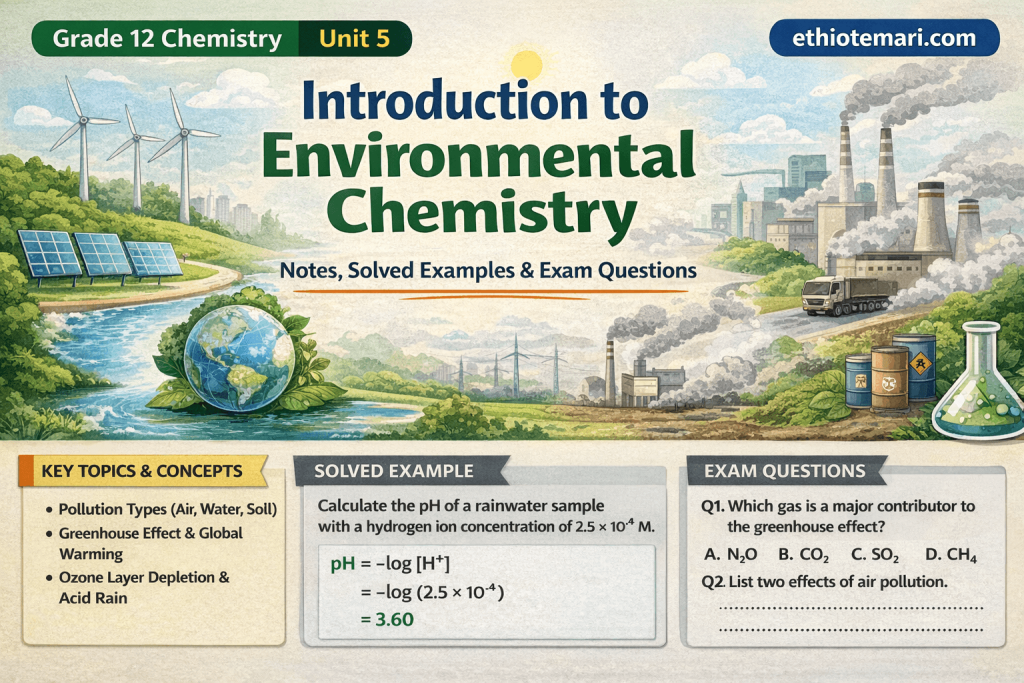
Welcome, dear student! We have now reached the final unit of your Grade 12 Chemistry course. This unit is very special because it connects chemistry directly to the world around you — the air you breathe, the water you drink, the soil that grows your food. Environmental chemistry is the study of chemical processes occurring in the environment and how human activities affect them. Let’s learn this important topic together!
5.1 Introduction
5.1.1 Components of the Environment
The environment is everything that surrounds us — living and non-living. It has four main components (also called “spheres”):
- Atmosphere: The layer of gases surrounding the Earth. It extends several hundred kilometers above the surface. The lowest layer (troposphere, 0–12 km) is where weather occurs and where most pollutants are released.
- Hydrosphere: All water on Earth — oceans, rivers, lakes, groundwater, ice caps, and water vapor in the atmosphere. It covers about 71% of Earth’s surface.
- Lithosphere: The solid outer part of Earth — soil, rocks, and minerals. It provides raw materials and supports plant growth.
- Biosphere: The zone where life exists — it overlaps with the other three spheres. It includes all living organisms (plants, animals, microorganisms) and their interactions with the environment.
Can you see how these four spheres interact? For example, when it rains, water moves from the atmosphere to the hydrosphere, then soaks into the lithosphere, where plants in the biosphere absorb it. These interactions are driven by natural cycles, which we will study next.
- Four components: Atmosphere (air), Hydrosphere (water), Lithosphere (land/soil), Biosphere (life).
- The troposphere (0–12 km) is where most air pollution occurs.
- The biosphere overlaps with all other three spheres.
- Composition of clean dry air: N2 (78%), O2 (21%), Ar (0.93%), CO2 (0.03–0.04%), and trace gases.
Practice Question 1: Name the four components of the environment and give one example of how they interact.
Answer: The four components are: Atmosphere (air), Hydrosphere (water), Lithosphere (soil/rocks), and Biosphere (living things).
Example of interaction: Plants (biosphere) absorb water from the soil (lithosphere/hydrosphere), take in CO2 from the air (atmosphere), and release oxygen back into the atmosphere through photosynthesis. This shows all four spheres interacting.
Practice Question 2: What is the approximate composition of nitrogen and oxygen in clean dry air?
Answer: Clean dry air contains approximately 78% nitrogen (N2) and 21% oxygen (O2). The remaining ~1% consists of argon (0.93%), carbon dioxide (0.03–0.04%), and trace amounts of other gases like neon, helium, and methane.
5.1.2 Natural Cycles in the Environment
In nature, elements continuously move between the atmosphere, hydrosphere, lithosphere, and biosphere. These movements are called biogeochemical cycles (bio = life, geo = earth, chemical = elements). Let’s study the three most important cycles.
The Carbon Cycle
Carbon is the basis of all organic life. The carbon cycle describes how carbon moves through the environment:
Key processes in the carbon cycle:
- Photosynthesis: Plants absorb CO2 from air and convert it to organic compounds (glucose) using sunlight.
- Respiration: Living organisms break down organic compounds to release energy, producing CO2.
- Decomposition: Dead organisms are broken down by decomposers, releasing CO2.
- Combustion: Burning fossil fuels and wood releases CO2 stored for millions of years.
- Sedimentation: Dead organisms can be buried and slowly form fossil fuels over millions of years.
The Nitrogen Cycle
Nitrogen is essential for proteins and DNA. Even though 78% of air is N2, most organisms cannot use it directly because the N≡N triple bond is very strong. The nitrogen cycle converts N2 into usable forms:
- Nitrogen fixation: Conversion of atmospheric N2 into nitrogen compounds. Can be biological (by nitrogen-fixing bacteria like Rhizobium in legume root nodules) or industrial (Haber process to make NH3), or by lightning (N2 + O2 → NO).
- Nitrification: Soil bacteria convert NH3/NH4+ → NO2− (nitrite) → NO3− (nitrate). This is done by nitrifying bacteria (Nitrosomonas and Nitrobacter).
- Assimilation: Plants absorb NO3− from soil and use it to make proteins. Animals get nitrogen by eating plants.
- Ammonification: Decomposers break down dead organisms and waste, converting organic nitrogen back into NH3.
- Denitrification: Denitrifying bacteria convert NO3− back into N2 gas, returning it to the atmosphere.
The Water Cycle
Water continuously circulates between the atmosphere, land, and oceans:
- Evaporation: Water from oceans, lakes, and rivers evaporates into the atmosphere.
- Transpiration: Plants release water vapor through their leaves.
- Condensation: Water vapor cools and forms clouds.
- Precipitation: Water falls as rain, snow, hail, etc.
- Runoff and infiltration: Water flows into rivers (runoff) or seeps into the ground (infiltration to become groundwater).
- Carbon cycle: photosynthesis, respiration, decomposition, combustion, sedimentation.
- Nitrogen cycle: fixation (biological/industrial/lightning), nitrification, assimilation, ammonification, denitrification.
- Water cycle: evaporation, transpiration, condensation, precipitation, runoff, infiltration.
- Human activities (burning fossil fuels, using fertilizers) disrupt these natural cycles.
- Nitrogen fixation = N2 → NH3/NO3−; Denitrification = NO3− → N2 (reverse of fixation).
Practice Question 3: Explain the difference between nitrification and denitrification in the nitrogen cycle.
Answer:
Nitrification is the process where soil bacteria convert ammonia (NH3) into nitrite (NO2−) and then into nitrate (NO3−). This makes nitrogen available for plant absorption. It is done by nitrifying bacteria (Nitrosomonas and Nitrobacter).
Denitrification is the opposite process — denitrifying bacteria convert nitrate (NO3−) back into nitrogen gas (N2), which returns to the atmosphere. This reduces the amount of available nitrogen in the soil. It occurs in waterlogged (oxygen-poor) soil conditions.
Practice Question 4: How does the burning of fossil fuels affect the carbon cycle?
Answer: Fossil fuels (coal, oil, natural gas) contain carbon that was removed from the atmosphere millions of years ago through photosynthesis and sedimentation. When we burn fossil fuels, this stored carbon is released as CO2 back into the atmosphere in a very short time. This disrupts the natural carbon balance — more CO2 is being added to the atmosphere than is being removed by photosynthesis, leading to increased atmospheric CO2 levels and contributing to global warming.
5.1.3 Concepts Related to Environmental Chemistry
Before we study pollution in detail, let’s understand some important concepts:
- Pollutant: Any substance introduced into the environment that has harmful effects on living organisms or the environment. Example: CO, SO2, lead, pesticides.
- Contaminant: A substance present in the environment that does NOT necessarily cause harm. It may or may not become a pollutant depending on its concentration. Example: small amounts of salt in a river.
- Receptor: The organism, material, or environment that is affected by a pollutant. Example: humans, plants, buildings, water bodies.
- Sink: A medium or environment that removes or stores a pollutant. Example: oceans act as a sink for CO2; soil can act as a sink for some heavy metals.
- Threshold limit value (TLV): The maximum allowable concentration of a pollutant in air to which workers can be exposed for 8 hours/day without harmful effects.
- Biodegradable pollutants: Pollutants that can be broken down by microorganisms (e.g., domestic sewage, paper).
- Non-biodegradable pollutants: Pollutants that cannot be broken down by natural processes (e.g., plastics, DDT, heavy metals like lead and mercury).
- Know the difference between pollutant and contaminant — contaminant is not necessarily harmful.
- TLV = maximum safe exposure level for 8 hours/day in workplace.
- Biodegradable vs. non-biodegradable — crucial distinction for waste management.
- Pollutants can be primary (emitted directly) or secondary (formed by reactions in the atmosphere).
Practice Question 5: Distinguish between a pollutant and a contaminant with examples.
Answer: A pollutant is a substance that causes harmful effects in the environment — e.g., carbon monoxide (CO) in air causes health problems. A contaminant is a substance present in the environment that does not necessarily cause harm at its current concentration — e.g., a small amount of sodium chloride in a river is a contaminant but not a pollutant. A contaminant can become a pollutant if its concentration exceeds a safe level.
5.2 Environmental Pollution
Pollution is any undesirable change in the physical, chemical, or biological characteristics of air, water, or land that can harmfully affect living organisms and the environment. Let’s study the three major types of pollution.
5.2.1 Air Pollution
Air pollution is the most visible form of pollution. Have you noticed the dark smoke coming from factories or old vehicles? That is air pollution in action!
Primary Air Pollutants
These are pollutants emitted directly from a source:
| Pollutant | Source | Effect |
|---|---|---|
| Carbon monoxide (CO) | Incomplete combustion of fossil fuels (vehicles, fires) | Binds to hemoglobin, reducing oxygen transport → headache, death at high concentration |
| Sulfur dioxide (SO2) | Burning sulfur-containing fuels (coal, oil), metal smelting, Contact process | Respiratory problems, acid rain, damages plants and buildings |
| Nitrogen oxides (NOx) | Vehicle engines, power plants, lightning | Respiratory problems, acid rain, smog formation |
| Particulate matter (SPM) | Dust, smoke, fly ash from industries and vehicles | Reduces visibility, respiratory diseases (asthma, bronchitis) |
| Hydrocarbons (VOCs) | Incomplete combustion, evaporation of solvents | Contribute to smog formation, some are carcinogenic |
| Lead (Pb) | Leaded petrol, paint, industrial emissions | Neurological damage, especially in children; anemia |
Secondary Air Pollutants
These are NOT emitted directly — they form in the atmosphere by chemical reactions between primary pollutants:
- Photochemical smog: Formed when NOx and hydrocarbons react in sunlight. Produces ozone (O3), PAN (peroxyacetyl nitrate), and aldehydes. Causes eye irritation, respiratory problems, and damages plants. Common in cities with heavy traffic and lots of sunlight.
- Acid rain: SO2 and NOx react with water and oxygen in the atmosphere to form sulfuric acid (H2SO4) and nitric acid (HNO3). These acids fall as acid rain (pH < 5.6). Damages buildings (especially marble/limestone), forests, aquatic life, and soil.
Chemistry of acid rain formation:
Why is acid rain harmful to marble buildings? Marble is calcium carbonate (CaCO3), which reacts with acid:
The calcium sulfate (CaSO4) is soluble and washes away, slowly destroying the structure!
- Know the sources and effects of CO, SO2, NOx, and particulate matter.
- CO is dangerous because it binds to hemoglobin (forms carboxyhemoglobin), reducing oxygen supply.
- Photochemical smog: NOx + hydrocarbons + sunlight → O3 + PAN + aldehydes.
- Acid rain: SO2 → H2SO4; NOx → HNO3; normal rain pH = 5.6; acid rain pH < 5.6.
- Acid rain damages marble: CaCO3 + H2SO4 → CaSO4 + H2O + CO2.
- Distinguish primary pollutants (emitted directly) from secondary pollutants (formed in atmosphere).
Practice Question 6: Explain how photochemical smog is formed. Why does it mainly occur during daytime?
Answer: Photochemical smog is formed when nitrogen oxides (NOx) from vehicle exhausts and hydrocarbons (VOCs) from incomplete combustion react in the presence of sunlight. Sunlight provides the energy (photons) needed to drive the chemical reactions: NO2 absorbs UV light and breaks into NO and O, which then forms ozone (O3) and other oxidants like PAN.
It mainly occurs during daytime because sunlight is required to initiate the photochemical reactions. At night, without sunlight, these reactions do not occur, so smog does not form.
Practice Question 7: Write a chemical equation to show why acid rain damages limestone buildings. Name the products.
Answer: Limestone is mainly calcium carbonate (CaCO3). When acid rain (containing H2SO4) falls on it:
CaCO3 + H2SO4 → CaSO4 + H2O + CO2
Products: Calcium sulfate (CaSO4), water (H2O), and carbon dioxide (CO2). The CaSO4 is slightly soluble in water and gets washed away by rain, causing gradual erosion of the building.
5.2.2 Water Pollution
Water pollution is the contamination of water bodies (rivers, lakes, groundwater, oceans) by substances that make the water unsafe for use. Do you know that many rivers in Ethiopian cities are polluted by domestic and industrial waste?
Sources of Water Pollution
- Domestic sewage: Human waste, soap, detergents, food waste — contains organic matter and pathogens.
- Industrial waste: Heavy metals (Hg, Pb, Cd), chemicals, hot water (thermal pollution), dyes.
- Agricultural runoff: Fertilizers (nitrates, phosphates) and pesticides washed from farmland by rain.
- Thermal pollution: Hot water from power plants and factories raises water temperature, reducing dissolved oxygen.
- Petroleum spills: Oil spills in oceans harm marine life.
Effects of Water Pollution
- Eutrophication: Excess nitrates and phosphates from fertilizers cause rapid growth of algae (algal bloom). When algae die, decomposition by bacteria consumes dissolved oxygen, killing fish and other aquatic organisms.
- Biomagnification: Heavy metals and pesticides accumulate in food chains, becoming more concentrated at each level.
- Waterborne diseases: Cholera, typhoid, dysentery from contaminated drinking water.
- Reduction of dissolved oxygen: Organic waste is decomposed by bacteria that consume O2, suffocating aquatic life.
- Eutrophication: excess nutrients → algal bloom → oxygen depletion → aquatic death.
- BOD (Biochemical Oxygen Demand) = amount of O2 needed to decompose organic matter. Higher BOD = more pollution.
- Biomagnification: concentration of pollutants increases up the food chain.
- Heavy metals (Hg, Pb, Cd) are toxic and non-biodegradable.
- Thermal pollution reduces dissolved oxygen (warm water holds less O2).
Practice Question 8: Explain the process of eutrophication and its harmful effects.
Answer: Eutrophication occurs when excess nutrients (nitrates and phosphates from fertilizers, detergents, or sewage) enter a water body. These nutrients cause rapid growth of algae on the water surface (algal bloom). The algal layer blocks sunlight from reaching deeper water, killing aquatic plants. When the algae die, decomposing bacteria break them down, consuming large amounts of dissolved oxygen from the water. The oxygen level drops so low that fish and other aquatic organisms die. The water may also develop bad odor and become unsuitable for drinking or recreation.
Practice Question 9: What is biochemical oxygen demand (BOD)? If a water sample has high BOD, what does it indicate?
Answer: Biochemical Oxygen Demand (BOD) is the amount of dissolved oxygen (in mg/L) required by microorganisms to decompose the organic matter present in a water sample over a specified period (usually 5 days at 20°C).
A high BOD indicates that the water contains a large amount of organic pollution. More organic matter means more bacteria are needed to decompose it, which consume more dissolved oxygen. This leaves less oxygen available for fish and other aquatic life. Clean water typically has a BOD of less than 5 mg/L, while polluted water can have BOD of 20 mg/L or more.
5.2.3 Land Pollution
Land pollution is the degradation of land due to the deposition of solid and semi-solid wastes on or in the soil.
Sources of Land Pollution
- Solid waste: Plastics, paper, glass, metals, food waste from households and industries.
- Agricultural chemicals: Pesticides, herbicides, and excess fertilizers that accumulate in soil.
- Industrial waste: Sludge, fly ash, radioactive waste, heavy metals.
- Mining activities: Land degradation, soil erosion, toxic tailings.
- Deforestation: Removal of vegetation leads to soil erosion and loss of fertility.
Effects of Land Pollution
- Loss of soil fertility — chemicals kill beneficial microorganisms.
- Groundwater contamination — pollutants leach into underground water supplies.
- Health problems — direct contact with toxic waste or through contaminated food and water.
- Reduction in crop yields — degraded soil produces less food.
- Visual pollution — ugly dumps and littered landscapes.
- Plastic waste is a major land pollutant — non-biodegradable, persists for centuries.
- Pesticides and heavy metals in soil can enter the food chain through crops.
- Leaching: pollutants dissolve in water and percolate into groundwater.
- Methods of waste disposal: landfill, incineration, composting, recycling.
- Best approach: Reduce, Reuse, Recycle (the 3R principle).
Practice Question 10: Why is plastic waste a particularly serious land pollution problem?
Answer: Plastic waste is especially serious because: (1) Plastics are non-biodegradable — they persist in the environment for hundreds of years. (2) They do not decompose naturally; instead, they break into smaller pieces called microplastics that contaminate soil and water. (3) Plastics can leach toxic chemicals (additives, plasticizers) into the soil. (4) They block water percolation into the ground, affecting groundwater recharge. (5) Burning plastics releases toxic gases (dioxins, furans) that cause air pollution. (6) They harm animals that accidentally consume them.
5.3 Global Warming and Climate Change
5.3.1 Global Warming and Climate Change
Have you noticed that summers in Ethiopia seem to be getting hotter? This is part of a global phenomenon called global warming.
Climate change refers to the broader changes in climate patterns (temperature, rainfall, wind patterns) that result from global warming. Global warming causes climate change.
Evidence of global warming:
- Rising global average temperatures (about 1.1°C increase since pre-industrial times).
- Melting of glaciers and polar ice caps.
- Rising sea levels (thermal expansion + ice melt).
- More frequent extreme weather events (droughts, floods, storms).
- Changing rainfall patterns affecting agriculture.
5.3.2 Chemistry of Greenhouse Gases and Their Effects
What causes global warming? The answer is the greenhouse effect. Certain gases in the atmosphere trap heat (infrared radiation) that would otherwise escape into space — just like glass in a greenhouse traps heat inside.
- Carbon dioxide (CO2): The most significant GHG. Released by burning fossil fuels, deforestation. Contributes about 60% of global warming.
- Methane (CH4): 25 times more potent than CO2 at trapping heat (over 100 years). Released from livestock (cows, sheep), rice paddies, landfills, natural gas leaks.
- Nitrous oxide (N2O): About 300 times more potent than CO2. Released from fertilizers, industrial processes, burning of biomass.
- Chlorofluorocarbons (CFCs): Very potent GHGs, also destroy the ozone layer. Used in refrigerators, aerosols (now mostly banned).
- Water vapor (H2O): The most abundant GHG, but its concentration is controlled by temperature (not directly by human activities).
How do greenhouse gases trap heat? Sunlight (visible radiation) passes through the atmosphere and warms the Earth’s surface. The warm surface emits infrared (IR) radiation back toward space. Greenhouse gases absorb this IR radiation and re-emit it in all directions, including back toward the surface. This traps heat in the lower atmosphere.
| Greenhouse Gas | Source | Global Warming Potential (vs CO₂) |
|---|---|---|
| CO2 | Fossil fuel burning, deforestation | 1 (reference) |
| CH4 | Livestock, rice paddies, landfills | ~25 |
| N2O | Fertilizers, industrial processes | ~300 |
| CFCs | Refrigerants, aerosols (banned) | ~1000–10000 |
Effects of Global Warming
- Rising sea levels → flooding of coastal cities and islands.
- Changes in agricultural productivity → food insecurity.
- Loss of biodiversity → species extinction.
- Spread of tropical diseases (malaria, dengue) to new areas.
- Economic disruption from extreme weather events.
- Desertification and water scarcity in some regions.
Mitigation Strategies
- Reduce fossil fuel use → shift to renewable energy (solar, wind, hydro, geothermal).
- Improve energy efficiency.
- Afforestation (planting trees) and reforestation — trees absorb CO2.
- Reduce methane emissions from agriculture and waste.
- International agreements (Paris Agreement, Kyoto Protocol).
- Carbon capture and storage (CCS) technology.
- Greenhouse effect is NATURAL — without it, Earth would be too cold for life. The problem is the ENHANCED greenhouse effect due to human activities.
- CO2 contributes ~60% of global warming; CH4 is 25× more potent; N2O is 300× more potent.
- Know the sources and relative global warming potentials of each GHG.
- Global warming ≠ climate change. Warming is the temperature increase; climate change is the broader effect.
- Ethiopia is vulnerable: droughts, flooding, loss of biodiversity.
Practice Question 11: Explain the difference between the natural greenhouse effect and the enhanced greenhouse effect.
Answer: The natural greenhouse effect is essential for life on Earth. Natural levels of greenhouse gases (CO2, CH4, H2O vapor) trap some heat from the Sun, keeping Earth’s average temperature at about 15°C instead of −18°C (which it would be without any greenhouse effect).
The enhanced greenhouse effect is the ADDITIONAL warming caused by human activities that have significantly increased the concentration of GHGs, especially CO2 from burning fossil fuels. This enhanced effect traps MORE heat than the natural effect, causing global temperatures to rise beyond natural levels, leading to climate change and its harmful consequences.
Practice Question 12: Methane has a higher global warming potential than CO2, yet CO2 is considered the main cause of global warming. Explain why.
Answer: Although methane (CH4) is about 25 times more potent than CO2 at trapping heat per molecule, CO2 is the main cause of global warming because:
(1) CO2 is present in MUCH larger concentrations in the atmosphere (~420 ppm for CO2 vs. ~1.9 ppm for CH4).
(2) CO2 is released in enormously larger quantities — burning fossil fuels releases billions of tonnes of CO2 annually.
(3) CO2 stays in the atmosphere for hundreds to thousands of years, while CH4 has a shorter atmospheric lifetime (~12 years).
So the TOTAL warming effect of CO2 far exceeds that of CH4 despite CH4 being more potent per molecule.
5.4 Green Chemistry and Cleaner Production
Now that we understand the problems of pollution and global warming, what can we do about them? This is where Green Chemistry comes in — it is the solution-oriented approach to environmental problems!
5.4.1 Principles of Green Chemistry
Paul Anastas and John Warner developed 12 Principles of Green Chemistry. Let’s learn the most important ones for your exam:
| Principle | Description | Example |
|---|---|---|
| 1. Prevention | Prevent waste rather than treat or clean up waste | Design reactions with 100% atom economy |
| 2. Atom Economy | Maximize incorporation of all materials into the final product | Addition polymerization > condensation (no by-product) |
| 3. Less Hazardous Synthesis | Use methods that produce little or no toxicity | Use H2O2 instead of Cl2 for bleaching |
| 4. Designing Safer Chemicals | Design products that are effective but minimally toxic | Biodegradable detergents instead of non-biodegradable ones |
| 5. Safer Solvents | Avoid auxiliary substances (solvents, separators) or use innocuous ones | Use water or supercritical CO2 instead of toxic organic solvents |
| 6. Energy Efficiency | Carry out reactions at room temperature and pressure if possible | Use catalysts instead of high temperature/pressure |
| 7. Use Renewable Feedstocks | Use renewable raw materials (biomass) rather than depleting fossil fuels | Make ethanol from sugarcane instead of petroleum |
| 8. Reduce Derivatives | Minimize unnecessary steps (protecting groups, temporary modifications) | Simplify synthetic routes |
| 9. Catalysis | Use selective catalysts rather than stoichiometric reagents | Enzymes, Ziegler-Natta catalysts |
| 10. Design for Degradation | Design products to break down into harmless substances at end of life | Biodegradable polymers (PHBV, PLA) |
| 11. Real-time Analysis | Monitor and control reactions in real-time to prevent hazardous by-products | In-line sensors in chemical plants |
| 12. Inherently Safer Chemistry for Accident Prevention | Choose substances that minimize risk of explosions, fires, releases | Use less volatile solvents |
Understanding Atom Economy
Atom economy is a very important concept in green chemistry. It measures how efficiently the atoms of reactants are converted into the desired product:
Higher atom economy means less waste! Addition reactions have 100% atom economy (no by-product), while substitution reactions have lower atom economy.
Worked Example 1Question: Calculate the atom economy for the Haber process: N2 + 3H2 → 2NH3
Solution:
Molar mass of desired product (2NH3) = 2 × 17 = 34 g/mol
Sum of molar masses of reactants = 28 + 3(2) = 28 + 6 = 34 g/mol
This makes sense — it’s an addition reaction with no by-product!
Worked Example 2Question: Calculate the atom economy for the Contact process step: 2SO2 + O2 → 2SO3
Solution:
Molar mass of desired product (2SO3) = 2 × 80 = 160 g/mol
Sum of reactants = 2(64) + 32 = 128 + 32 = 160 g/mol
- Green chemistry = prevent pollution at source, not treat it after.
- Atom economy: (mass of desired product / total mass of reactants) × 100%.
- Addition reactions have 100% atom economy; substitution/elimination reactions have lower.
- Know at least 6 of the 12 principles with examples.
- Important principles for exam: prevention, atom economy, safer solvents, energy efficiency, design for degradation, renewable feedstocks.
Practice Question 13: Calculate the atom economy for the Ostwald process Step 3: 3NO2 + H2O → 2HNO3 + NO
Answer:
Desired product: 2HNO3 = 2 × 63 = 126 g/mol
Sum of all reactants: 3(46) + 18 = 138 + 18 = 156 g/mol
Atom Economy = (126/156) × 100% = 80.8%
The atom economy is less than 100% because NO is produced as a by-product (though it is recycled in the process, reducing waste in practice).
Practice Question 14: Give two examples of how green chemistry principles can be applied in industry.
Answer:
(1) Safer solvents (Principle 5): Replacing toxic organic solvents (like benzene, chloroform) with water or supercritical CO2 in industrial processes. For example, using supercritical CO2 for decaffeinating coffee instead of dichloromethane.
(2) Design for degradation (Principle 10): Developing biodegradable polymers like PHBV and PLA to replace conventional non-biodegradable plastics. These break down naturally at the end of their useful life, reducing plastic waste and pollution.
(3) Renewable feedstocks (Principle 7): Producing ethanol fuel from sugarcane molasses (renewable biomass) instead of from petroleum (non-renewable fossil fuel). Ethiopia does this at its sugar factories.
5.4.2 Cleaner Production in Chemistry
Cleaner production is the practical application of green chemistry in industries. It means continuously applying preventive strategies to increase efficiency and reduce risks to humans and the environment.
- Input substitution: Replace toxic raw materials with safer alternatives.
- Technology modification: Use better equipment and processes that generate less waste.
- Good housekeeping: Proper management to prevent spills, leaks, and waste.
- Product modification: Redesign products to be less harmful during use and disposal.
- Recycling and reuse: Recover and reuse materials within the process.
Examples of cleaner production in Ethiopian industries:
- Sugar industry: Using bagasse (cane residue) as boiler fuel instead of burning additional fuel. Molasses is fermented to produce ethanol instead of being wasted.
- Tannery industry: Treating wastewater before discharge, recovering chromium for reuse instead of dumping it.
- Cement industry: Using alternative fuels and raw materials (like agricultural waste) to reduce fossil fuel consumption.
- Textile industry: Using less water and less toxic dyes in fabric processing.
- Cleaner production = applying green chemistry principles in industry.
- Focus on PREVENTION, not treatment after pollution occurs.
- Five main strategies: input substitution, technology modification, good housekeeping, product modification, recycling.
- Know examples relevant to Ethiopian industries (sugar, tannery, cement).
Practice Question 15: Explain how the Ethiopian sugar industry applies cleaner production principles.
Answer: The Ethiopian sugar industry applies cleaner production through: (1) Using bagasse as fuel: Instead of wasting the fibrous residue from crushing sugarcane, it is burned in boilers to generate steam and electricity for the factory, reducing the need for imported fossil fuels. (2) Fermenting molasses: The by-product molasses is fermented to produce ethanol, which can be used as fuel or chemical feedstock, turning waste into a valuable product. (3) Water recycling: Wastewater is treated and reused within the factory, reducing fresh water consumption and water pollution. (4) Press mud as fertilizer: The filter cake residue is used as fertilizer on sugarcane fields, recycling nutrients back to the soil.
Revision Notes — Exam Focus
Components of the Environment
- Atmosphere (air): Troposphere (0–12 km) = where pollution occurs. Clean air: 78% N2, 21% O2, 0.93% Ar, ~0.04% CO2.
- Hydrosphere (water): 71% of Earth’s surface.
- Lithosphere (land/soil/rocks).
- Biosphere (living things): Overlaps with all three above.
Natural Cycles — Quick Summary
| Cycle | Key Processes | Human Disruption |
|---|---|---|
| Carbon | Photosynthesis, respiration, decomposition, combustion, sedimentation | Burning fossil fuels ↑ CO2 |
| Nitrogen | Fixation (biological/industrial/lightning), nitrification, assimilation, ammonification, denitrification | Excess fertilizers → eutrophication |
| Water | Evaporation, transpiration, condensation, precipitation, runoff, infiltration | Deforestation, pollution, overuse |
Air Pollution — Quick Reference
| Pollutant | Primary/Secondary | Source | Key Effect |
|---|---|---|---|
| CO | Primary | Incomplete combustion | Binds hemoglobin → suffocation |
| SO2 | Primary | Coal, oil burning | Acid rain, respiratory problems |
| NOx | Primary | Vehicles, power plants | Acid rain, smog formation |
| O3 (tropospheric) | Secondary | NOx + VOCs + sunlight | Smog component, respiratory damage |
| Acid rain | Secondary | SO2 → H2SO4; NOx → HNO3 | Destroys buildings, forests, lakes |
Greenhouse Gases — Quick Reference
| Gas | GWP (vs CO2) | Main Source |
|---|---|---|
| CO2 | 1 | Fossil fuels, deforestation |
| CH4 | ~25 | Livestock, rice paddies, landfills |
| N2O | ~300 | Fertilizers |
| CFCs | ~1000–10000 | Refrigerants (banned) |
Key Formula
Green Chemistry — 12 Principles Summary
- Prevent waste
- Maximize atom economy
- Less hazardous chemical synthesis
- Design safer chemicals
- Use safer solvents and auxiliaries
- Design for energy efficiency
- Use renewable feedstocks
- Reduce derivatives
- Use catalysts (not stoichiometric reagents)
- Design for degradation
- Real-time analysis for pollution prevention
- Inherently safer chemistry for accident prevention
Important Definitions
- Pollutant: Substance causing harm in the environment.
- Contaminant: Substance present but not necessarily harmful.
- TLV: Maximum safe concentration for 8-hour workplace exposure.
- Eutrophication: Nutrient enrichment → algal bloom → oxygen depletion.
- BOD: Oxygen needed to decompose organic matter in water.
- Biomagnification: Pollutant concentration increases up the food chain.
- Green chemistry: Design of chemical products/processes that reduce/eliminate hazardous substances.
- Atom economy: Efficiency of atom utilization in a reaction.
- Cleaner production: Practical application of green chemistry in industry.
Common Mistakes to Avoid
- Mistake 1: Confusing pollutant with contaminant. Not all contaminants are pollutants!
- Mistake 2: Saying ozone (O3) is always bad. Stratospheric O3 is PROTECTIVE (blocks UV). Tropospheric O3 is a POLLUTANT.
- Mistake 3: Confusing global warming with climate change. Warming = temperature increase; climate change = broader effects.
- Mistake 4: Forgetting that CH4 has higher GWP than CO2 per molecule but CO2 causes more total warming due to much higher concentration.
- Mistake 5: Saying the greenhouse effect is entirely bad. The NATURAL greenhouse effect keeps Earth habitable; the ENHANCED version is the problem.
- Mistake 6: Confusing nitrification and denitrification. Nitrification: NH3 → NO3− (useful). Denitrification: NO3− → N2 (returns to atmosphere).
- Mistake 7: Calculating atom economy incorrectly — use ALL reactants in the denominator, not just the limiting reactant.
- Mistake 8: Forgetting that acid rain can also be caused by NOx (forming HNO3), not only by SO2 (forming H2SO4).
Challenge Exam Questions
Test your understanding with these challenging questions from Unit 5!
Section A: Multiple Choice Questions
Question 1: Which of the following is a secondary air pollutant?
(a) CO (b) SO2 (c) Ozone (O3) in the troposphere (d) NO
Answer: (c) Ozone (O3) in the troposphere
Ozone in the troposphere (ground level) is NOT emitted directly. It is formed when NOx and hydrocarbons react in the presence of sunlight — making it a secondary pollutant. CO, SO2, and NO are all primary pollutants because they are emitted directly from sources. Note: stratospheric ozone is protective (not a pollutant), but tropospheric ozone is harmful.
Question 2: The greenhouse gas with the highest global warming potential (GWP) is:
(a) CO2 (b) CH4 (c) N2O (d) CFCs
Answer: (d) CFCs
CFCs have a GWP of about 1,000 to 10,000 times that of CO2, making them by far the most potent greenhouse gases per molecule. This is why they were banned by the Montreal Protocol. N2O is next (~300×), then CH4 (~25×), and CO2 is the reference (=1).
Question 3: Which process in the nitrogen cycle converts atmospheric nitrogen directly into a form usable by plants?
(a) Nitrification (b) Denitrification (c) Nitrogen fixation (d) Ammonification
Answer: (c) Nitrogen fixation
Nitrogen fixation converts inert atmospheric N2 into ammonia (NH3) or nitrogen compounds that plants can absorb. This can be done biologically (by Rhizobium bacteria in legume root nodules), industrially (Haber process), or by lightning. Nitrification converts NH3 to NO3− (but the N was already fixed). Denitrification does the opposite — returns N to the atmosphere.
Question 4: Atom economy for a reaction is 100% when:
(a) The reaction is exothermic (b) No by-product is formed (c) A catalyst is used (d) The yield is 100%
Answer: (b) No by-product is formed
Atom economy = (mass of desired product / total mass of reactants) × 100%. If no by-product is formed, ALL the mass of reactants ends up in the desired product, giving 100% atom economy. This occurs in addition reactions (e.g., polymerization, Haber process). Note: yield and atom economy are different concepts — yield refers to how much product is actually obtained, while atom economy refers to how efficiently atoms are used.
Question 5: Acid rain with pH 3.5 is more harmful than acid rain with pH 4.5 because:
(a) It has more SO2 dissolved (b) It has a higher H+ concentration (c) It contains more dissolved oxygen (d) It is warmer
Answer: (b) It has a higher H+ concentration
pH = −log[H+], so lower pH means higher H+ concentration. pH 3.5 has [H+] = 10−3.5 = 3.16 × 10⁻⁴ M, while pH 4.5 has [H+] = 10−4.5 = 3.16 × 10⁻⁵ M. The pH 3.5 rain is 10 times more acidic (10× higher [H+]) and therefore more destructive to buildings, soil, and aquatic life.
Section B: Fill in the Blanks
Question 6: The layer of the atmosphere where most weather phenomena and air pollution occur is the __________.
Answer: troposphere (extending from 0 to about 12 km above Earth’s surface).
Question 7: The process of converting atmospheric N2 into NH3 by Rhizobium bacteria in legume root nodules is called biological __________.
Answer: nitrogen fixation.
Question 8: Photochemical smog requires three components: __________, __________, and __________.
Answer: nitrogen oxides (NOx), hydrocarbons (VOCs), and sunlight.
Question 9: The measure of the amount of oxygen required by microorganisms to decompose organic matter in water is called __________.
Answer: Biochemical Oxygen Demand (BOD).
Question 10: Green chemistry Principle 2, which aims to maximize the incorporation of all reactant atoms into the desired product, is called __________.
Answer: atom economy.
Section C: Short Answer Questions
Question 11: Explain the difference between stratospheric ozone and tropospheric ozone. Why is one beneficial and the other harmful?
Answer:
Stratospheric ozone (O3): Found in the stratosphere (15–35 km altitude). It forms the “ozone layer” that absorbs harmful UV-B and UV-C radiation from the Sun, protecting living organisms from skin cancer, cataracts, and DNA damage. It is BENEFICIAL.
Tropospheric ozone (O3): Found at ground level in the troposphere (0–12 km). It is a secondary pollutant formed from NOx and VOCs reacting in sunlight. It causes respiratory problems (asthma, coughing), damages crops and plants, and is a component of photochemical smog. It is HARMFUL.
The SAME molecule (O3) is beneficial in one location and harmful in another!
Question 12: Describe how heavy metal pollution in soil can eventually affect human health, using the concept of biomagnification.
Answer: When heavy metals (like mercury, cadmium, or lead) are released into soil (from industrial waste, pesticides, or mining), they can be absorbed by plants growing in that soil. Herbivores eat the contaminated plants, accumulating the metals in their bodies. Carnivores that eat the herbivores receive an even higher concentration. This biomagnification means the concentration of heavy metals increases at each level of the food chain. Humans, being at the top of the food chain, receive the highest concentration, which can cause serious health problems: mercury damages the nervous system, cadmium damages kidneys, and lead causes anemia and neurological damage (especially in children).
Question 13: Why is the natural greenhouse effect important for life on Earth? What has gone wrong?
Answer: The natural greenhouse effect is essential because without it, Earth’s average temperature would be about −18°C instead of the current +15°C — too cold for liquid water and most life forms. Natural levels of CO2, CH4, and water vapor trap enough heat to keep Earth habitable.
What has gone wrong is the enhanced greenhouse effect. Human activities — mainly burning fossil fuels — have increased atmospheric CO2 from about 280 ppm (pre-industrial) to over 420 ppm today. This extra CO2 traps more heat than the natural effect, causing global temperatures to rise beyond natural levels, leading to climate change with harmful consequences.
Question 14: Explain three ways in which green chemistry principles can be applied to reduce water pollution from the textile industry.
Answer:
(1) Safer chemicals (Principle 3): Replace toxic synthetic dyes with natural or less toxic dyes that do not contain heavy metals (like chromium). This reduces the toxicity of textile wastewater.
(2) Water efficiency: Implement closed-loop water systems where water is treated and reused within the factory instead of being discharged. This reduces both water consumption and pollution (Principle 1: Prevention).
(3) Design for degradation (Principle 10): Use biodegradable sizing agents and finishing chemicals instead of persistent ones. This ensures that any chemicals that do enter wastewater can be broken down naturally, reducing long-term water pollution.
Section D: Calculation Questions
Question 15: Calculate the atom economy for the reaction: CaCO3 + 2HCl → CaCl2 + H2O + CO2. Assume CaCl2 is the desired product. (MCa = 40, MC = 12, MO = 16, MH = 1, MCl = 35.5)
Answer:
Molar mass of desired product (CaCl2) = 40 + 2(35.5) = 111 g/mol
Sum of reactant masses = CaCO3 + 2HCl = (40+12+48) + 2(36.5) = 100 + 73 = 173 g/mol
Atom Economy = (111/173) × 100% = 64.2%
The atom economy is only 64.2% because H2O and CO2 are produced as by-products, wasting atoms that don’t end up in the desired product.
Question 16: The fermentation of glucose to produce ethanol has the equation: C6H12O6 → 2C2H5OH + 2CO2. Calculate the atom economy if ethanol is the desired product. (MC = 12, MH = 1, MO = 16)
Answer:
Molar mass of desired product (2C2H5OH) = 2 × (24 + 6 + 16) = 2 × 46 = 92 g/mol
Sum of reactant masses = C6H12O6 = 72 + 12 + 96 = 180 g/mol
Atom Economy = (92/180) × 100% = 51.1%
The atom economy is only 51.1% because CO2 is a by-product. Almost half the mass of the glucose is “wasted” as CO2. (Note: In practice, CO2 can be captured and used, improving overall efficiency.)
Question 17: A water sample from a river has a BOD of 8 mg/L. A second sample from upstream has a BOD of 2 mg/L. Which sample is more polluted? Explain your reasoning. What does this tell you about dissolved oxygen levels?
Answer: The sample with BOD of 8 mg/L is more polluted.
Reasoning: BOD measures the amount of dissolved oxygen needed by microorganisms to decompose organic matter in the water. A higher BOD means MORE organic pollution is present (more food for bacteria). The downstream sample (8 mg/L) has 4 times more organic pollution than the upstream sample (2 mg/L).
Dissolved oxygen: The sample with BOD = 8 mg/L will have LOWER dissolved oxygen because more bacteria are consuming more oxygen to decompose the larger amount of organic waste. If BOD exceeds the available dissolved oxygen, aquatic life will suffocate.
Question 18: Calculate the atom economy for the production of urea: 2NH3 + CO2 → CO(NH2)2 + H2O. (MC = 12, MO = 16, MN = 14, MH = 1)
Answer:
Molar mass of desired product (urea, CO(NH2)2) = 12 + 16 + 2(14 + 2) = 12 + 16 + 32 = 60 g/mol
Sum of reactant masses = 2NH3 + CO2 = 2(17) + 44 = 34 + 44 = 78 g/mol
Atom Economy = (60/78) × 100% = 76.9%
The atom economy is 76.9%. About 23% of the reactant mass is lost as water (H2O, 18 g/mol). This is a condensation reaction, so atom economy is less than 100%.
Question 19: Compare the environmental impact of producing polyethene (addition polymer) with producing nylon-6,6 (condensation polymer) using the concept of atom economy. Which is “greener” and why?
Answer: Polyethene production is greener in terms of atom economy.
Polyethene is made by addition polymerization: $n\text{CH}_2=\text{CH}_2 \rightarrow (-\text{CH}_2-\text{CH}_2-)_n$. This has 100% atom economy — no by-product is formed. ALL atoms from the monomer end up in the polymer.
Nylon-6,6 is made by condensation polymerization: the reaction between adipic acid and hexanediamine eliminates water as a by-product. This means the atom economy is less than 100% — some atoms from the reactants are “wasted” in the water molecule.
However, note that the overall environmental impact also depends on other factors: energy used, toxicity of reactants, and what happens to the polymer at the end of its life (both are non-biodegradable).
Question 20: A factory releases both SO2 and NOx into the atmosphere. (a) Write equations showing how each contributes to acid rain formation. (b) If both acids fall on a marble statue, write the equations for the reactions that damage the statue. (c) Suggest two green chemistry strategies to reduce these emissions.
Answer:
(a) Acid rain formation:
From SO2: SO2 + H2O → H2SO3 and 2H2SO3 + O2 → 2H2SO4
From NOx: 2NO2 + H2O → HNO3 + HNO2
(b) Damage to marble (CaCO3):
With sulfuric acid: CaCO3 + H2SO4 → CaSO4 + H2O + CO2
With nitric acid: CaCO3 + 2HNO3 → Ca(NO3)2 + H2O + CO2
Both reactions dissolve the marble, causing erosion.
(c) Green chemistry strategies:
(1) Prevention (Principle 1): Use low-sulfur coal or remove sulfur from fuel before burning (desulfurization) to reduce SO2 emissions. Use catalytic converters in vehicle exhausts to convert NOx to N2 and O2.
(2) Renewable feedstocks (Principle 7): Replace fossil fuels with renewable energy sources (solar, wind, hydro, geothermal) to eliminate both SO2 and NOx emissions at the source.