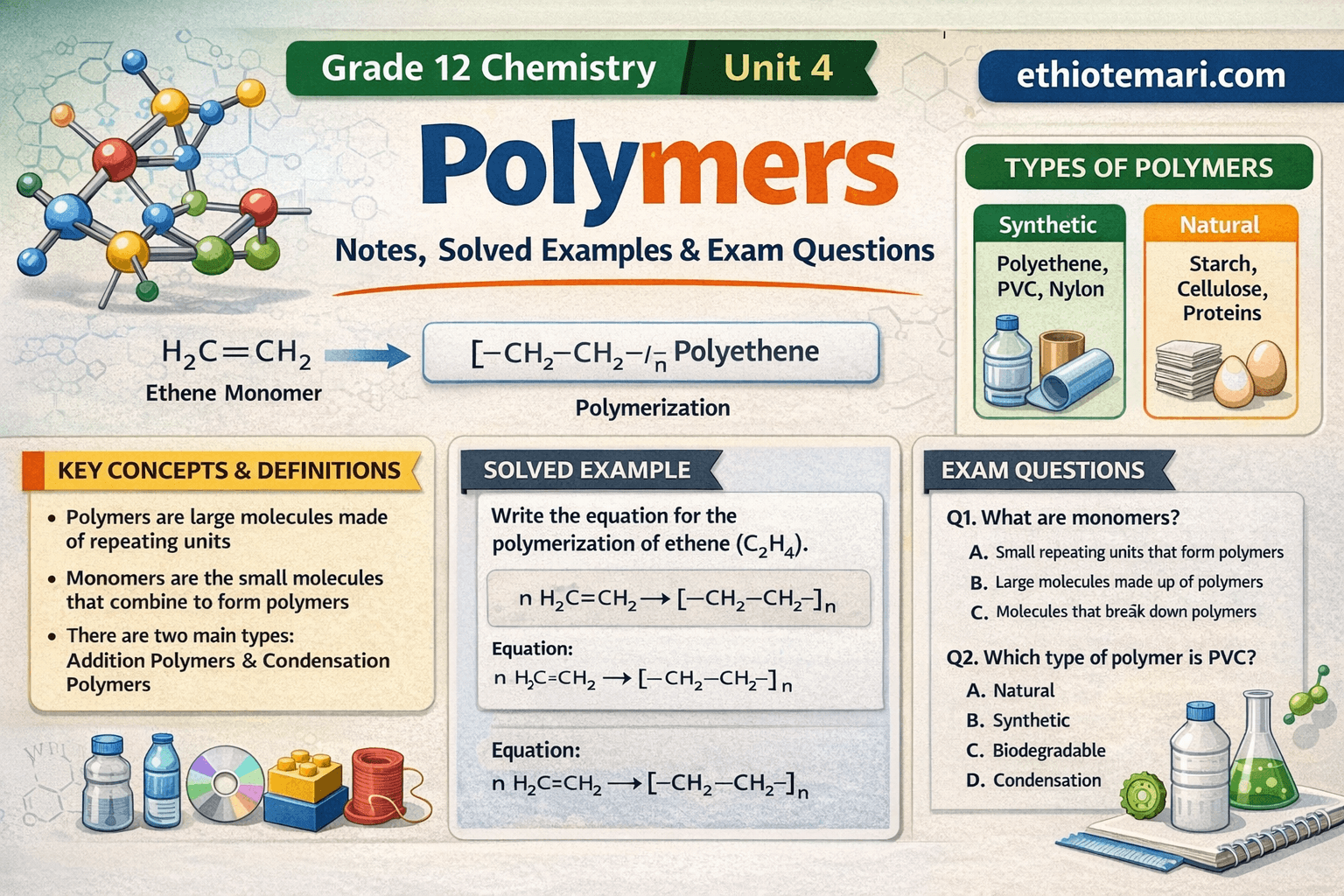
Welcome, dear student! Have you ever wondered what plastic bags, rubber tires, the DNA in your cells, and the protein in your food all have in common? They are all polymers! The word “polymer” comes from Greek: poly means “many” and meros means “parts.” So a polymer is a large molecule made of many small repeating units. In this unit, we will learn how polymers are formed, their different types, and their importance in our daily life. Let’s begin!
4.1 Introduction to Polymers
Before we go deep, let’s understand some basic terms:
- Monomer: A small, simple molecule that can join with other similar molecules to form a polymer. (Example: ethene is a monomer for polyethene.)
- Polymer: A very large molecule (macromolecule) made by linking many monomers together through chemical bonds.
- Polymerization: The chemical process of joining monomers to form a polymer.
- Degree of polymerization (n): The number of monomer units in a polymer chain. If n = 1000, it means 1000 monomers joined together.
Think of it like this: a monomer is a single bead, and a polymer is a long necklace made of many beads connected together. The way the beads connect can vary — and that gives us different types of polymers!
Polymers are everywhere around us:
- Natural polymers: Cotton (cellulose), silk, wool (proteins), rubber (natural rubber), DNA, starch
- Synthetic (man-made) polymers: Plastics (polyethene, PVC), synthetic rubber (neoprene), nylon, polyester, Bakelite
- Semi-synthetic polymers: Rayon (from cellulose), cellulose acetate
- Monomer = small repeating unit; Polymer = large chain of monomers.
- Degree of polymerization (n) = number of monomer units in the chain.
- Know examples of natural, synthetic, and semi-synthetic polymers.
- Polymers are also called macromolecules because of their large size.
Practice Question 1: What is the difference between a monomer and a polymer? Give one example of each.
Answer: A monomer is a small molecule that can join with others to form a polymer. A polymer is a large molecule made of many monomers linked together. Example: Ethene (CH2=CH2) is a monomer; polyethene (−CH2−CH2−)n is the polymer made from it.
Practice Question 2: Classify each of the following as natural, synthetic, or semi-synthetic polymer: (a) Starch (b) Nylon (c) Rayon (d) PVC (e) Silk (f) Protein
Answer:
(a) Starch — Natural polymer (made of glucose monomers)
(b) Nylon — Synthetic polymer (made in a laboratory/factory)
(c) Rayon — Semi-synthetic polymer (natural cellulose chemically modified)
(d) PVC — Synthetic polymer
(e) Silk — Natural polymer (a protein produced by silkworms)
(f) Protein — Natural polymer (made of amino acid monomers)
4.2 Polymerization Reactions
How are polymers formed? There are two main types of polymerization reactions. Understanding the difference between them is very important for your exam!
4.2.1 Addition Polymerization
Addition polymerization is a reaction in which many monomer molecules join together to form a polymer without losing any small molecule as a by-product. The monomers simply add to each other.
- The monomer must have a double bond (C=C) or triple bond.
- Often needs an initiator (like peroxides) or catalyst to start the reaction.
- No by-product is formed — the mass of the polymer equals the total mass of all monomers.
Let’s look at some important addition polymers:
(a) Polyethene (Polyethylene, PE)
Monomer: Ethene (CH2=CH2)
There are two types:
- Low-Density Polyethene (LDPE): Made at high pressure (1000–3000 atm) with oxygen initiator. Branched chains → softer, flexible, less dense. Used for plastic bags, squeeze bottles, cling film.
- High-Density Polyethene (HDPE): Made at low pressure (1–10 atm) with Ziegler-Natta catalyst. Linear chains → stronger, harder, more dense. Used for pipes, buckets, milk crates.
(b) Polypropene (Polypropylene, PP)
Monomer: Propene (CH2=CHCH3)
Uses: Rope, carpet fibers, plastic furniture, food containers, medical equipment.
(c) Polystyrene (PS)
Monomer: Styrene (C6H5CH=CH2)
Uses: Disposable cups, packaging foam (Styrofoam), insulation, toy models.
(d) Polyvinyl Chloride (PVC)
Monomer: Vinyl chloride (CH2=CHCl)
Uses: Water pipes, cable insulation, flooring, window frames.
(e) Polytetrafluoroethene (PTFE, Teflon)
Monomer: Tetrafluoroethene (CF2=CF2)
Uses: Non-stick coating for cookware, electrical insulation, chemical-resistant liners. PTFE is very chemically inert and has a very high melting point.
(f) Polymethyl methacrylate (PMMA, Perspex)
Monomer: Methyl methacrylate
Uses: Transparent sheets (as a glass substitute), lenses, aircraft windows, light covers. It is shatter-resistant.
(g) Synthetic Rubber — Polychloroprene (Neoprene)
Monomer: Chloroprene (CH2=CClCH=CH2)
Uses: Wetsuits, gloves, hoses, shoe soles. More resistant to oil and heat than natural rubber.
Worked Example 1Question: Write the equation for the formation of polypropene from propene. Identify the monomer and the repeating unit.
Solution:
Monomer: CH2=CHCH3 (propene)
The double bond opens, and monomers link together:
Repeating unit: −CH2−CH(CH3)−
This is an addition polymerization because no small molecule is eliminated — the double bond simply opens and monomers join together.
- Requires monomers with double or triple bonds (unsaturated monomers).
- No by-product is formed.
- Know the monomer, repeating unit, and uses for: polyethene, polypropene, PVC, polystyrene, PTFE (Teflon), PMMA (Perspex).
- LDPE = branched, soft, flexible (high pressure); HDPE = linear, strong (low pressure, Ziegler-Natta catalyst).
- To find the monomer from a polymer: break the single bond in the repeating unit and make it a double bond.
Practice Question 3: What is the monomer of PVC? Write the polymerization equation.
Answer:
Monomer of PVC: Vinyl chloride, CH2=CHCl
Equation: $n\text{CH}_2=\text{CHCl} \rightarrow (-\text{CH}_2-\text{CH}(\text{Cl})-)_n$
Repeating unit: −CH2−CH(Cl)−
Practice Question 4: A polymer has the repeating unit −CH2−CH(C6H5)−. Identify the monomer and name the polymer.
Answer:
To find the monomer from a repeating unit: break the backbone single bond and create a double bond.
Repeating unit: −CH2−CH(C6H5)−
Open to: CH2=CH(C6H5)
This is styrene, and the polymer is polystyrene.
4.2.2 Condensation Polymerization
Now let’s learn about the second type. Have you noticed that when you cook food, sometimes water evaporates? In condensation polymerization, something similar happens — a small molecule (usually water) is eliminated each time monomers join.
Key difference from addition polymerization:
- Addition: monomers with double bonds, no by-product.
- Condensation: monomers with functional groups (−OH, −COOH, −NH2), small molecule eliminated.
(a) Polyamides — Nylon-6,6
Nylon is one of the most important condensation polymers. Nylon-6,6 is made from two monomers:
- Hexanedioic acid (adipic acid): HOOC−(CH2)4−COOH
- Hexane-1,6-diamine: H2N−(CH2)6−NH2
The name “6,6” means each monomer has 6 carbon atoms. The −COOH group of the acid reacts with the −NH2 group of the amine, forming an amide bond (−CO−NH−) and eliminating water.
Uses of Nylon-6,6: Rope, tire cord, stockings, parachutes, carpets, bristles for toothbrushes.
(b) Polyesters — Terylene (Dacron)
Terylene is made from two monomers:
- Benzene-1,4-dicarboxylic acid (terephthalic acid): HOOC−C6H4−COOH
- Ethane-1,2-diol (ethylene glycol): HO−CH2−CH2−OH
The −COOH group reacts with the −OH group, forming an ester bond (−COO−) and eliminating water.
Uses of Terylene: Fabrics (mixed with cotton as tericot), sails, seat belts, PET bottles, magnetic tapes.
(c) Phenol-Formaldehyde Resin (Bakelite)
Bakelite is made from phenol (C6H5OH) and formaldehyde (HCHO) with an acid or base catalyst:
Bakelite is a thermosetting polymer — once set, it cannot be remelted. It has a three-dimensional cross-linked structure.
Uses: Electrical switches, radio cabinets, handles of utensils, billiard balls.
(d) Urea-Formaldehyde Resin
Made from urea (CO(NH2)2) and formaldehyde (HCHO):
Uses: Electrical fittings, decorative laminates, foam insulation, adhesives for plywood.
(e) Melamine-Formaldehyde Resin
Made from melamine (C3H6N6) and formaldehyde (HCHO). Very hard and heat-resistant.
Uses: Unbreakable crockery (melamine ware), laminates, coatings.
Worked Example 2Question: What type of polymerization occurs in the formation of nylon-6,6? Identify the functional groups involved and the small molecule eliminated.
Solution:
Type: Condensation polymerization.
Functional groups: The −COOH (carboxyl) group of adipic acid reacts with the −NH2 (amino) group of hexane-1,6-diamine.
Bond formed: Amide bond (−CO−NH−).
Small molecule eliminated: Water (H2O). Each time an amide bond forms, one H from −NH2 and one −OH from −COOH combine to form H2O.
Worked Example 3Question: Write the equation for the formation of Terylene. What type of bond is formed?
Solution:
The bond formed is an ester bond (−COO−), formed by the reaction of −COOH with −OH. This is why Terylene is called a polyester.
- Monomers must have TWO functional groups each (difunctional).
- A small molecule (usually H2O) is eliminated each time monomers join.
- Polyamides (nylon): amide bond (−CO−NH−); from diacid + diamine.
- Polyesters (terylene): ester bond (−COO−); from diacid + diol.
- Bakelite: phenol + formaldehyde → thermosetting resin.
- Know the monomers, bond type, and uses for each condensation polymer.
- The number of water molecules eliminated is (2n − 1) for a linear polymer from two monomers.
Practice Question 5: What small molecule is eliminated when nylon-6,6 is formed? Explain how it is formed.
Answer: Water (H2O) is eliminated. It is formed when the −COOH (carboxyl) group of adipic acid reacts with the −NH2 (amino) group of hexane-1,6-diamine. The −OH from the carboxyl group and the −H from the amino group combine to form H2O, and the remaining parts join through an amide bond (−CO−NH−).
Practice Question 6: Distinguish between addition and condensation polymerization in three points.
Answer:
(1) Monomer type: Addition polymerization requires monomers with double/triple bonds (unsaturated). Condensation polymerization requires monomers with two functional groups each (difunctional).
(2) By-product: Addition polymerization produces NO by-product. Condensation polymerization eliminates a small molecule (H2O, HCl, etc.) as by-product.
(3) Mass conservation: In addition polymerization, mass of polymer = total mass of monomers. In condensation polymerization, mass of polymer < total mass of monomers (because a by-product is lost).
4.3 Classification of Polymers
Polymers can be classified in several different ways. Each classification system tells us something different about the polymer. Let’s learn them one by one.
4.3.1 Classification Based on Source
| Type | Description | Examples |
|---|---|---|
| Natural | Found in nature | Cellulose, starch, proteins, natural rubber, silk, wool, DNA |
| Synthetic | Man-made in factories/labs | Polyethene, PVC, nylon, polyester, Bakelite, Teflon |
| Semi-synthetic | Natural polymer chemically modified | Rayon, cellulose acetate, gun cotton |
4.3.2 Classification Based on Structure
| Type | Description | Examples |
|---|---|---|
| Linear | Monomers joined in a straight chain | HDPE, nylon, Terylene |
| Branched | Main chain with side branches | LDPE, amylopectin (starch) |
| Cross-linked (network) | Chains connected by cross-links (3D network) | Bakelite, melamine, vulcanized rubber |
4.3.3 Classification Based on Mode of Polymerization
| Type | How formed | Examples |
|---|---|---|
| Addition polymers | Addition polymerization (no by-product) | Polyethene, PVC, polystyrene, PTFE, PMMA |
| Condensation polymers | Condensation polymerization (by-product eliminated) | Nylon, Terylene, Bakelite, urea-formaldehyde |
4.3.4 Classification Based on Thermal Behavior
This is a very important classification — you will see it often in exams!
Thermosetting polymers: Once set (cured), they cannot be melted or reshaped. Heating causes them to decompose instead of melting. This is because they have a cross-linked 3D structure that locks the chains in place.
| Feature | Thermoplastic | Thermosetting |
|---|---|---|
| Can be remelted? | Yes | No |
| Structure | Linear or branched | Cross-linked (3D network) |
| On heating | Softens → melts | Decomposes/burns |
| Strength | Generally weaker | Generally stronger, harder |
| Examples | Polyethene, PVC, polystyrene, nylon, Terylene | Bakelite, melamine, urea-formaldehyde, vulcanized rubber |
| Recyclable? | Yes (easily) | No (cannot be remelted) |
4.3.5 Classification Based on Molecular Forces
| Type | Intermolecular forces | Properties | Examples |
|---|---|---|---|
| Elastomers | Weak van der Waals | Stretchable, elastic, can return to original shape | Natural rubber, neoprene |
| Fibers | Strong hydrogen bonding | Strong, can be drawn into threads | Nylon, Terylene, silk, cotton |
| Thermoplastic resins | Moderate intermolecular forces | Soften on heating, moldable | Polyethene, PVC, polystyrene |
| Thermosetting resins | Strong covalent cross-links | Hard, rigid, cannot be remelted | Bakelite, melamine |
- Thermoplastic vs. Thermosetting is the most frequently tested classification.
- Thermoplastic = linear/branched chains = can be remelted = recyclable.
- Thermosetting = cross-linked = cannot be remelted = NOT recyclable.
- Elastomers have weak forces (stretchable); fibers have strong H-bonding (thread-forming).
- Know at least 3 examples for each category in every classification system.
- Bakelite and melamine are BOTH thermosetting AND condensation polymers.
- Nylon and Terylene are BOTH thermoplastic AND condensation polymers.
Practice Question 7: Classify the following as thermoplastic or thermosetting: (a) Polyethene (b) Bakelite (c) PVC (d) Melamine (e) Nylon (f) Polystyrene
Answer:
(a) Polyethene — Thermoplastic (linear chains, can be remelted)
(b) Bakelite — Thermosetting (cross-linked 3D structure)
(c) PVC — Thermoplastic
(d) Melamine — Thermosetting
(e) Nylon — Thermoplastic
(f) Polystyrene — Thermoplastic
Practice Question 8: Explain why Bakelite cannot be remelted once it has been set, while polyethene can be melted and reshaped many times.
Answer: Bakelite has a cross-linked three-dimensional network structure where polymer chains are connected to each other by strong covalent bonds throughout the entire mass. When heated, these cross-links prevent the chains from sliding past each other, so the material cannot flow or melt — it just decomposes at high temperature.
Polyethene, on the other hand, has linear chains held together only by weak intermolecular forces (van der Waals forces). When heated, these weak forces are overcome, the chains can slide past each other, and the polymer softens and melts. Upon cooling, it solidifies again. This process can be repeated.
Practice Question 9: A student says “All condensation polymers are thermosetting.” Is this statement correct? Give reasons.
Answer: This statement is INCORRECT. While some condensation polymers are thermosetting (like Bakelite and melamine, which form 3D cross-linked networks), many condensation polymers are thermoplastic. For example, nylon-6,6 and Terylene are condensation polymers (they eliminate water during formation) but they have linear chain structures and can be melted and reshaped — they are thermoplastic. The thermal behavior depends on the structure (linear vs. cross-linked), not on the type of polymerization.
Biodegradable and Non-Biodegradable Polymers
This is an important topic related to environmental chemistry. Have you seen plastic waste polluting rivers and farmlands? This is because most synthetic polymers are non-biodegradable — they cannot be broken down by microorganisms.
| Type | Description | Examples |
|---|---|---|
| Biodegradable | Can be broken down by natural processes/microorganisms | Cellulose, starch, proteins, natural rubber, PHBV, polylactic acid (PLA) |
| Non-biodegradable | Cannot be broken down naturally; persist in environment | Polyethene, PVC, polystyrene, Bakelite, nylon, Terylene |
Why are most synthetic polymers non-biodegradable? Because the strong covalent bonds in their backbone (especially C−C bonds in addition polymers) cannot be broken by enzymes produced by microorganisms. Natural polymers like cellulose and starch have bonds (like ester and glycosidic bonds) that enzymes can recognize and break.
Solutions to plastic waste problem:
- Reduce: Use less plastic
- Reuse: Use reusable bags and containers
- Recycle: Separate and recycle thermoplastic polymers
- Develop biodegradable polymers: PHBV (poly-3-hydroxybutyrate-co-3-hydroxyvalerate), PLA (polylactic acid)
- Use biopolymers from renewable sources
- Most synthetic addition polymers (PE, PVC, PS) are non-biodegradable.
- Natural polymers (cellulose, starch, proteins) are biodegradable.
- PHBV and PLA are examples of biodegradable synthetic polymers.
- Thermoplastics CAN be recycled (melted and reshaped); thermosetting polymers CANNOT.
- Non-biodegradability of plastics is a major environmental concern.
Practice Question 10: Why is cellulose biodegradable but polyethene is not, even though both are polymers?
Answer: Cellulose has glycosidic bonds (C−O−C) between glucose units. Microorganisms produce enzymes (like cellulase) that can specifically recognize and break these glycosidic bonds, converting cellulose back into glucose.
Polyethene has a backbone of C−C single bonds with no oxygen or other heteroatoms. No natural enzyme can recognize or break these C−C bonds in the long hydrocarbon chain. The polymer is chemically inert and persists in the environment for hundreds of years.
Some Additional Important Polymers — Summary Table
| Polymer | Monomer(s) | Type | Thermal Type | Key Uses |
|---|---|---|---|---|
| Polyethene (PE) | Ethene | Addition | Thermoplastic | Bags, bottles, pipes |
| Polypropene (PP) | Propene | Addition | Thermoplastic | Rope, containers |
| PVC | Vinyl chloride | Addition | Thermoplastic | Pipes, cables |
| Polystyrene (PS) | Styrene | Addition | Thermoplastic | Cups, foam, packaging |
| PTFE (Teflon) | Tetrafluoroethene | Addition | Thermoplastic | Non-stick coating |
| PMMA (Perspex) | Methyl methacrylate | Addition | Thermoplastic | Transparent sheets |
| Nylon-6,6 | Adipic acid + hexanediamine | Condensation | Thermoplastic | Rope, fabrics, bristles |
| Terylene | Terephthalic acid + ethylene glycol | Condensation | Thermoplastic | Fabrics, PET bottles |
| Bakelite | Phenol + formaldehyde | Condensation | Thermosetting | Switches, handles |
| Melamine resin | Melamine + formaldehyde | Condensation | Thermosetting | Crockery, laminates |
| Urea-formaldehyde | Urea + formaldehyde | Condensation | Thermosetting | Electrical fittings, plywood glue |
| Neoprene | Chloroprene | Addition | Elastomer | Wetsuits, gloves |
| Natural rubber | Isoprene | Addition | Elastomer | Tires, gloves (after vulcanization) |
Practice Question 11: Name a polymer that is: (a) an addition polymer AND thermoplastic, (b) a condensation polymer AND thermosetting, (c) a condensation polymer AND thermoplastic, (d) an elastomer.
Answer:
(a) Polyethene, PVC, or polystyrene (addition + thermoplastic)
(b) Bakelite or melamine (condensation + thermosetting)
(c) Nylon-6,6 or Terylene (condensation + thermoplastic)
(d) Natural rubber or neoprene (elastomer)
Practice Question 12: Identify the monomer(s) of Terylene. Write the polymerization reaction and name the type of bond formed.
Answer:
Monomers: Benzene-1,4-dicarboxylic acid (terephthalic acid) and ethane-1,2-diol (ethylene glycol).
Reaction:
$n\text{HOOC}-\text{C}_6\text{H}_4-\text{COOH} + n\text{HOCH}_2\text{CH}_2\text{OH} \rightarrow (-\text{OC}-\text{C}_6\text{H}_4-\text{COOCH}_2\text{CH}_2\text{O}-)_n + (2n-1)\text{H}_2\text{O}$
Type of bond: Ester bond (−COO−)
Revision Notes — Exam Focus
Definitions at a Glance
- Monomer: Small repeating unit of a polymer.
- Polymer: Large molecule made of many monomers linked together.
- Polymerization: Process of forming polymers from monomers.
- Degree of polymerization: Number of monomer units (n) in a polymer chain.
- Addition polymerization: Monomers with double bonds join without eliminating any by-product.
- Condensation polymerization: Monomers with functional groups join with elimination of a small molecule (H2O, HCl).
- Thermoplastic: Can be melted and reshaped repeatedly (linear/branched chains).
- Thermosetting: Cannot be remelted once set (cross-linked 3D structure).
- Elastomer: Polymer with elastic properties (weak intermolecular forces).
- Biodegradable polymer: Can be broken down by microorganisms.
Addition Polymers — Quick Reference
| Polymer | Monomer | Repeating Unit | Key Use |
|---|---|---|---|
| PE | CH2=CH2 | −CH2−CH2− | Bags, bottles |
| PP | CH2=CHCH3 | −CH2−CH(CH3)− | Rope, containers |
| PVC | CH2=CHCl | −CH2−CH(Cl)− | Pipes, cables |
| PS | C6H5CH=CH2 | −CH2−CH(C6H5)− | Cups, foam |
| PTFE | CF2=CF2 | −CF2−CF2− | Non-stick coating |
| PMMA | CH2=C(CH3)(COOCH3) | −CH2−C(CH3)(COOCH3)− | Transparent sheets |
| Neoprene | CH2=CClCH=CH2 | −CH2−CCl=CH−CH2− | Wetsuits, gloves |
Condensation Polymers — Quick Reference
| Polymer | Monomer 1 | Monomer 2 | Bond | Type |
|---|---|---|---|---|
| Nylon-6,6 | HOOC(CH2)4COOH | H2N(CH2)6NH2 | Amide (−CONH−) | Thermoplastic |
| Terylene | HOOC−C6H4−COOH | HOCH2CH2OH | Ester (−COO−) | Thermoplastic |
| Bakelite | C6H5OH | HCHO | Methylene bridges | Thermosetting |
| Melamine resin | C3H6N6 | HCHO | Methylene bridges | Thermosetting |
| Urea-formaldehyde | CO(NH2)2 | HCHO | Methylene bridges | Thermosetting |
Classification Summary
Common Mistakes to Avoid
- Mistake 1: Saying all condensation polymers are thermosetting. WRONG — nylon and Terylene are condensation polymers but are thermoplastic (linear chains).
- Mistake 2: Confusing the monomers of nylon-6,6. Remember: DIACID (adipic acid, 6C) + DIAMINE (hexanediamine, 6C). Both have 6 carbons — hence “6,6.”
- Mistake 3: Writing the wrong monomer for PVC. The monomer is CH2=CHCl (vinyl chloride), NOT CH2=CH2 + Cl2.
- Mistake 4: Forgetting that PTFE is a FLUOROcarbon polymer — all H atoms in ethene are replaced by F atoms.
- Mistake 5: Saying natural rubber is not a polymer. It IS a polymer of isoprene.
- Mistake 6: Confusing thermoplastic and thermosetting properties. Memorize the examples!
- Mistake 7: Saying condensation polymerization does not need a catalyst. Some condensation reactions DO need acid or base catalysts (e.g., Bakelite formation).
- Mistake 8: Forgetting that cross-linked polymers are BOTH thermosetting AND have stronger intermolecular forces.
How to Find the Monomer from a Polymer
Challenge Exam Questions
These questions will test your deep understanding of polymers. Try each one before revealing the answer!
Section A: Multiple Choice Questions
Question 1: Which of the following is a thermosetting polymer?
(a) Nylon-6,6 (b) Polyethene (c) Bakelite (d) Terylene
Answer: (c) Bakelite
Bakelite has a three-dimensional cross-linked structure formed from phenol and formaldehyde. Once set, it cannot be remelted — it is thermosetting. Nylon-6,6, polyethene, and Terylene all have linear chains and are thermoplastic.
Question 2: The monomer of PTFE (Teflon) is:
(a) CH2=CF2 (b) CF2=CF2 (c) CHF=CHF (d) C6H5CF=CF2
Answer: (b) CF2=CF2
PTFE is polytetrafluoroethene. The monomer is tetrafluoroethene, CF2=CF2, where ALL four hydrogen atoms of ethene are replaced by fluorine atoms. Option (a) has only 2 F atoms — that would give a different polymer.
Question 3: Which polymer is used for making non-stick cookware?
(a) Polystyrene (b) PMMA (c) PTFE (d) Polypropene
Answer: (c) PTFE (Teflon)
PTFE (polytetrafluoroethene, Teflon) is extremely chemically inert and has a very low coefficient of friction. These properties make it ideal as a non-stick coating for cookware. It is also used in electrical insulation and chemical-resistant linings.
Question 4: The type of bond formed during the synthesis of nylon-6,6 is:
(a) Ester bond (b) Amide bond (c) Glycosidic bond (d) Peptide bond only
Answer: (b) Amide bond
Nylon-6,6 is a polyamide. The amide bond (−CO−NH−) is formed by the reaction of the −COOH group of adipic acid with the −NH2 group of hexanediamine, with elimination of water. Note: an amide bond IS a peptide bond when it occurs in proteins — but in the context of nylon, we call it an amide bond. Option (a) is for polyesters like Terylene.
Question 5: Which of the following is a biodegradable polymer?
(a) Polythene (b) PVC (c) Cellulose (d) Polystyrene
Answer: (c) Cellulose
Cellulose is a natural polymer made of glucose units linked by glycosidic bonds. Microorganisms produce cellulase enzymes that can break these bonds, making cellulose biodegradable. Polythene, PVC, and polystyrene are synthetic polymers with strong C−C bonds that no natural enzyme can break — they are non-biodegradable.
Section B: Fill in the Blanks
Question 6: LDPE has a __________ structure and is produced at __________ pressure, while HDPE has a __________ structure and is produced at __________ pressure.
Answer: branched; high; linear; low. LDPE (low-density polyethene) has branched chains made at high pressure (1000–3000 atm). HDPE (high-density polyethene) has linear chains made at low pressure (1–10 atm) using a Ziegler-Natta catalyst.
Question 7: In condensation polymerization, the monomers must be __________, meaning each monomer must have __________ functional groups.
Answer: difunctional; two. Each monomer in condensation polymerization needs two functional groups so it can react in both directions to extend the chain. For example, adipic acid has two −COOH groups and hexanediamine has two −NH2 groups.
Question 8: The polymer used for making parachutes and ropes is __________, which is classified as a __________ polymer based on polymerization type.
Answer: nylon-6,6; condensation. Nylon-6,6 is a condensation polymer (formed with elimination of water from adipic acid and hexanediamine). Its strength and durability make it suitable for parachutes, ropes, tire cords, and fabrics.
Question 9: __________ is a transparent thermoplastic used as a substitute for glass, and its monomer is __________.
Answer: PMMA (Perspex/polymethyl methacrylate); methyl methacrylate (CH2=C(CH3)(COOCH3)). PMMA is transparent, lightweight, and shatter-resistant — making it an excellent substitute for glass in windows, lenses, and aircraft canopies.
Question 10: Thermosetting polymers cannot be recycled because they have a __________ structure with strong __________ cross-links.
Answer: three-dimensional (3D) network; covalent. The covalent cross-links connect polymer chains throughout the entire structure, preventing them from moving. When heated, the chains cannot slide, so the material cannot melt — it decomposes instead, making recycling impossible.
Section C: Short Answer Questions
Question 11: Explain the difference between LDPE and HDPE in terms of: (a) structure, (b) production conditions, (c) properties, (d) uses.
Answer:
(a) Structure: LDPE has branched chains (irregular side branches prevent close packing). HDPE has linear chains (can pack closely together).
(b) Production: LDPE is made at high pressure (1000–3000 atm) with oxygen as initiator. HDPE is made at low pressure (1–10 atm) with Ziegler-Natta catalyst.
(c) Properties: LDPE is softer, more flexible, less dense, weaker, and more transparent. HDPE is harder, stronger, more dense, less flexible, and more opaque.
(d) Uses: LDPE → plastic bags, cling film, squeeze bottles. HDPE → pipes, buckets, milk crates, detergent bottles.
Question 12: Why are elastomers elastic? Explain using the concept of intermolecular forces.
Answer: Elastomers (like natural rubber and neoprene) have weak intermolecular forces (weak van der Waals forces) between their polymer chains. When a force is applied (stretching), these weak forces are easily overcome, allowing the chains to slide past each other and the material to stretch. When the force is removed, the chains spontaneously return to their original coiled arrangement (due to the natural tendency for entropy increase), and the material snaps back to its original shape. In contrast, fibers have strong hydrogen bonding that prevents chain movement, making them rigid instead of elastic.
Question 13: What is vulcanization of rubber? Why is natural rubber vulcanized?
Answer: Vulcanization is the process of heating natural rubber with sulfur (usually 2–5%) to create cross-links between the polymer chains. Natural rubber (polyisoprene) is too soft, sticky, and has poor mechanical strength at high temperatures because its linear chains have very weak intermolecular forces. Vulcanization introduces sulfur cross-links between chains, making the rubber: (1) harder and stronger, (2) more elastic (returns to shape better), (3) more resistant to heat and oxidation, (4) less sticky. This is why rubber for tires, shoe soles, and hoses is always vulcanized.
Question 14: Explain why Bakelite is used for making electrical switches but polyethene is not suitable for this purpose.
Answer: Bakelite is a thermosetting polymer with a cross-linked 3D structure. It is: (1) hard and rigid, (2) has excellent heat resistance (does not soften when hot), (3) is a good electrical insulator, (4) is fire-resistant. These properties make it ideal for electrical switches that may get warm during use.
Polyethene is thermoplastic — it softens and melts on heating. If used for electrical switches, it could deform or melt due to the heat generated by electrical current, causing short circuits and fire hazards. It also lacks the mechanical strength needed for switch housings.
Section D: Structural and Equation Questions
Question 15: A polymer has the repeating unit −CH2−CHF−. (a) Identify the monomer. (b) Name the polymer. (c) Is it an addition or condensation polymer?
Answer:
(a) Break the C−C single bond in the repeating unit and make it a double bond: CH2=CHF (vinyl fluoride).
(b) The polymer is polyvinyl fluoride (PVF).
(c) It is an addition polymer — formed by opening the double bond of vinyl fluoride monomers, with no by-product eliminated.
Question 16: Write balanced equations for the formation of: (a) Nylon-6,6 from its monomers, (b) Bakelite from phenol and formaldehyde. In each case, identify the type of polymerization and the small molecule eliminated.
Answer:
(a) Nylon-6,6:
$n\text{HOOC}(\text{CH}_2)_4\text{COOH} + n\text{H}_2\text{N}(\text{CH}_2)_6\text{NH}_2 \rightarrow (-\text{OC}(\text{CH}_2)_4\text{CONH}(\text{CH}_2)_6\text{NH}-)_n + (2n-1)\text{H}_2\text{O}$
Type: Condensation polymerization; Small molecule eliminated: H2O
(b) Bakelite:
$n\text{C}_6\text{H}_5\text{OH} + n\text{HCHO} \rightarrow \text{Bakelite} + n\text{H}_2\text{O}$
Type: Condensation polymerization; Small molecule eliminated: H2O
Question 17: A student wants to produce a polymer that can be used for making fabrics and is also recyclable. Which type of polymer would you recommend — thermoplastic or thermosetting? Give one specific example and justify your choice.
Answer: I would recommend a thermoplastic polymer. Thermoplastics can be melted and reshaped, which makes them recyclable. A specific example is Terylene (polyester) or nylon.
Justification:
(1) Terylene can be drawn into fine fibers for fabric production — it is strong and durable.
(2) As a thermoplastic (linear chains), it can be melted and reprocessed, making it recyclable.
(3) A thermosetting polymer (like Bakelite) would NOT be suitable because it cannot be melted or recycled, and it cannot be drawn into fibers due to its rigid cross-linked structure.
Question 18: Explain why the number of water molecules eliminated in the formation of a linear condensation polymer from two monomers is (2n − 1) and not 2n, where n is the number of each type of monomer.
Answer: In a linear condensation polymer chain with n monomers of each type, there are (2n − 1) amide or ester bonds formed. This is because when 2n monomers join in a linear chain, the number of bonds between them is one less than the number of monomer units: if you have 5 beads in a row, there are only 4 connections between them.
Mathematically: 2n monomers → (2n − 1) bonds between them → (2n − 1) water molecules eliminated.
For example, with n = 2 (2 acid + 2 amine molecules = 4 monomers total):
4 monomers → 3 bonds → 3 H2O eliminated = 2(2) − 1 = 3 ✓
Question 19: Complete the following table by filling in the missing information:
| Polymer | Monomer(s) | Addition/Condensation | Thermoplastic/Thermosetting |
|---|---|---|---|
| Polystyrene | ? | ? | ? |
| Nylon-6,6 | ? | ? | ? |
| Melamine resin | ? | ? | ? |
| PVC | ? | ? | ? |
Answer:
| Polymer | Monomer(s) | Addition/Condensation | Thermoplastic/Thermosetting |
|---|---|---|---|
| Polystyrene | Styrene (C6H5CH=CH2) | Addition | Thermoplastic |
| Nylon-6,6 | Adipic acid + hexanediamine | Condensation | Thermoplastic |
| Melamine resin | Melamine + formaldehyde | Condensation | Thermosetting |
| PVC | Vinyl chloride (CH2=CHCl) | Addition | Thermoplastic |
Question 20: A company wants to manufacture unbreakable dinner plates. Which polymer would you choose — PMMA, melamine, or polyethene? Explain your choice by comparing the properties of all three.
Answer: I would choose melamine resin.
Comparison:
Melamine: Thermosetting polymer — extremely hard, heat-resistant (plates won’t deform when hot food is served), scratch-resistant, and does NOT break easily. This is exactly why melamine ware is used for unbreakable dinner plates.
PMMA (Perspex): Thermoplastic — transparent and shatter-resistant (better than glass), but it would soften if hot food is placed on it. Not ideal for dinner plates.
Polyethene: Thermoplastic — soft, flexible, and melts at relatively low temperatures (around 100–130°C). Hot food would easily deform or melt a polyethene plate. It also lacks the hardness needed for plates.
Melamine’s thermosetting nature (cross-linked, heat-resistant, hard) makes it the best choice for unbreakable dinner plates.