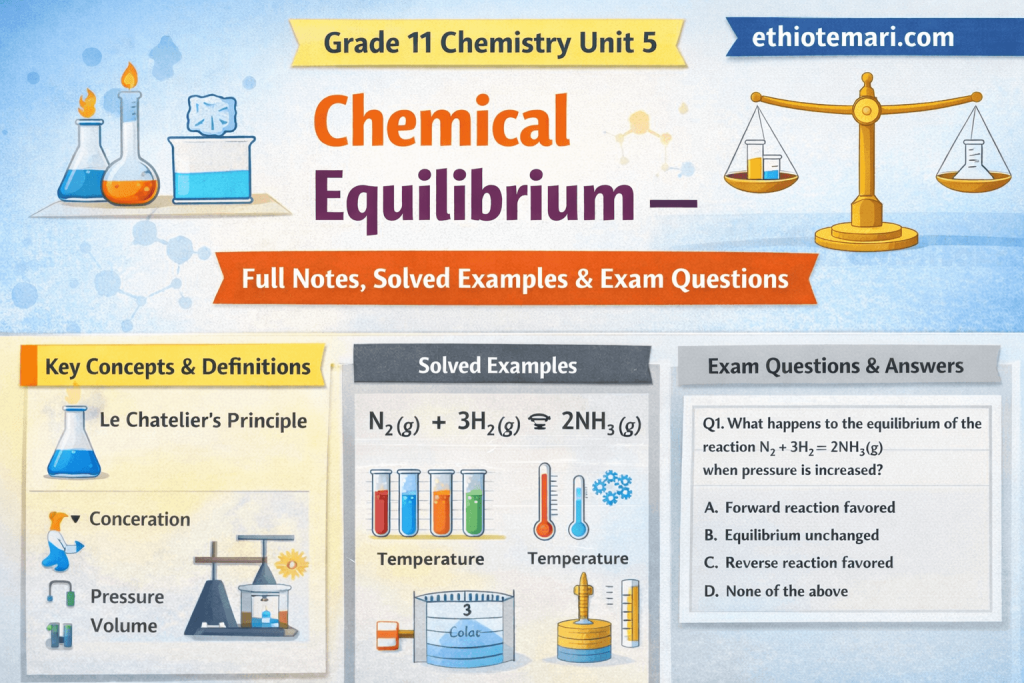
Hello dear student! Welcome to Unit 5 — Chemical Equilibrium. In Unit 4, we studied how fast reactions happen (kinetics). Now we ask a different question: how far does a reaction proceed? Many reactions do not go to completion — instead, they reach a state where both reactants and products are present. This state is called chemical equilibrium, and understanding it is essential for chemistry and for many industrial processes. Let’s learn it step by step.
5.1 Introduction
In our daily lives, we see many processes that seem to reach a balance. Water in a closed container evaporates, but the water level doesn’t drop to zero — because condensation is happening at the same rate as evaporation. This idea of balance is the foundation of chemical equilibrium.
Think about this: when you mix hydrogen and nitrogen gases, do they completely convert to ammonia? The answer is no — some ammonia forms, but some hydrogen and nitrogen always remain. Why? Let’s find out.
5.2 Chemical Equilibrium
5.2.1 Reversible and Irreversible Reactions
A reversible reaction is one that can proceed in both the forward and reverse directions. We write it with a double arrow:
The forward reaction converts reactants to products; the reverse reaction converts products back to reactants.
An irreversible reaction proceeds in only one direction — the products do not react to re-form the reactants under the given conditions. We write it with a single arrow (→). Examples: combustion reactions, precipitation reactions that go to completion.
Can you think of a reversible reaction you have observed? What about dissolving salt in water — salt dissolves, but if you add too much, some settles at the bottom. The process of dissolving and crystallizing happens simultaneously at equilibrium!
5.2.2 Attainment and Characteristics of Chemical Equilibria
Consider a reversible reaction in a closed system. Initially, only reactants are present, so the forward reaction is fast and the reverse reaction is zero. As products accumulate, the forward reaction slows down (lower reactant concentration) and the reverse reaction speeds up (higher product concentration).
Eventually, the rate of the forward reaction equals the rate of the reverse reaction. At this point, the system has reached chemical equilibrium.
Key point: At equilibrium, the reaction has NOT stopped! Both forward and reverse reactions continue at equal rates. This is why we call it a dynamic equilibrium — it is dynamic (active), not static (still).
Characteristics of chemical equilibrium:
- Dynamic nature: Forward and reverse reactions continue at equal rates.
- Constant concentrations: The concentrations of all species remain constant (but NOT necessarily equal).
- Requires a closed system: Equilibrium can only be reached if no matter enters or leaves the system.
- It can be approached from either direction: Whether you start with reactants or products, the same equilibrium is reached.
- It is affected by external conditions: Changing temperature, pressure, or concentration can shift the equilibrium position.
5.2.3 Conditions for Attainment of Chemical Equilibria
For equilibrium to be established, these conditions must be met:
- The reaction must be reversible.
- The system must be closed (no exchange of matter with surroundings).
- The temperature must be constant.
- Sufficient time must be allowed for equilibrium to be reached.
• Equilibrium is DYNAMIC — reactions do NOT stop.
• Concentrations are constant, not necessarily equal.
• Must be a closed system at constant temperature.
• Can be reached from either direction (forward or reverse).
• Macroscopic properties (color, pressure, density) remain constant.
1. Explain why chemical equilibrium is called “dynamic” rather than “static.”
2. Why can’t equilibrium be achieved in an open container?
At equilibrium, both the forward and reverse reactions continue to occur at equal rates. Molecules are still reacting — products are still being formed from reactants, and reactants are still being re-formed from products. The rates are equal, so there is no NET change in concentrations. This ongoing activity is why it is called “dynamic” (active) rather than “static” (still).
Answer 2:
In an open container, matter can escape (as gas) or enter from the surroundings. For example, if a gaseous product escapes, the reverse reaction cannot occur because that product is no longer available. This prevents the system from reaching the balance point where forward rate = reverse rate. A closed system is essential to trap all species so both directions can proceed.
5.2.4 Equilibrium Expression and Equilibrium Constant
For a general reversible reaction at equilibrium:
The equilibrium constant expression (in terms of concentration) is:
Where [A], [B], [C], [D] are the equilibrium concentrations (in mol/L or M) and a, b, c, d are the stoichiometric coefficients.
Important rules for writing Kc expressions:
- Products in numerator, reactants in denominator.
- Pure solids and pure liquids are NOT included in the equilibrium expression. Their concentrations are essentially constant and are absorbed into the value of K.
- Aqueous solutions and gases ARE included (their concentrations can change).
- The coefficients become exponents.
- Kc has no units (by convention in modern chemistry, we treat it as dimensionless).
(a) $\text{N}_2(g) + 3\text{H}_2(g) \rightleftharpoons 2\text{NH}_3(g)$
(b) $\text{CaCO}_3(s) \rightleftharpoons \text{CaO}(s) + \text{CO}_2(g)$
(c) $\text{Fe}^{3+}(aq) + \text{SCN}^-(aq) \rightleftharpoons \text{FeSCN}^{2+}(aq)$
Solution:
(a) $$K_c = \frac{[\text{NH}_3]^2}{[\text{N}_2][\text{H}_2]^3}$$
All species are gases, so all are included.
(b) $$K_c = [\text{CO}_2]$$
CaCO₃(s) and CaO(s) are pure solids — they are NOT included. Only the gaseous CO₂ appears.
(c) $$K_c = \frac{[\text{FeSCN}^{2+}]}{[\text{Fe}^{3+}][\text{SCN}^-]}$$
All species are in aqueous solution, so all are included.
Meaning of the Value of K
- K >> 1: Equilibrium lies to the RIGHT (products favored). Most reactants have converted to products.
- K << 1: Equilibrium lies to the LEFT (reactants favored). Very little product has formed.
- K ≈ 1: Significant amounts of both reactants and products are present at equilibrium.
Calculating Kc from Equilibrium Concentrations
$\text{N}_2(g) + 3\text{H}_2(g) \rightleftharpoons 2\text{NH}_3(g)$
At equilibrium: [N₂] = 0.50 M, [H₂] = 1.50 M, [NH₃] = 0.25 M. Calculate Kc.
Solution:
$$K_c = \frac{[\text{NH}_3]^2}{[\text{N}_2][\text{H}_2]^3} = \frac{(0.25)^2}{(0.50)(1.50)^3} = \frac{0.0625}{(0.50)(3.375)} = \frac{0.0625}{1.6875} = 0.0370$$
ICE Tables (Initial-Change-Equilibrium)
When you know initial concentrations and Kc, but not equilibrium concentrations, you use an ICE table:
Where x is the change in moles per liter. The coefficients a, b, c, d multiply x according to the stoichiometry. Then substitute equilibrium values into the Kc expression and solve for x.
Solution:
Set up ICE table (1.00 L flask, so moles = concentrations):
| | H₂ | I₂ | HI |
| Initial | 1.00 | 1.00 | 0 |
| Change | −x | −x | +2x |
| Equilibrium | 1.00−x | 1.00−x | 2x |
$$K_c = \frac{[\text{HI}]^2}{[\text{H}_2][\text{I}_2]} = \frac{(2x)^2}{(1.00-x)(1.00-x)} = \frac{4x^2}{(1.00-x)^2} = 49.0$$
Take the square root of both sides:
$$\frac{2x}{1.00-x} = \sqrt{49.0} = 7.0$$
$$2x = 7.0(1.00 – x) = 7.0 – 7.0x$$
$$9x = 7.0$$
$$x = 0.778$$
Equilibrium concentrations:
$$[\text{H}_2] = 1.00 – 0.778 = 0.222 \text{ M}$$
$$[\text{I}_2] = 1.00 – 0.778 = 0.222 \text{ M}$$
$$[\text{HI}] = 2(0.778) = 1.556 \text{ M}$$
• Products in numerator, reactants in denominator; coefficients become exponents.
• Pure solids and pure liquids are EXCLUDED from Kc expression.
• Kc depends only on TEMPERATURE. Changing concentration or pressure does NOT change Kc.
• Use ICE tables when initial concentrations are given but equilibrium concentrations are not.
• K >> 1: products favored. K << 1: reactants favored.
• Always check that your answer gives positive equilibrium concentrations (if x > [A]₀, something is wrong).
1. Write Kc for: $\text{PCl}_5(g) \rightleftharpoons \text{PCl}_3(g) + \text{Cl}_2(g)$. If at equilibrium [PCl₅] = 0.40 M, [PCl₃] = 0.20 M, [Cl₂] = 0.20 M, calculate Kc.
2. Why are pure solids excluded from the equilibrium expression?
$$K_c = \frac{[\text{PCl}_3][\text{Cl}_2]}{[\text{PCl}_5]} = \frac{(0.20)(0.20)}{0.40} = \frac{0.04}{0.40} = 0.10$$
Answer 2:
The concentration of a pure solid (or pure liquid) is essentially constant — it equals its density divided by molar mass, which does not change during the reaction. Including a constant value in the equilibrium expression would not provide useful information. Therefore, by convention, we omit pure solids and liquids from Kc, and their constant concentrations are effectively absorbed into the value of Kc itself.
Equilibrium Constant in Terms of Partial Pressure (Kp)
For reactions involving gases, we can express K in terms of partial pressures instead of concentrations:
Where P_A, P_B, etc. are the equilibrium partial pressures in atm (or bar).
Relationship between Kp and Kc:
Where:
- R = 0.0821 L·atm/(mol·K)
- T = temperature in Kelvin
- Δn = (moles of gaseous products) − (moles of gaseous reactants) — from the balanced equation
Solution:
$$\Delta n = 2 – (1 + 3) = 2 – 4 = -2$$
$$K_p = K_c(RT)^{\Delta n} = (0.040) \times (0.0821 \times 500)^{-2}$$
$$= (0.040) \times (41.05)^{-2} = (0.040) \times \frac{1}{1685.1} = (0.040) \times 5.934 \times 10^{-4}$$
$$= 2.37 \times 10^{-5}$$
Special cases:
- If Δn = 0, then Kp = Kc (e.g., H₂ + I₂ → 2HI: Δn = 2 − 2 = 0).
- If Δn > 0, Kp > Kc.
- If Δn < 0, Kp < Kc.
• Kp uses partial pressures; Kc uses molar concentrations.
• Kp = Kc(RT)^Δn where Δn = (gas products) − (gas reactants).
• Count ONLY gaseous species for Δn (ignore solids and liquids).
• If Δn = 0, Kp = Kc.
• Pure solids and liquids are also excluded from Kp expression.
1. For $\text{PCl}_5(g) \rightleftharpoons \text{PCl}_3(g) + \text{Cl}_2(g)$, calculate Δn and state whether Kp > Kc, Kp < Kc, or Kp = Kc.
2. For the reaction in question 1, if Kp = 1.80 at 500 K, calculate Kc.
Δn = (1 + 1) − 1 = 1. Since Δn > 0, Kp > Kc.
Answer 2:
$$K_p = K_c(RT)^{\Delta n}$$
$$1.80 = K_c(0.0821 \times 500)^1$$
$$1.80 = K_c(41.05)$$
$$K_c = \frac{1.80}{41.05} = 0.0439$$
5.2.5 Applications of Equilibrium Constant
The Reaction Quotient (Q)
The reaction quotient Q has the same form as Kc, but uses current concentrations (not necessarily equilibrium concentrations):
By comparing Q with K, we can predict the direction the reaction will proceed:
| Comparison | Meaning | Reaction Proceeds |
|---|---|---|
| Q < K | Too few products | Forward (→ right) |
| Q = K | At equilibrium | No net change |
| Q > K | Too many products | Reverse (→ left) |
Solution:
$$Q_c = \frac{[\text{NH}_3]^2}{[\text{N}_2][\text{H}_2]^3} = \frac{(0.20)^2}{(0.10)(0.30)^3} = \frac{0.04}{(0.10)(0.027)} = \frac{0.04}{0.0027} = 14.8$$
Since Q (14.8) > K (0.50), there are too many products. The reaction will shift to the left (reverse direction), consuming NH₃ and producing more N₂ and H₂.
Predicting the Extent of Reaction
The magnitude of K tells us how far a reaction proceeds:
- K > 10³: Reaction proceeds nearly to completion (products strongly favored).
- K < 10⁻³: Reaction hardly proceeds (reactants strongly favored).
- 10⁻³ < K < 10³: Significant amounts of both reactants and products at equilibrium.
• Q uses current concentrations; K uses equilibrium concentrations.
• Q < K → forward (right). Q > K → reverse (left). Q = K → equilibrium.
• The system always moves toward equilibrium (toward K).
• The same logic applies to Qp vs Kp using partial pressures.
1. For $\text{Fe}^{3+}(aq) + \text{SCN}^-(aq) \rightleftharpoons \text{FeSCN}^{2+}(aq)$, Kc = 200. In a mixture, [Fe³⁺] = 0.01 M, [SCN⁻] = 0.01 M, [FeSCN²⁺] = 0.10 M. Which direction will the reaction shift?
$$Q_c = \frac{[\text{FeSCN}^{2+}]}{[\text{Fe}^{3+}][\text{SCN}^-]} = \frac{0.10}{(0.01)(0.01)} = \frac{0.10}{0.0001} = 1000$$
Since Q (1000) > K (200), the reaction shifts to the left (reverse), consuming FeSCN²⁺ and producing more Fe³⁺ and SCN⁻.
5.2.6 Changing Equilibrium Conditions: Le Chatelier’s Principle
This is one of the most important topics in this unit! Le Chatelier’s Principle states:
Think of it like a seesaw — if you push one side down, the system tries to balance itself.
1. Change in Concentration
- Adding a reactant: System shifts RIGHT (forward) to consume the added reactant.
- Removing a reactant: System shifts LEFT (reverse) to replace the removed reactant.
- Adding a product: System shifts LEFT to consume the added product.
- Removing a product: System shifts RIGHT to replace the removed product.
Remember: Adding something pushes the equilibrium AWAY from it. Removing something pulls the equilibrium TOWARD it.
(a) Adding more N₂ (b) Removing NH₃ (c) Adding H₂ and removing NH₃ simultaneously
Solution:
(a) Adding N₂ → equilibrium shifts right → more NH₃ produced, H₂ consumed.
(b) Removing NH₃ → equilibrium shifts right → more NH₃ produced from N₂ and H₂.
(c) Adding H₂ AND removing NH₃ → both changes push the equilibrium to the right. The shift is even stronger than with either change alone.
2. Change in Pressure (and Volume)
Changing pressure by changing the volume of the container only affects reactions where there is a change in the number of moles of GAS:
- Increasing pressure (decreasing volume): System shifts toward the side with FEWER moles of gas.
- Decreasing pressure (increasing volume): System shifts toward the side with MORE moles of gas.
- If moles of gas are equal on both sides: Pressure change has NO effect on equilibrium.
Important: Adding an inert gas at constant volume does NOT change the equilibrium (partial pressures of reacting gases don’t change). Adding an inert gas at constant pressure DOES shift equilibrium (because volume must increase, decreasing partial pressures).
(a) $\text{N}_2(g) + 3\text{H}_2(g) \rightleftharpoons 2\text{NH}_3(g)$ [1+3=4 mol gas → 2 mol gas]
(b) $\text{H}_2(g) + \text{I}_2(g) \rightleftharpoons 2\text{HI}(g)$ [2 mol gas → 2 mol gas]
(c) $\text{PCl}_5(g) \rightleftharpoons \text{PCl}_3(g) + \text{Cl}_2(g)$ [1 mol gas → 2 mol gas]
Solution:
(a) Increasing pressure → shifts right (toward fewer moles of gas: 4→2). More NH₃ formed.
(b) Same moles of gas on both sides (2→2) → no shift.
(c) Increasing pressure → shifts left (toward fewer moles of gas: 2→1). More PCl₅ formed.
3. Change in Temperature
This is different from concentration and pressure changes because changing temperature actually changes the value of K.
- For an exothermic reaction (ΔH < 0, heat is released):
Increasing temperature → shifts LEFT (toward reactants, absorbing heat).
K decreases with increasing temperature. - For an endothermic reaction (ΔH > 0, heat is absorbed):
Increasing temperature → shifts RIGHT (toward products, absorbing heat).
K increases with increasing temperature.
Treat heat (ΔH) as a product (exothermic) or reactant (endothermic) in the equilibrium:
Solution:
Since the reaction is exothermic (heat is a product):
(a) Increasing temperature → system shifts left (to absorb the added heat).
(b) Kc decreases (fewer products at equilibrium).
(c) Yield of NH₃ decreases (equilibrium shifts away from NH₃).
This is why the Haber process uses moderate temperatures — too high reduces NH₃ yield!
4. Effect of a Catalyst
A catalyst increases the rates of BOTH forward and reverse reactions equally. Therefore:
- A catalyst does NOT shift the equilibrium position.
- A catalyst does NOT change the value of K.
- A catalyst simply helps the system reach equilibrium FASTER.
| Change | Shifts Equilibrium? | Changes K? |
|---|---|---|
| Concentration | Yes | No |
| Pressure/Volume (if Δn ≠ 0) | Yes | No |
| Temperature | Yes | Yes! |
| Catalyst | No | No |
| Inert gas (constant V) | No | No |
• Adding a substance → shift AWAY from it. Removing → shift TOWARD it.
• Pressure increase (volume decrease) → shift toward fewer moles of GAS.
• Count ONLY gas moles for pressure effects. Solids and liquids are ignored.
• Temperature is the ONLY factor that changes K.
• Exothermic: increase T → shift left, K decreases.
• Endothermic: increase T → shift right, K increases.
• Catalyst: NO effect on equilibrium position or K. Only speeds up attainment.
• Equal moles of gas on both sides → pressure change has NO effect.
1. For the endothermic reaction $\text{CaCO}_3(s) \rightleftharpoons \text{CaO}(s) + \text{CO}_2(g)$, predict the effect of: (a) increasing temperature, (b) increasing pressure, (c) removing CO₂.
2. Why does a catalyst not affect the equilibrium position?
(a) Endothermic → increasing T shifts right (toward products). More CO₂ forms. K increases.
(b) Increasing P → shift toward fewer moles of gas. Left side: 0 mol gas; right side: 1 mol gas. Shifts left. Less CO₂.
(c) Removing CO₂ → shift right (toward the removed substance). More CaCO₃ decomposes to produce CO₂.
Answer 2:
A catalyst lowers the activation energy equally for BOTH the forward and reverse reactions. This means it increases both rates by the same factor. Since the rates remain equal at equilibrium (just both faster), the position of equilibrium (the ratio of concentrations) does not change. K remains the same because K depends on the energy difference between products and reactants (ΔG), not on the pathway.
5.2.7 Equilibrium and Industry
Understanding chemical equilibrium is crucial for industrial processes. Let’s look at two important examples:
The Haber Process (Manufacture of Ammonia)
Applying Le Chatelier’s Principle to maximize NH₃ yield:
| Factor | Effect | Chosen Condition | Reason |
|---|---|---|---|
| Pressure | High P → shifts right (4→2 mol gas) | 200-300 atm | Increases yield, but very high P is expensive |
| Temperature | Low T → shifts right (exothermic) | 400-500 °C | Low T gives better yield but slow rate; compromise needed |
| Catalyst | No effect on equilibrium, speeds up rate | Fe catalyst | Allows reasonable rate at moderate T |
| Concentration | Remove NH₃ → shifts right | Continuous removal of NH₃ | Improves yield by shifting equilibrium right |
Notice the compromise between thermodynamics (yield) and kinetics (rate). Low temperature gives high yield but slow rate. The chosen temperature (400-500 °C) is a compromise between yield and rate, made possible by using a catalyst.
The Contact Process (Manufacture of Sulfuric Acid)
Similar principles apply: high pressure (favors products, 3→2 mol gas), moderate temperature (compromise), and a V₂O₅ catalyst.
• Haber process: N₂ + 3H₂ → 2NH₃. High P, moderate T, Fe catalyst, remove NH₃.
• Contact process: 2SO₂ + O₂ → 2SO₃. High P, moderate T, V₂O₅ catalyst.
• The compromise between yield (thermodynamics) and rate (kinetics) is a key concept.
• A catalyst does NOT improve yield — it only allows lower temperature to be used with acceptable rate.
1. In the Haber process, why isn’t room temperature used even though it would give the highest yield of NH₃?
2. Why is NH₃ continuously removed from the reaction chamber in the Haber process?
At room temperature, the yield of NH₃ would be very high (exothermic reaction favors products at low T). However, the rate of reaction would be extremely slow — it would take years to produce a useful amount of NH₃. The moderate temperature (400-500 °C) combined with an iron catalyst provides a compromise: a reasonable rate with an acceptable yield.
Answer 2:
Removing NH₃ shifts the equilibrium to the right (Le Chatelier’s Principle — removing a product pushes equilibrium toward more product formation). This increases the conversion of N₂ and H₂ to NH₃. The removed NH₃ is then liquefied and collected, while unreacted N₂ and H₂ are recycled back into the reaction chamber.
Quick Revision Notes — Exam Focus
1. Important Definitions
• Dynamic equilibrium: Both reactions continue at equal rates (not static).
• Reversible reaction: Reaction that can proceed in both forward and reverse directions.
• Equilibrium constant (Kc): Ratio of product concentrations to reactant concentrations at equilibrium, each raised to their stoichiometric coefficients.
• Kp: Equilibrium constant expressed in terms of partial pressures.
• Reaction quotient (Q): Same form as K, but uses current (non-equilibrium) concentrations.
• Le Chatelier’s Principle: When a stress is applied to a system at equilibrium, it shifts to counteract the stress.
• ICE table: Method for organizing Initial, Change, and Equilibrium concentrations.
2. All Key Formulas
3. Rules for Writing K Expressions
4. Q vs K — Quick Decision
5. Le Chatelier’s Summary
| Change | Direction of Shift | Changes K? |
|---|---|---|
| Add reactant | Right | No |
| Remove reactant | Left | No |
| Add product | Left | No |
| Remove product | Right | No |
| Increase P (decrease V) | Toward fewer gas moles | No |
| Decrease P (increase V) | Toward more gas moles | No |
| Increase T (exothermic) | Left | Yes (K↓) |
| Increase T (endothermic) | Right | Yes (K↑) |
| Add catalyst | No shift | No |
| Add inert gas (const V) | No shift | No |
6. Haber Process Conditions
• Pressure: 200-300 atm (high P favors products: 4→2 mol gas)
• Temperature: 400-500 °C (compromise: lower T gives better yield but slow rate)
• Catalyst: Iron (Fe) with promoters
• NH₃ is continuously removed to shift equilibrium right
• Unreacted N₂ and H₂ are recycled
7. Common Mistakes to Avoid
❌ Using initial concentrations instead of equilibrium concentrations to calculate K.
❌ Forgetting that K changes ONLY with temperature.
❌ Thinking a catalyst changes K or equilibrium position.
❌ Forgetting to count ONLY gas moles when calculating Δn for Kp = Kc(RT)^Δn.
❌ Confusing Q and K — Q uses any concentrations, K uses equilibrium concentrations only.
❌ Saying “pressure change shifts equilibrium” without checking if Δn ≠ 0 (if gas moles are equal on both sides, pressure has no effect).
❌ Getting the direction wrong for temperature changes — remember to treat heat as product (exothermic) or reactant (endothermic).
❌ Forgetting that inert gas at constant volume does NOT affect equilibrium.
Challenge Exam Questions
Test yourself thoroughly! Try each question before checking the answer.
Section A: Multiple Choice Questions
A) The forward reaction has stopped. B) The concentrations of reactants and products are equal.
C) The rates of forward and reverse reactions are equal. D) The value of K is 1.
At equilibrium, forward rate = reverse rate (dynamic equilibrium). The reactions have NOT stopped (A is wrong). Concentrations are constant but NOT necessarily equal (B is wrong). K can be any positive value, not necessarily 1 (D is wrong).
A) $K_c = \frac{[\text{CaO}][\text{CO}_2]}{[\text{CaCO}_3]}$ B) $K_c = [\text{CO}_2]$ C) $K_c = \frac{1}{[\text{CO}_2]}$ D) $K_c = \frac{[\text{CaO}]}{[\text{CaCO}_3]}$
CaCO₃(s) and CaO(s) are pure solids and are excluded from the equilibrium expression. Only the gaseous CO₂ remains: $K_c = [\text{CO}_2]$.
A) The reaction is at standard conditions. B) Δn = 0.
C) All reactants and products are solids. D) The temperature is 0 K.
Kp = Kc(RT)^Δn. If Kp = Kc, then (RT)^Δn = 1, which means Δn = 0. This occurs when the total moles of gaseous products equals the total moles of gaseous reactants.
A) Increase the yield of products. B) Shift equilibrium to the right.
C) Increase the value of K. D) Have no effect on the equilibrium position.
A catalyst increases both forward and reverse rates equally. It does NOT shift equilibrium, does NOT change K, and does NOT change the yield. It only helps the system reach equilibrium faster.
A) Increasing temperature B) Decreasing pressure
C) Increasing pressure D) Adding a catalyst
Increasing pressure shifts equilibrium toward fewer moles of gas (3 mol → 2 mol), favoring SO₃ production. Increasing temperature would shift left (exothermic reaction), decreasing yield. Decreasing pressure shifts left (more moles of gas on left). Catalyst has no effect on yield.
Section B: Fill in the Blanks
Section C: Short Answer Questions
In a closed system, no matter can enter or leave. This is essential because equilibrium requires both forward and reverse reactions to occur. If the system were open, one or more products (especially gases) could escape, preventing the reverse reaction from occurring. Without the reverse reaction, the system can never reach the state where forward rate = reverse rate. For example, in an open container, water vapor escapes and evaporation continues indefinitely without reaching equilibrium with condensation.
Why yield increases: Increasing pressure (by decreasing volume) shifts equilibrium toward the side with fewer moles of gas. Left side: 1 + 3 = 4 mol gas. Right side: 2 mol gas. The system shifts right to reduce the pressure, producing more NH₃.
Why Kc doesn’t change: Kc depends ONLY on temperature. Pressure changes affect the equilibrium CONCENTRATIONS (the position of equilibrium), but the ratio [NH₃]²/([N₂][H₂]³) at the new equilibrium remains the same as long as temperature is constant. The system adjusts its concentrations so that Kc is maintained.
No, this is incorrect. A catalyst increases the rate of both forward and reverse reactions equally. It provides an alternative pathway with lower activation energy for BOTH directions. Since both rates increase by the same factor, the equilibrium position (the ratio of product to reactant concentrations) remains unchanged. The catalyst only helps the system reach equilibrium faster — it does not change WHERE the equilibrium is. Think of it as making a car go faster but not changing the destination.
Section D: Calculation Questions
ICE table (1.00 L, so moles = M):
| | PCl₅ | PCl₃ | Cl₂ |
| Initial | 1.00 | 0 | 0 |
| Change | −x | +x | +x |
| Equilibrium | 1.00−x | x | x |
$$K_c = \frac{[\text{PCl}_3][\text{Cl}_2]}{[\text{PCl}_5]} = \frac{x \cdot x}{1.00 – x} = \frac{x^2}{1.00 – x} = 0.0211$$
$$x^2 = 0.0211(1.00 – x) = 0.0211 – 0.0211x$$
$$x^2 + 0.0211x – 0.0211 = 0$$
Using the quadratic formula: $x = \frac{-0.0211 + \sqrt{0.0211^2 + 4(0.0211)}}{2}$
$$= \frac{-0.0211 + \sqrt{0.000445 + 0.0844}}{2} = \frac{-0.0211 + 0.2913}{2} = \frac{0.2702}{2} = 0.1351$$
[PCl₅] = 1.00 − 0.135 = 0.865 M
[PCl₃] = [Cl₂] = 0.135 M
Initial concentrations: [H₂] = [I₂] = 0.200/5.00 = 0.0400 M
ICE table:
| | H₂ | I₂ | HI |
| Initial | 0.0400 | 0.0400 | 0 |
| Change | −x | −x | +2x |
| Equilibrium | 0.0400−x | 0.0400−x | 2x |
$$K_c = \frac{(2x)^2}{(0.0400-x)^2} = \frac{4x^2}{(0.0400-x)^2} = 50.5$$
$$\frac{2x}{0.0400-x} = \sqrt{50.5} = 7.106$$
$$2x = 7.106(0.0400 – x) = 0.2842 – 7.106x$$
$$9.106x = 0.2842$$
$$x = 0.03122$$
[HI] = 2(0.03122) = 0.0624 M
$$K_p = \frac{(P_{\text{NO}_2})^2}{P_{\text{N}_2\text{O}_4}}$$
$$0.025 = \frac{(0.15)^2}{P_{\text{N}_2\text{O}_4}} = \frac{0.0225}{P_{\text{N}_2\text{O}_4}}$$
$$P_{\text{N}_2\text{O}_4} = \frac{0.0225}{0.025} = 0.90 \text{ atm}$$
Total pressure = P_N₂O₄ + P_NO₂ = 0.90 + 0.15 = 1.05 atm
$$\Delta n = 2 – (1 + 3) = -2$$
$$K_p = K_c(RT)^{\Delta n} = (0.040)(0.0821 \times 500)^{-2}$$
$$= (0.040)(41.05)^{-2} = (0.040) \times \frac{1}{1685.1}$$
$$= 2.37 \times 10^{-5}$$
$$Q_c = \frac{[\text{NOCl}]^2}{[\text{NO}]^2[\text{Cl}_2]} = \frac{(1.0)^2}{(0.050)^2(0.020)} = \frac{1.0}{(0.0025)(0.020)} = \frac{1.0}{0.000050} = 20,000$$
Kc = 46,000
Since Q (20,000) < K (46,000), there are too few products. The reaction shifts to the right (forward direction) to produce more NOCl.
ICE table (1.0 L):
| | A | B | C | D |
| Initial | 2.0 | 2.0 | 0 | 0 |
| Change | −x | −x | +x | +x |
| Equilibrium | 2.0−x | 2.0−x | x | x |
$$K_c = \frac{[C][D]}{[A][B]} = \frac{x \cdot x}{(2.0-x)(2.0-x)} = \frac{x^2}{(2.0-x)^2} = 4.0$$
$$\frac{x}{2.0-x} = \sqrt{4.0} = 2.0$$
$$x = 2(2.0 – x) = 4.0 – 2x$$
$$3x = 4.0$$
$$x = 1.333$$
[A] = 2.0 − 1.333 = 0.667 M
[B] = 2.0 − 1.333 = 0.667 M
[C] = [D] = 1.333 M
(a) If temperature is increased to 600 K, will Kc increase or decrease? Explain.
(b) If the volume of the container is halved at constant temperature, what happens to the equilibrium concentrations of each gas?
(c) If He(g) is added at constant volume, what happens to the equilibrium?
(a) The reaction is exothermic (ΔH < 0, heat is a product). Increasing temperature adds heat, so the equilibrium shifts LEFT (away from heat). This means fewer products at the new equilibrium, so Kc decreases. (Kc will be less than 0.040 at 600 K.)
(b) Halving the volume doubles the pressure. The system shifts toward fewer moles of gas (4 → 2), so it shifts RIGHT. This means [NH₃] increases, while [N₂] and [H₂] decrease. Note: Kc remains 0.040 (temperature unchanged), but the individual concentrations adjust to maintain this ratio.
(c) Adding He(g) at constant volume increases the total pressure but does NOT change the partial pressures of N₂, H₂, or NH₃. Therefore, there is no shift in the equilibrium position. The equilibrium concentrations remain unchanged.