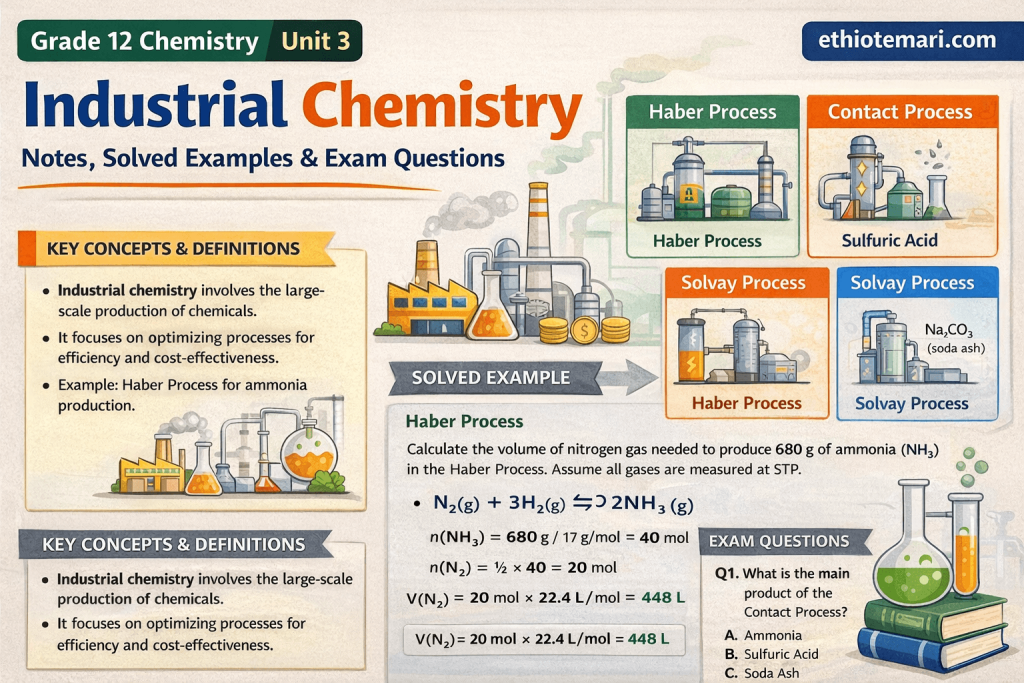
Welcome, dear student! In this unit, we move from the laboratory into the real world of Industrial Chemistry. Have you ever wondered how the fertilizer that helps grow our food is made? Or how the cement used to build our schools and homes is produced? Industrial chemistry is about turning raw materials into useful products on a large scale. Let’s learn this step by step!
3.2 Natural Resources and Industry
3.2.1 Natural Resources (Raw Materials)
Every industrial process starts with raw materials. These come from natural resources, which can be classified into three main types:
- Renewable resources: Can be replaced naturally within a short time — e.g., wood, water, air, solar energy, biomass.
- Non-renewable resources: Cannot be replaced once used — e.g., fossil fuels (coal, petroleum, natural gas), minerals, metals.
- Perpetual resources: Will never run out — e.g., sunlight, wind, tides.
For industrial chemistry, the most important raw materials come from:
- The air — nitrogen (N2) and oxygen (O2)
- Minerals and ores — sulfur, limestone, phosphate rock, bauxite
- Fossil fuels — coal, petroleum, natural gas
- Water — as a solvent, reactant, and coolant
- Biomass — plants and animal products
3.2.2 Industry
An industry is a place where raw materials are converted into finished or semi-finished products on a large scale. Industrial chemistry involves designing, operating, and optimizing chemical processes in factories. Key factors considered include:
- Availability of raw materials — Is the resource nearby or affordable to transport?
- Energy supply — Many reactions need heat, electricity, or both.
- Market demand — Will people buy the product?
- Environmental impact — Waste disposal, pollution control.
- Transport facilities — Roads, railways, ports for moving materials.
- Know the difference between renewable and non-renewable resources with examples.
- Industry location depends on raw materials, energy, market, transport, and labor.
- Ethiopia has significant natural resources: limestone, natural gas, coal, iron ore, water, geothermal energy.
Practice Question 1: Classify each of the following as renewable or non-renewable: (a) Petroleum (b) Water (c) Natural gas (d) Wood (e) Sunlight (f) Iron ore
Answer:
(a) Petroleum — Non-renewable (formed over millions of years)
(b) Water — Renewable (naturally replenished through the water cycle)
(c) Natural gas — Non-renewable (fossil fuel)
(d) Wood — Renewable (trees can be regrown)
(e) Sunlight — Perpetual (will never run out)
(f) Iron ore — Non-renewable (finite mineral deposit)
Practice Question 2: Explain why most cement factories in Ethiopia are located near limestone deposits.
Answer: Limestone is the main raw material for cement production and it is very heavy and bulky. Transporting it over long distances would be extremely expensive. By locating factories near limestone deposits, transportation costs are minimized, making the process more economical.
3.3 Manufacturing of Valuable Products
3.3.1 Ammonia (NH3)
Ammonia is one of the most important industrial chemicals in the world. Do you know why? Because it is the starting material for making fertilizers, explosives, and many other chemicals! Ammonia is manufactured by the Haber process.
The Haber Process
Conditions: Temperature: 450–500°C; Pressure: 150–300 atm; Catalyst: iron (Fe) with promoters (Al2O3 and K2O)
Why these conditions? Let’s think carefully:
- Low temperature would favor the forward reaction (exothermic), but the reaction would be too slow. So a compromise temperature of 450–500°C is used — fast enough rate with reasonable yield.
- High pressure favors the forward reaction (4 moles of gas → 2 moles of gas, so increasing pressure shifts equilibrium to the right by Le Chatelier’s principle). But very high pressure is expensive and dangerous, so 150–300 atm is used.
- Iron catalyst speeds up the reaction so that acceptable yields are achieved even at the compromise temperature.
Steps in the Haber Process
- Hydrogen production: Natural gas (CH4) is reacted with steam:
CH4(g) + H2O(g) → CO(g) + 3H2(g)
Then CO is removed: CO(g) + H2O(g) → CO2(g) + H2(g)
- Air separation: N2 is obtained from liquid air by fractional distillation.
- Compression: N2 and H2 are compressed to 150–300 atm.
- Reaction: Gases pass over the iron catalyst at 450–500°C in the reactor.
- Cooling: The mixture is cooled; NH3 condenses (liquefies) and is collected.
- Recycling: Unreacted N2 and H2 are recycled back into the reactor.
Uses of Ammonia
- Manufacture of fertilizers: ammonium sulfate ((NH4)2SO4), ammonium nitrate (NH4NO3), urea (CO(NH2)2)
- Manufacture of nitric acid (Ostwald process)
- Refrigerant (liquid ammonia)
- Cleaning agent (household ammonia)
- Production of explosives, dyes, and pharmaceuticals
- Reaction: N2 + 3H2 ⇌ 2NH3; exothermic; decrease in moles of gas.
- Compromise temperature (450–500°C) — low enough for reasonable yield, high enough for reasonable rate.
- High pressure (150–300 atm) — favors forward reaction (fewer gas moles).
- Iron catalyst with Al2O3 and K2O promoters.
- Unreacted gases are recycled to improve efficiency.
- Yield is about 15–20% per pass, but recycling increases overall conversion.
Practice Question 3: Explain why a compromise temperature is used in the Haber process instead of a low temperature which would give a higher equilibrium yield.
Answer: The reaction N2 + 3H2 ⇌ 2NH3 is exothermic, so a low temperature would shift equilibrium to the right and give a higher yield. However, at low temperature the reaction rate would be extremely slow — it could take years to reach equilibrium! A compromise temperature of 450–500°C is used: the yield is lower than at room temperature, but the rate is fast enough to make the process economically viable. The iron catalyst further helps increase the rate at this temperature.
Practice Question 4: Using Le Chatelier’s principle, explain why high pressure favors ammonia production in the Haber process.
Answer: In the reaction N2(g) + 3H2(g) ⇌ 2NH3(g), there are 4 moles of gas on the left and 2 moles of gas on the right. Increasing pressure shifts the equilibrium toward the side with fewer moles of gas (to reduce the pressure), which is the right side (ammonia). Therefore, high pressure increases the yield of ammonia.
3.3.2 Nitric Acid (HNO3)
Nitric acid is another very important industrial chemical. It is used to make fertilizers, explosives, dyes, and plastics. Nitric acid is manufactured by the Ostwald process.
The Ostwald Process
The process occurs in three main steps:
Step 1: Catalytic oxidation of ammonia
Conditions: Platinum-rhodium catalyst, temperature of about 850°C.
Step 2: Oxidation of nitric oxide
This step occurs as the gases cool. NO reacts with excess O2 to form brown NO2 gas. No catalyst is needed — this reaction happens spontaneously at room temperature.
Step 3: Absorption in water
NO2 is dissolved in water to produce nitric acid. The NO produced is recycled back to Step 2, where it is re-oxidized to NO2. This recycling increases efficiency.
The nitric acid produced is about 50–60% concentrated. If higher concentration (98%) is needed, it is concentrated by distillation with concentrated sulfuric acid as a dehydrating agent.
Uses of Nitric Acid
- Manufacture of fertilizers: ammonium nitrate (NH4NO3)
- Manufacture of explosives: TNT, nitroglycerin
- Production of dyes, drugs, and plastics
- Etching of metals
- As a laboratory reagent
- Three steps: NH3 → NO → NO2 → HNO3
- Step 1 needs Pt/Rh catalyst at 850°C (exothermic).
- Step 2 is spontaneous (no catalyst), NO + O2 → NO2.
- Step 3: NO is recycled back to Step 2 for higher efficiency.
- Direct product is about 50–60% HNO3; concentrated to 98% using H2SO4.
Practice Question 5: Write balanced equations for all three steps of the Ostwald process and state the catalyst used in Step 1.
Answer:
Step 1: 4NH3(g) + 5O2(g) → 4NO(g) + 6H2O(g); Catalyst: Platinum-rhodium (Pt/Rh) at 850°C
Step 2: 2NO(g) + O2(g) → 2NO2(g); No catalyst needed
Step 3: 3NO2(g) + H2O(l) → 2HNO3(aq) + NO(g); NO is recycled
Practice Question 6: Why is the NO produced in Step 3 of the Ostwald process recycled?
Answer: The NO produced in Step 3 still contains valuable nitrogen that has already been processed through the expensive catalytic oxidation step. Instead of wasting it, the NO is mixed with air and re-oxidized to NO2 (Step 2), then absorbed again in water (Step 3). This recycling significantly increases the overall yield and efficiency of the process, reducing waste and cost.
3.3.3 Nitrogen-Based Fertilizers
Ethiopia’s economy depends heavily on agriculture, and fertilizers play a crucial role in increasing crop yields. Fertilizers supply essential elements that plants need to grow: mainly nitrogen (N), phosphorus (P), and potassium (K) — called NPK fertilizers.
Types of Nitrogen Fertilizers
| Fertilizer | Formula | % Nitrogen | How Made |
|---|---|---|---|
| Ammonium sulfate | (NH4)2SO4 | ~21% | NH3 + H2SO4 → (NH4)2SO4 |
| Ammonium nitrate | NH4NO3 | ~35% | NH3 + HNO3 → NH4NO3 |
| Urea | CO(NH2)2 | ~46% | NH3 + CO2 → CO(NH2)2 + H2O |
Why is urea the most popular nitrogen fertilizer? It has the highest nitrogen content (46%) and is less hygroscopic (absorbs less water from air) compared to ammonium nitrate, making it easier to store and transport.
Phosphate Fertilizers
Made from phosphate rock (Ca3(PO4)2):
- Single superphosphate (SSP): Ca3(PO4)2 + 2H2SO4 → Ca(H2PO4)2 + 2CaSO4
- Triple superphosphate (TSP): Ca3(PO4)2 + 4H3PO4 → 3Ca(H2PO4)2
Question: Calculate the percentage of nitrogen in urea, CO(NH2)2. (MC = 12, MO = 16, MN = 14, MH = 1)
Solution:
Molar mass of CO(NH2)2 = 12 + 16 + 2(14 + 2×1) = 12 + 16 + 32 = 60 g/mol
Mass of nitrogen in one mole = 2 × 14 = 28 g
- NPK fertilizers supply Nitrogen, Phosphorus, and Potassium.
- Urea has the highest %N (46.67%) among common nitrogen fertilizers.
- Ammonium sulfate: NH3 + H2SO4; Ammonium nitrate: NH3 + HNO3.
- Know how to calculate % composition of a fertilizer.
- Excessive fertilizer use causes water pollution (eutrophication).
Practice Question 7: Calculate the percentage of nitrogen in ammonium sulfate, (NH4)2SO4.
Answer:
Molar mass of (NH4)2SO4 = 2(14 + 4×1) + 32 + 4×16 = 2(18) + 32 + 64 = 36 + 32 + 64 = 132 g/mol
Mass of N = 2 × 14 = 28 g
%N = (28/132) × 100% = 21.2%
3.3.4 Sulphuric Acid (H2SO4)
Sulfuric acid is often called the “king of chemicals” because it is the most widely used industrial chemical in the world! It is used in making fertilizers, detergents, batteries, and many other products. Sulfuric acid is manufactured by the Contact process.
The Contact Process
Step 1: Production of SO2
Sulfur is burned in air:
Alternatively, SO2 can be obtained by roasting metal sulfide ores, e.g.:
Step 2: Catalytic oxidation of SO2 to SO3
Conditions: Temperature: 400–450°C; Pressure: 1–2 atm; Catalyst: vanadium(V) oxide (V2O5)
Why these conditions? Think about it:
- The reaction is exothermic, so low temperature favors SO3. But a compromise temperature of 400–450°C is needed for a reasonable rate.
- 2 moles → 2 moles of gas, so pressure has minimal effect on equilibrium. Moderate pressure (1–2 atm) is used mainly for practical reasons.
- V2O5 catalyst increases the rate at the compromise temperature.
Important: Why not use a higher temperature? Because at higher temperatures, the equilibrium shifts BACK (toward SO2), reducing the yield. The name “Contact process” comes from the fact that SO2 and O2 must “contact” the catalyst surface.
Step 3: Absorption of SO3
SO3 is NOT dissolved directly in water (this would create a dangerous mist of H2SO4). Instead:
Then the oleum (H2S2O7) is diluted with water:
Uses of Sulfuric Acid
- Manufacture of fertilizers (ammonium sulfate, superphosphates)
- Manufacture of detergents and soaps
- Lead-acid batteries (in cars)
- Petroleum refining
- Chemical manufacturing (drugs, dyes, pigments)
- Steel processing (pickling)
- Three steps: S → SO2 → SO3 → H2SO4
- Step 2 is the key step: 2SO2 + O2 ⇌ 2SO3; exothermic; V2O5 catalyst at 400–450°C.
- SO3 is absorbed in H2SO4 (NOT water) to form oleum (H2S2O7).
- Oleum is then diluted to get H2SO4.
- Compromise temperature — same reasoning as Haber process.
- Before Step 2, SO2 must be purified (dust removal, arsenic removal) to prevent catalyst poisoning.
Practice Question 8: Explain why SO3 is absorbed in concentrated H2SO4 rather than directly in water.
Answer: If SO3 is dissolved directly in water, the reaction is extremely exothermic and produces a fine mist of sulfuric acid droplets. This mist is very difficult to condense and collect — it would escape into the atmosphere as acid fog, causing pollution and loss of product. Instead, SO3 is absorbed in concentrated H2SO4 to form oleum (H2S2O7), which is a liquid that can be safely diluted with water later.
Practice Question 9: Why must SO2 be purified before entering the contact tower?
Answer: Impurities such as dust particles, arsenic compounds, and other contaminants can “poison” the V2O5 catalyst. Catalyst poisoning means the impurities adsorb onto the catalyst surface and block the active sites, making the catalyst ineffective. Purification steps (dust removal by electrostatic precipitators, washing, and arsenic removal) ensure the catalyst remains active and has a long working life.
3.3.5 Some Common Pesticides and Herbicides
Agricultural pests (insects, weeds, fungi) reduce crop yields significantly. Chemicals used to control these pests are called pesticides.
| Type | Purpose | Examples |
|---|---|---|
| Insecticides | Kill insects | DDT, malathion, rotenone |
| Herbicides (weed killers) | Kill weeds | 2,4-D, paraquat, glyphosate |
| Fungicides | Kill fungi | Bordeaux mixture (CuSO4 + Ca(OH)2) |
| Rodenticides | Kill rodents | Warfarin, zinc phosphide |
Problems with pesticides:
- Bioaccumulation — pesticides build up in food chains (e.g., DDT in eagle eggs).
- Pollution of water and soil.
- Pests can develop resistance over time.
- Harmful to non-target organisms (bees, fish, birds).
- Know the four types: insecticides, herbicides, fungicides, rodenticides.
- Bordeaux mixture = CuSO4 + Ca(OH)2 (fungicide).
- DDT is a chlorinated hydrocarbon insecticide — banned in many countries due to bioaccumulation.
- Integrated Pest Management (IPM) combines chemical, biological, and cultural methods to reduce pesticide use.
Practice Question 10: What is bioaccumulation? Why is DDT particularly problematic in this regard?
Answer: Bioaccumulation is the process where a chemical substance builds up in an organism’s body over time because it is absorbed faster than it can be eliminated. DDT is fat-soluble (not water-soluble), so it accumulates in fatty tissues. As it moves up the food chain (from water → plankton → small fish → large fish → birds of prey), its concentration increases at each level (biomagnification). This caused thinning of eggshells in birds like eagles, leading to population decline — which is why DDT was banned in many countries.
3.3.6 Sodium Carbonate (Na2CO3)
Sodium carbonate (washing soda, Na2CO3·10H2O) is used in glass manufacturing, soap production, water softening, and as a cleaning agent. It is manufactured by the Solvay process.
The Solvay Process
Step 1: Ammonia is absorbed in saturated brine (NaCl solution):
NH3(g) + H2O(l) → NH4+(aq) + OH−(aq)
Step 2: CO2 (from heating limestone) is passed through the solution:
CaCO3(s) → CaO(s) + CO2(g)
The CO2 reacts with the ammoniated brine:
Sodium bicarbonate (NaHCO3) precipitates because it is less soluble in the cold solution.
Step 3: NaHCO3 is filtered and heated to form Na2CO3:
The CO2 produced is recycled back to Step 2.
Step 4: The CaO from Step 2 (heating limestone) is slaked to form Ca(OH)2, which is used to recover NH3 from the remaining NH4Cl solution:
The recovered NH3 is recycled. The only by-product is CaCl2.
- Raw materials: NaCl, CaCO3, NH3 (only NH3 is recycled, not consumed).
- Key intermediate: NaHCO3 precipitates and is heated to give Na2CO3.
- CO2 and NH3 are both recycled — this makes the process economical.
- By-product: CaCl2 (used for road de-icing, dust control).
- The Solvay process cannot produce potassium carbonate (KHCO3 is too soluble to precipitate).
Practice Question 11: Why is ammonia recycled in the Solvay process?
Answer: Ammonia is an expensive raw material. If it were not recycled and was lost after one cycle, the process would be economically unviable. By treating the NH4Cl solution with Ca(OH)2, ammonia gas is released and can be fed back into the process. This recycling means only a small initial amount of ammonia is needed to keep the process running continuously.
3.3.7 Sodium Hydroxide (NaOH)
Sodium hydroxide (caustic soda) is one of the most important industrial chemicals. It is used in soap making, paper production, aluminum extraction, and many other processes. NaOH is produced by the electrolysis of concentrated NaCl solution (brine) — the chlor-alkali process (which we studied in Unit 2).
Products: NaOH (remains in solution), Cl2 (at anode), H2 (at cathode)
Uses of NaOH
- Soap and detergent manufacturing (saponification of fats)
- Paper and pulp industry
- Aluminum extraction (Bayer process: dissolves Al2O3)
- Textile industry (mercerization of cotton)
- Oil refining
- Drain cleaner
- NaOH is produced by electrolysis of brine (chlor-alkali process).
- Three products: NaOH, Cl2, and H2.
- NaOH is a strong base and is highly corrosive.
- Used in soap making (reacts with fats/oils to form soap + glycerol).
3.4 Some Manufacturing Industries in Ethiopia
Ethiopia has been developing its industrial sector rapidly. Let’s learn about some of the important manufacturing industries in our country.
3.4.1 Glass Manufacturing
Glass is made by heating a mixture of raw materials until they fuse together. The main ingredient is silica sand (SiO2), but pure silica needs very high temperature to melt. So other chemicals are added to lower the melting point.
- Silica sand (SiO2) — the main component (~70%)
- Sodium carbonate (Na2CO3) — lowers melting point (acts as a flux)
- Limestone (CaCO3) — adds strength and durability
- Cullet (recycled glass) — reduces energy needed and waste
Manufacturing process:
- Raw materials are mixed in correct proportions and finely ground.
- The mixture is melted in a furnace at about 1500°C.
- The molten glass is shaped by blowing, pressing, or drawing.
- The glass is annealed (slowly cooled) to remove internal stresses and prevent cracking.
Types of glass: soda-lime glass (windows, bottles), borosilicate glass (lab glassware — Pyrex), colored glass (with metal oxides), safety glass (laminated).
- Main components: SiO2 + Na2CO3 + CaCO3
- Na2CO3 acts as a flux (lowers melting point).
- CaCO3 adds strength/chemical stability.
- Annealing = slow cooling to remove stress.
- Borosilicate glass has B2O3 added — resistant to thermal shock.
Practice Question 12: What is the role of sodium carbonate in glass manufacturing?
Answer: Sodium carbonate (Na2CO3) acts as a flux — it lowers the melting point of silica (SiO2) from about 1700°C to about 1500°C. This significantly reduces the energy needed for the melting process, making glass production more economical. Without a flux, the furnace would need much higher temperatures, increasing fuel costs.
3.4.2 Manufacturing of Ceramics
Ceramics are made from clay and other non-metallic minerals that are shaped and then hardened by heating. Ethiopia has a long tradition of ceramics.
Process:
- Preparation: Clay is purified, ground, and mixed with water to form a plastic mass.
- Forming: Shaped by hand, on a potter’s wheel, or by casting into molds.
- Drying: Slowly dried to remove water (prevents cracking).
- Firing (biscuit firing): Heated in a kiln at about 900–1000°C to harden.
- Glazing: A glassy coating is applied and the item is fired again at higher temperature (~1100–1300°C).
Uses: pottery, tiles, sanitary ware, electrical insulators, refractory bricks (for furnace linings).
3.4.3 Cement
Cement is one of Ethiopia’s most important industrial products — think of all the buildings, roads, and dams being constructed! Cement is mainly Portland cement.
Manufacturing Process (Dry Process):
- Crushing and grinding: Raw materials are ground into a fine powder.
- Blending: Mixed in correct proportions (about 60–65% CaO, 17–25% SiO2, 3–8% Al2O3, 1–6% Fe2O3).
- Preheating: Fed into a preheater tower to reduce energy consumption.
- Burning in rotary kiln: Heated to about 1450°C. Chemical reactions form clinker — hard, grey nodules.
- Cooling: Clinker is cooled quickly.
- Adding gypsum: 2–5% gypsum (CaSO4·2H2O) is added to clinker and ground into fine powder — this is cement.
Why is gypsum added? Without gypsum, cement would harden immediately when water is added (flash setting). Gypsum delays the setting time, allowing time for mixing, transporting, and placing the concrete.
Chemical composition of clinker:
- Tricalcium silicate (3CaO·SiO2) — hardens quickly, gives early strength
- Dicalcium silicate (2CaO·SiO2) — hardens slowly, gives long-term strength
- Tricalcium aluminate (3CaO·Al2O3) — generates heat during setting
- Tetracalcium aluminoferrite (4CaO·Al2O3·Fe2O3)
When cement is mixed with water, it undergoes hydration reactions and hardens into a strong solid — this is concrete (when mixed with sand and gravel).
- Raw materials: limestone + clay.
- Key step: burning in rotary kiln at ~1450°C to form clinker.
- Gypsum (2–5%) is added to control setting time (prevent flash setting).
- Cement + water + sand + gravel = concrete.
- Ethiopia has large limestone deposits — good for cement industry.
Practice Question 13: Explain the role of gypsum in cement manufacturing.
Answer: Gypsum (CaSO4·2H2O) is added to the clinker before final grinding (about 2–5% by weight). Its role is to retard (slow down) the setting time of cement. Without gypsum, the tricalcium aluminate (3CaO·Al2O3) in cement would react violently with water and cause “flash setting” — the cement would harden almost immediately, leaving no time for mixing, transporting, or placing. Gypsum forms a protective layer around the cement particles, slowing the hydration reaction and allowing workable time.
3.4.4 Sugar Manufacturing
Ethiopia is one of Africa’s major sugar producers. Sugar is manufactured mainly from sugarcane (grown in Wonji, Metehara, Fincha, and Tendaho sugar estates).
Manufacturing process:
- Harvesting and crushing: Sugarcane is crushed to extract juice.
- Purification: Juice is treated with lime (CaO) and heated — impurities precipitate and are filtered out.
- Evaporation: Clear juice is concentrated by evaporating water in multiple-effect evaporators.
- Crystallization: Concentrated syrup is further heated under vacuum until sugar crystals form.
- Centrifugation: Crystals are separated from remaining syrup (molasses) by spinning in a centrifuge.
- Drying and packaging: Sugar crystals are dried and packaged.
By-products of the sugar industry:
- Molasses — used to make ethanol, animal feed
- Bagasse (cane fiber) — used as fuel for boilers, paper pulp, animal feed
- Press mud — used as fertilizer
- Raw material: sugarcane (Ethiopia: Wonji, Metehara, Fincha, Tendaho).
- Key steps: crushing → purification (lime) → evaporation → crystallization → centrifugation.
- By-products: molasses (for ethanol), bagasse (fuel/fiber), press mud (fertilizer).
- Lime (CaO) is added to neutralize acidity and precipitate impurities.
3.4.5 Paper and Pulp
Paper is made from cellulose fibers, which come from wood, bagasse (sugarcane residue), or recycled paper. Ethiopia produces paper using both wood pulp and bagasse.
Process:
- Pulping: Raw material is broken down into fibers by chemical (kraft process using NaOH + Na2S) or mechanical means.
- Bleaching: Pulp is bleached with chlorine or hydrogen peroxide to make white paper.
- Paper making: Pulp is mixed with water, spread on a wire mesh, water drains away, and the sheet is pressed and dried.
3.4.6 Tannery
Ethiopia has the largest livestock population in Africa, making the leather industry very important. Tanneries convert animal hides and skins into leather.
Main stages:
- Curing: Hides are treated with salt to prevent decomposition.
- Soaking and liming: Rehydrated and treated with lime (Ca(OH)2) and sodium sulfide to remove hair and flesh.
- Deliming: Lime is removed using ammonium salts.
- Tanning: Hides are treated with chromium(III) sulfate (chrome tanning) or vegetable tannins to preserve and strengthen the leather.
- Finishing: Leather is dyed, dried, and polished.
- Lime (Ca(OH)2) + Na2S removes hair (unhairing).
- Chrome tanning uses Cr2(SO4)3 — gives soft, flexible leather.
- Vegetable tanning uses tannins from tree bark — gives firm, brown leather.
- Ethiopia’s large livestock population supports a strong leather industry.
3.4.7 Food Processing and Preservation
Food processing transforms raw agricultural products into preserved, safe, and convenient food. Methods include:
- Thermal processing: Canning (heating food in sealed containers), pasteurization (milk, juice)
- Dehydration/drying: Sun drying, spray drying (milk powder)
- Cold preservation: Refrigeration, freezing
- Chemical preservation: Using salt, sugar, vinegar, or food preservatives (sodium benzoate, sorbic acid)
- Fermentation: Injera (teff + fermentation), tella, tej
3.4.8 Manufacturing of Ethanol
Ethanol (ethyl alcohol, C2H5OH) can be produced by fermentation or synthetic methods.
Fermentation method:
Sugars from molasses, grains, or fruits are converted to ethanol by yeast (Saccharomyces cerevisiae):
The ethanol produced is about 8–15% concentrated. It is then purified by fractional distillation to about 95% ethanol.
Synthetic method:
Ethylene (from petroleum cracking) is hydrated:
Uses of ethanol: Beverages, solvent, fuel (bioethanol), antiseptic, chemical feedstock.
3.4.9 Soap and Detergent
Soap has been made for thousands of years. It is produced by saponification — the reaction of fats or oils with sodium hydroxide.
Soap manufacturing process:
- Saponification: Fat or oil is heated with NaOH solution.
- Salting out: NaCl is added to precipitate (separate) the soap from the mixture.
- Purification: Soap is washed, dried, and molded into bars.
How soap works: Soap molecules have two parts — a hydrophilic (water-loving) head and a hydrophobic (water-fearing) tail. The tail attaches to grease/oil, while the head interacts with water. This allows grease to be lifted off surfaces and washed away as emulsified droplets.
Soap vs. Detergent:
| Feature | Soap | Detergent |
|---|---|---|
| Source | Natural fats/oils + NaOH | Synthetic (from petroleum) |
| Works in hard water? | No (forms scum with Ca²⁺/Mg²⁺) | Yes (does not form scum) |
| Biodegradability | Highly biodegradable | Some types are not biodegradable |
| Example | Na stearate | Sodium dodecyl benzene sulfonate |
Why doesn’t soap work well in hard water? Hard water contains Ca2+ and Mg2+ ions. These react with soap to form insoluble calcium/magnesium salts of fatty acids — a gray, sticky substance called scum. This wastes soap and leaves stains. Detergents don’t have this problem because their calcium salts are soluble.
- Soap = fat/oil + NaOH (saponification).
- Soap has hydrophilic head + hydrophobic tail — this is how it cleans.
- Soap forms scum in hard water (with Ca2+/Mg2+); detergents do not.
- Detergents are synthetic, work in hard water, but some are non-biodegradable.
- By-product of soap making: glycerol (used in cosmetics, pharmaceuticals).
Practice Question 14: Explain with a chemical equation why soap does not work well in hard water.
Answer: Hard water contains Ca2+ and Mg2+ ions. Soap (sodium stearate, C17H35COONa) reacts with these ions to form insoluble salts (scum):
2C17H35COONa + Ca2+ → (C17H35COO)2Ca↓ + 2Na+
The calcium stearate (scum) is insoluble in water, so it precipitates as a gray, sticky substance. This wastes soap (less soap available for cleaning) and leaves stains on clothes and surfaces. Detergents avoid this problem because their calcium salts remain soluble.
Practice Question 15: What is glycerol and how is it obtained during soap manufacturing?
Answer: Glycerol (glycerin, C3H5(OH)3) is a thick, sweet-tasting liquid that is a by-product of the saponification reaction. When a triglyceride (fat/oil) reacts with NaOH, it is broken down into soap (sodium salts of fatty acids) and glycerol. The glycerol remains dissolved in the water layer and is separated from the soap by “salting out” (adding NaCl precipitates the soap while glycerol stays in solution). Glycerol is used in cosmetics, pharmaceuticals, food, and as an antifreeze.
Revision Notes — Exam Focus
Summary of Major Industrial Processes
| Process | Product | Key Reaction | Key Conditions |
|---|---|---|---|
| Haber | NH3 | N2 + 3H2 ⇌ 2NH3 | Fe catalyst, 450–500°C, 150–300 atm |
| Ostwald | HNO3 | 4NH3 + 5O2 → 4NO + 6H2O | Pt/Rh catalyst, 850°C |
| Contact | H2SO4 | 2SO2 + O2 ⇌ 2SO3 | V2O5 catalyst, 400–450°C |
| Solvay | Na2CO3 | 2NaHCO3 → Na2CO3 + CO2 + H2O | NaHCO3 precipitates from cold solution |
| Chlor-alkali | NaOH, Cl2, H2 | 2NaCl + 2H2O → 2NaOH + Cl2 + H2 | Electrolysis of brine |
Important Definitions
- Renewable resource: Can be naturally replenished within a short time (e.g., water, wood).
- Non-renewable resource: Cannot be replaced once used (e.g., coal, petroleum, minerals).
- Flux: A substance added to lower the melting point (e.g., Na2CO3 in glass).
- Slag: Impurities removed as molten waste during metal extraction.
- Clinker: Hard nodules produced in the cement kiln before grinding with gypsum.
- Saponification: Reaction of fats/oils with NaOH to produce soap + glycerol.
- Bioaccumulation: Build-up of substances in organisms over time.
- Bioremediation: Use of living organisms to clean up pollution.
- Eutrophication: Excessive nutrients in water causing algal bloom and oxygen depletion.
- Annealing: Slow cooling of glass to remove internal stresses.
Key Equations to Remember
Common Mistakes to Avoid
- Mistake 1: Writing the Haber process reaction as non-reversible (no ⇌). It IS reversible — equilibrium is important!
- Mistake 2: Saying SO3 is dissolved directly in water. NO — it goes into H2SO4 first to make oleum.
- Mistake 3: Confusing catalysts: Haber = Fe; Ostwald = Pt/Rh; Contact = V2O5.
- Mistake 4: Saying NH3 is consumed in the Solvay process. NH3 is RECYCLED, not consumed.
- Mistake 5: Forgetting that the Contact process reaction has equal moles of gas on both sides (2:1→2:2), so pressure has minimal effect.
- Mistake 6: Saying cement = clinker alone. Gypsum MUST be added (2–5%) to control setting.
- Mistake 7: Confusing soap and detergent — soap comes from natural fats + NaOH; detergents are synthetic from petroleum.
- Mistake 8: Saying urea has lower %N than ammonium sulfate. Urea has 46.7% N vs. 21.2% for ammonium sulfate — urea is HIGHER.
- Mistake 9: Forgetting to mention NO recycling in the Ostwald process.
- Mistake 10: Confusing the temperatures: Haber (450–500°C), Ostwald (850°C), Contact (400–450°C).
Ethiopian Industries — Quick Reference
| Industry | Main Raw Materials | Key Locations in Ethiopia |
|---|---|---|
| Cement | Limestone + clay | Mugher, Diredawa, Mekelle |
| Sugar | Sugarcane | Wonji, Metehara, Fincha, Tendaho |
| Leather/Tannery | Animal hides/skins | Modjo, Kombolcha, Bahir Dar |
| Glass | Silica sand + Na2CO3 + CaCO3 | Addis Ababa |
| Textile | Cotton | Awasa, Bahir Dar, Kombolcha |
| Paper | Wood/bagasseAwasa, Addis Ababa | |
| Chemical/Fertilizer | Natural gas, minerals | Awash Melkasa (fertilizer factory) |
Challenge Exam Questions
Test yourself with these difficult questions! Try each one before checking the answer.
Section A: Multiple Choice Questions
Question 1: Which catalyst is used in the Contact process for sulfuric acid manufacture?
(a) Iron (Fe) (b) Platinum-rhodium (Pt/Rh) (c) Vanadium(V) oxide (V2O5) (d) Manganese(IV) oxide (MnO2)
Answer: (c) Vanadium(V) oxide (V2O5)
V2O5 is the catalyst used in the Contact process for the oxidation of SO2 to SO3. Iron is used in the Haber process. Pt/Rh is used in the Ostwald process. MnO2 is used as a catalyst in the laboratory preparation of chlorine from HCl.
Question 2: The function of adding gypsum to cement clinker is to:
(a) Increase the strength of cement (b) Speed up the setting time
(c) Slow down the setting time (d) Lower the melting point of the mixture
Answer: (c) Slow down the setting time
Gypsum (CaSO4·2H2O) is added to prevent flash setting — the rapid hardening that would occur due to tricalcium aluminate reacting with water. Gypsum forms a protective layer, retarding the hydration and giving workers enough time to mix, transport, and place the concrete.
Question 3: Which nitrogen fertilizer has the highest percentage of nitrogen?
(a) Ammonium sulfate (b) Ammonium nitrate (c) Urea (d) Calcium ammonium nitrate
Answer: (c) Urea
Urea (CO(NH2)2) has 46.7% nitrogen, which is the highest among common nitrogen fertilizers. Ammonium sulfate has ~21%, ammonium nitrate has ~35%, and calcium ammonium nitrate has about 26% nitrogen.
Question 4: In the Solvay process, ammonia is recovered by treating NH4Cl solution with:
(a) H2SO4 (b) Ca(OH)2 (c) NaOH (d) HCl
Answer: (b) Ca(OH)2
In the Solvay process, the NH4Cl remaining after NaHCO3 precipitation is treated with Ca(OH)2 (slaked lime, obtained from heating limestone): 2NH4Cl + Ca(OH)2 → 2NH3 + CaCl2 + 2H2O. The NH3 is recycled. This Ca(OH)2 comes from the same limestone that provides CO2, making the process efficient.
Question 5: SO3 from the Contact process is absorbed in concentrated H2SO4 rather than water because:
(a) Water is too expensive (b) Direct dissolution creates an acid mist
(c) H2SO4 reacts faster (d) Water would reduce SO3 to SO2
Answer: (b) Direct dissolution creates an acid mist
When SO3 reacts directly with water, the reaction is so exothermic that it produces a fine mist of H2SO4 droplets that are difficult to condense and would escape as atmospheric pollution. Absorbing in concentrated H2SO4 to form oleum is safer and more efficient.
Section B: Fill in the Blanks
Question 6: In the Haber process, a __________ temperature is used because low temperature gives a high yield but a very slow __________.
Answer: compromise (450–500°C); rate of reaction.
Question 7: In the Ostwald process, Step 2 (NO to NO2) does not require a __________ because the reaction occurs __________ at room temperature.
Answer: catalyst; spontaneously.
Question 8: The main raw materials for glass manufacturing are silica sand, sodium __________, and __________.
Answer: carbonate (Na2CO3); limestone (CaCO3).
Question 9: In sugar manufacturing, the by-product __________ can be used as fuel for boilers, and __________ can be fermented to produce ethanol.
Answer: bagasse; molasses.
Question 10: Soap does not work well in hard water because it forms insoluble __________ with Ca2+ and Mg2+ ions, known as __________.
Answer: salts (calcium/magnesium salts of fatty acids); scum.
Section C: Short Answer Questions
Question 11: Compare the Haber process and the Contact process in terms of: (a) nature of the reaction (exothermic/endothermic), (b) effect of pressure on equilibrium, (c) catalyst used.
Answer:
(a) Both are exothermic (Haber: ΔH = −92 kJ/mol; Contact: ΔH = −198 kJ/mol).
(b) Haber: 4 mol gas → 2 mol gas — increasing pressure significantly favors the forward reaction. Contact: 2 mol gas → 2 mol gas — pressure change has minimal effect on equilibrium.
(c) Haber: Iron (Fe) with Al2O3/K2O promoters. Contact: Vanadium(V) oxide (V2O5).
Question 12: Why is it important for Ethiopia to develop its fertilizer manufacturing industry rather than importing all fertilizers?
Answer: Developing local fertilizer manufacturing has several advantages: (1) Ethiopia’s economy depends heavily on agriculture, and fertilizers are essential for increasing crop yields to ensure food security. (2) Importing fertilizers costs large amounts of foreign currency (foreign exchange). (3) Ethiopia has the necessary raw materials — natural gas (for hydrogen in Haber process) and phosphate rock. (4) Local manufacturing creates jobs and develops industrial skills. (5) It reduces dependence on international supply chains which can be disrupted. The fertilizer factory at Awash Melkasa is an example of this effort.
Question 13: Describe the environmental problems associated with the fertilizer industry and suggest possible solutions.
Answer:
Problems:
(1) Eutrophication: Excess fertilizer (especially nitrates and phosphates) washes into rivers and lakes, causing algal blooms that deplete oxygen and kill aquatic life.
(2) NOx and SOx emissions: From the Haber and Contact processes, contributing to acid rain and air pollution.
(3) Ammonia leakage: Can contaminate soil and water, harm aquatic organisms.
Solutions:
(1) Educate farmers on proper fertilizer application rates and timing.
(2) Use slow-release fertilizers that reduce leaching.
(3) Install pollution control equipment (scrubbers, catalytic converters) in factories.
(4) Promote organic farming and composting to reduce chemical fertilizer dependency.
(5) Monitor water quality near fertilizer plants.
Question 14: Explain why the Solvay process cannot be used to manufacture potassium carbonate (K2CO3).
Answer: In the Solvay process, sodium bicarbonate (NaHCO3) precipitates from the cold ammoniated brine because it has low solubility. However, potassium bicarbonate (KHCO3) is significantly MORE soluble in cold water and does NOT precipitate under the same conditions. Since the precipitation step is essential for separating the product, the Solvay process cannot be adapted for potassium carbonate. K2CO3 must be produced by other methods (e.g., from potassium chloride and magnesium carbonate).
Section D: Step-by-Step Calculation Questions
Question 15: Calculate the percentage of phosphorus in single superphosphate (SSP), Ca(H2PO4)2. (MCa = 40, MH = 1, MP = 31, MO = 16)
Answer:
Molar mass of Ca(H2PO4)2 = 40 + 4(1) + 2(31) + 8(16) = 40 + 4 + 62 + 128 = 234 g/mol
Mass of P in one mole = 2 × 31 = 62 g
%P = (62/234) × 100% = 26.5%
Question 16: An ammonia plant produces 340 kg of NH3 per hour. (a) What volume of N2 (at STP) is consumed per hour? (b) What volume of H2 (at STP) is consumed per hour? (MN = 14, MH = 1; molar volume at STP = 22.4 L/mol)
Answer:
Molar mass of NH3 = 14 + 3 = 17 g/mol
Moles of NH3 produced per hour = 340,000 / 17 = 20,000 mol
From N2 + 3H2 → 2NH3:
(a) Moles of N2 needed = 20,000/2 = 10,000 mol
Volume of N2 at STP = 10,000 × 22.4 = 224,000 L = 224 m³
(b) Moles of H2 needed = 3 × 10,000 = 30,000 mol
Volume of H2 at STP = 30,000 × 22.4 = 672,000 L = 672 m³
Question 17: A cement factory produces 1000 tonnes of clinker per day. How much gypsum (in kg) should be added per day to make cement? (Assume 4% gypsum by mass)
Answer:
Mass of gypsum needed = 4% of clinker mass
= 0.04 × 1000 tonnes = 40 tonnes per day
= 40 × 1000 = 40,000 kg per day
Question 18: In the fermentation of glucose, 180 g of glucose (C6H12O6) produced 46 g of ethanol (C2H5OH). Calculate the percentage yield. (Mglucose = 180, Methanol = 46)
Answer:
C6H12O6 → 2C2H5OH + 2CO2
1 mol glucose (180 g) → 2 mol ethanol (2 × 46 = 92 g)
Theoretical yield of ethanol from 180 g glucose = 92 g
Actual yield = 46 g
% yield = (46/92) × 100% = 50%
Question 19: Write balanced chemical equations for the complete Solvay process, starting from NaCl, CaCO3, and NH3, and ending with Na2CO3. Show how NH3 and CO2 are recycled.
Answer:
1. Limestone decomposition: CaCO3(s) → CaO(s) + CO2(g)
2. Slaking: CaO(s) + H2O(l) → Ca(OH)2(aq)
3. Ammoniation: NH3(g) + H2O(l) → NH4+(aq) + OH−(aq)
4. Carbonation: NH4+(aq) + HCO3−(aq) + Na+(aq) → NaHCO3(s)↓ + NH4+(aq)
(From: NH3 + CO2 + H2O → NH4HCO3; then NH4HCO3 + NaCl → NaHCO3 + NH4Cl)
5. Calcination: 2NaHCO3(s) → Na2CO3(s) + CO2(g) + H2O(g) — CO2 is recycled to Step 4
6. Ammonia recovery: 2NH4Cl(aq) + Ca(OH)2(aq) → 2NH3(g) + CaCl2(aq) + 2H2O(l) — NH3 is recycled to Step 3
Net result: NaCl + CaCO3 → Na2CO3 + CaCl2 (NH3 and CO2 are not consumed)
Question 20: Explain why bioaccumulation of DDT is a greater problem for top predators (like eagles) than for organisms lower in the food chain.
Answer: DDT is fat-soluble and not easily excreted by organisms. When it enters a food chain, each organism at a higher trophic level eats many organisms from the level below. Since DDT accumulates in body fat and is not eliminated, the concentration increases at each level — this is called biomagnification. For example: if water has 0.001 ppb DDT, plankton might have 0.04 ppb, small fish 0.5 ppb, large fish 2 ppb, and eagle tissues 25 ppb. Top predators like eagles eat many large fish, so they receive a massive dose. The accumulated DDT interferes with calcium metabolism, causing thin eggshells that break during incubation — leading to population decline. This is why DDT was banned in many countries.
Question 21: A student claims that both the Haber process and the Contact process use a compromise temperature for the same reason. Is this claim correct? Explain with reference to Le Chatelier’s principle.
Answer: Yes, the claim is correct in principle. Both processes involve exothermic reactions, so low temperature would give higher equilibrium yield (Le Chatelier’s principle: decreasing temperature favors the exothermic direction). However, low temperature also means very slow reaction rate (kinetic limitation). Therefore, in BOTH processes, a compromise temperature is chosen — high enough for a reasonable rate but low enough for acceptable yield. The catalyst (Fe in Haber, V2O5 in Contact) allows the compromise temperature to be used by increasing the rate without needing even higher temperatures.