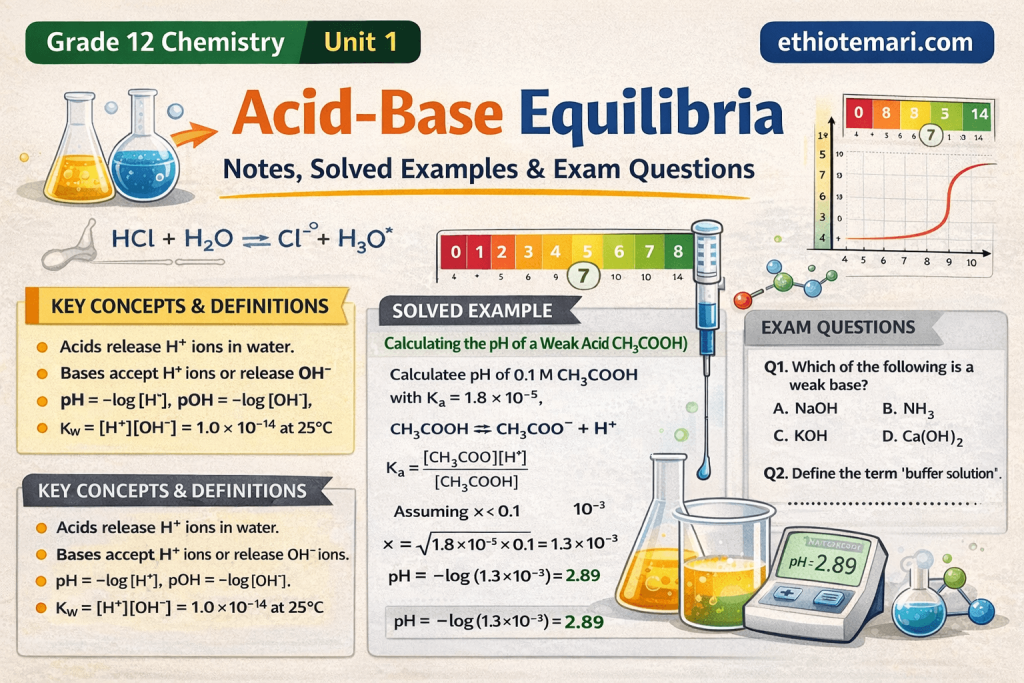
Welcome, dear student! In this unit, we will learn about acid-base equilibria. This is one of the most important topics in Grade 12 Chemistry. Take your time, read each section carefully, and try the practice questions. Let’s begin!
1.1 Acid-Base Concepts
1.1.1 Arrhenius Concept of Acids and Bases
The Swedish chemist Svante Arrhenius gave the first successful definition of acids and bases. His idea was simple but powerful:
An acid is a substance that increases the concentration of H+ (proton) in aqueous solution.
A base is a substance that increases the concentration of OH− (hydroxide ion) in aqueous solution.
For example, when hydrogen chloride dissolves in water:
HCl(aq) + H2O(l) → H3O+(aq) + Cl−(aq)
HCl increases H3O+ concentration, so it is an Arrhenius acid.
When sodium hydroxide dissolves in water:
NaOH(s) + H2O(l) → Na+(aq) + OH−(aq)
NaOH increases OH− concentration, so it is an Arrhenius base.
Strong acids (HCl, HNO3, HClO4, H2SO4, HI, HBr) ionize completely. Strong bases (Group IA and Group IIA hydroxides, except Be) also ionize completely.
But can you see the problem with Arrhenius’s idea? Think about it — what about ammonia (NH3)? It acts as a base but it does NOT contain OH−! This is one of the limitations of the Arrhenius concept.
- Arrhenius acids produce H+ (or H3O+) in water; bases produce OH− in water.
- Works ONLY for aqueous solutions — this is its main limitation.
- Cannot explain why NH3, Na2CO3 act as bases without OH− in their formula.
- Cannot explain acid-base reactions in non-aqueous solvents.
Practice Question 1: Classify NaCl(aq) as an Arrhenius acid, Arrhenius base, or neither. Explain your answer.
Answer: NaCl is neither an Arrhenius acid nor an Arrhenius base. When NaCl dissolves in water: NaCl(s) + H2O(l) → Na+(aq) + Cl−(aq). It does NOT produce H+ or OH− ions. Therefore, it cannot be classified as either.
Practice Question 2: State two limitations of the Arrhenius concept of acids and bases.
Answer: (1) It applies only to aqueous solutions — it cannot explain acid-base reactions in non-aqueous solvents. (2) It cannot explain why substances like NH3 and Na2CO3 behave as bases even though they do not contain OH− in their formula.
1.1.2 Brønsted-Lowry Concept of Acids and Bases
To solve the problems of Arrhenius’s theory, Brønsted and Lowry (in 1923) proposed a broader definition. Have you noticed that in acid-base reactions, something is being transferred? Let’s see:
An acid is a proton (H+) donor.
A base is a proton (H+) acceptor.
This is a wonderful definition because it is NOT limited to water! Let’s look at ammonia reacting with water:
NH3(aq) + H2O(l) ⇌ NH4+(aq) + OH−(aq)
Here, NH3 accepts a proton from H2O. So NH3 is a Brønsted-Lowry base, and H2O is a Brønsted-Lowry acid. See? NH3 doesn’t need OH− to be a base!
Conjugate Acid-Base Pairs
Now here is a very important idea. In every Brønsted-Lowry reaction, acids and bases come in pairs. Look at this reaction:
CH3COOH(aq) + H2O(l) ⇌ CH3COO−(aq) + H3O+(aq)
When CH3COOH donates a proton, it becomes CH3COO−. These two form a conjugate acid-base pair. Similarly, H2O (which accepted a proton to become H3O+) and H3O+ form another conjugate pair.
- The conjugate base has one fewer H and one more negative charge than the acid.
- The conjugate acid has one more H and one fewer negative charge than the base.
- Example: Acid = NH4+ → Conjugate base = NH3 (lost one H+)
| Acid | + | Base | ⇌ | Base | + | Acid |
|---|---|---|---|---|---|---|
| HF | + | H2O | ⇌ | F− | + | H3O+ |
| HCOOH | + | CN− | ⇌ | HCOO− | + | HCN |
| NH4+ | + | CO32− | ⇌ | NH3 | + | HCO3− |
| H2PO4− | + | OH− | ⇌ | HPO42− | + | H2O |
Question: Identify the Brønsted-Lowry acids, bases, and conjugate pairs in: NH3 + H2PO4− ⇌ NH4+ + HPO42−
Solution: Look for proton donors and acceptors.
- H2PO4− donates a proton to become HPO42− → Acid (and HPO42− is its conjugate base)
- NH3 accepts a proton to become NH4+ → Base (and NH4+ is its conjugate acid)
- Conjugate pair 1: H2PO4− / HPO42−
- Conjugate pair 2: NH3 / NH4+
Question: Identify acids, bases, and conjugate pairs in: HCl + H2PO4− ⇌ Cl− + H3PO4
Solution:
- HCl donates a proton → Acid; Cl− is its conjugate base
- H2PO4− accepts a proton → Base; H3PO4 is its conjugate acid
- Conjugate pair 1: HCl / Cl−
- Conjugate pair 2: H2PO4− / H3PO4
Strengths of Conjugate Acid-Base Pairs
Here is a very important rule — please remember it well for your exam:
A reaction proceeds in the direction where a stronger acid + stronger base → weaker acid + weaker base.
For example: HCl is a strong acid, so Cl− is a very weak base. CH3COOH is a weak acid, so CH3COO− is a relatively stronger base (compared to Cl−).
- Acid = proton donor; Base = proton acceptor (not limited to water!)
- Every acid has a conjugate base; every base has a conjugate acid.
- Stronger acid → weaker conjugate base; Stronger base → weaker conjugate acid.
- Water can act as BOTH acid and base (it is amphiprotic).
Practice Question 3: Identify the Brønsted-Lowry acids, bases, and conjugate pairs in: HClO2 + H2O ⇌ ClO2− + H3O+
Answer: HClO2 donates a proton → Acid; ClO2− is its conjugate base. H2O accepts a proton → Base; H3O+ is its conjugate acid.
Conjugate pair 1: HClO2 / ClO2−
Conjugate pair 2: H2O / H3O+
Practice Question 4: In the reaction OCl− + H2O ⇌ HOCl + OH−, identify the acid, base, and both conjugate pairs.
Answer: H2O donates a proton → Acid; OH− is its conjugate base. OCl− accepts a proton → Base; HOCl is its conjugate acid.
Conjugate pair 1: H2O / OH−
Conjugate pair 2: OCl− / HOCl
Amphiprotic Species and Auto-ionization
Can a substance be BOTH an acid and a base? Yes! Such substances are called amphiprotic species. They can either donate or accept a proton depending on what they react with.
Water is the most important amphiprotic species:
- With NH3 (a base): H2O donates a proton → acts as an acid
- With CH3COOH (an acid): H2O accepts a proton → acts as a base
Another example: HCO3−
- With OH−: HCO3− donates H+ → acts as an acid
- With HF: HCO3− accepts H+ → acts as a base
Auto-ionization (Self-ionization) is when two identical molecules react to produce ions. Water auto-ionizes:
H2O(l) + H2O(l) ⇌ H3O+(aq) + OH−(aq)
One water molecule acts as an acid, the other as a base!
Ammonia also undergoes auto-ionization: 2NH3(l) ⇌ NH4+ + NH2−
- Amphiprotic species can donate OR accept a proton.
- Common examples: H2O, HCO3−, HSO4−, H2PO4−, HPO42−
- Auto-ionization: two identical molecules produce a cation and an anion.
Practice Question 5: Write equations to show the amphiprotic behavior of H2PO4−.
Answer:
As an acid (donating H+ to OH−): H2PO4− + OH− → HPO42− + H2O
As a base (accepting H+ from H3O+): H2PO4− + H3O+ → H3PO4 + H2O
1.1.3 Lewis Concept of Acids and Bases
The Brønsted-Lowry concept focuses on proton transfer. But what about reactions where no proton is involved at all? G.N. Lewis proposed an even broader definition:
A Lewis acid is an electron-pair acceptor.
A Lewis base is an electron-pair donor.
Think about it this way: a Lewis acid has an empty orbital (it is “electron-hungry”), and a Lewis base has a lone pair of electrons to share.
Worked Example 3Question: Identify the Lewis acid and Lewis base in: BF3 + NH3 → F3B—NH3
Solution: Boron in BF3 has only 6 valence electrons — it needs 2 more. So BF3 accepts an electron pair → Lewis acid. Nitrogen in NH3 has a lone pair → it donates an electron pair → Lewis base.
Worked Example 4Question: Identify Lewis acid and base in: CaO + CO2 → CaCO3
Solution: The O2− in CaO donates an electron pair → Lewis base (CaO). CO2 accepts the electron pair (carbon is electron-deficient) → Lewis acid.
Worked Example 5Question: Identify Lewis acid and base in: BeCl2 + 2Cl− → BeCl42−
Solution: Be in BeCl2 has only 4 electrons around it (electron-deficient) → Lewis acid. Cl− ions have lone pairs to donate → Lewis bases.
- Lewis acid = electron-pair acceptor (has empty orbital or is electron-deficient).
- Lewis base = electron-pair donor (has lone pair electrons).
- All Brønsted-Lowry bases are also Lewis bases (they have lone pairs to accept protons).
- But NOT all Lewis acids are Brønsted-Lowry acids (e.g., BF3, CO2 are Lewis acids but not Brønsted acids).
- Common Lewis acids: BF3, AlCl3, BeCl2, CO2, SO3, H+, metal cations.
- Common Lewis bases: NH3, H2O, OH−, Cl−, CN−, ROH.
Practice Question 6: Identify the Lewis acid and base in: H2O + SO3 → H2SO4
Answer: H2O has lone pairs on oxygen → Lewis base. SO3 is electron-deficient (sulfur can accept electron pairs) → Lewis acid.
Practice Question 7: Why is BF3 a Lewis acid but NOT a Brønsted-Lowry acid?
Answer: BF3 is a Lewis acid because boron has only 6 valence electrons and can accept an electron pair. However, BF3 does NOT donate a proton (H+), so it does NOT fit the Brønsted-Lowry definition of an acid (which requires proton donation).
1.2 Ionic Equilibria of Weak Acids and Bases
1.2.1 Ionization of Water
Did you know that even pure water conducts electricity — just a very tiny amount? This is because water undergoes self-ionization (auto-ionization):
H2O(l) + H2O(l) ⇌ H3O+(aq) + OH−(aq)
The equilibrium constant for this reaction is called the ion-product constant for water (Kw):
We often write [H+] instead of [H3O+], so:
In pure water: [H+] = [OH−] = x, so x2 = 1.0 × 10⁻¹⁴, therefore x = 1.0 × 10⁻⁷ M.
This gives us three important cases for any aqueous solution at 25°C:
- Neutral: [H+] = [OH−] = 1.0 × 10⁻⁷ M
- Acidic: [H+] > [OH−] (i.e., [H+] > 10−7 M)
- Basic: [OH−] > [H+] (i.e., [OH−] > 10−7 M)
But no matter what is dissolved in water, the product [H+][OH−] always equals 1.0 × 10⁻¹⁴ at 25°C. This is extremely useful!
Worked Example 6Question: A solution has [H3O+] = 3.0 × 10⁻⁴ M at 25°C. Calculate [OH−]. Is the solution acidic, basic, or neutral?
Solution:
Since [H3O+] > [OH−], the solution is acidic.
- Kw = [H+][OH−] = 1.0 × 10⁻¹⁴ at 25°C
- At 37°C (body temperature), Kw = 2.5 × 10⁻¹⁴
- If you know [H+], you can always find [OH−] and vice versa.
- Water is a weak electrolyte because it ionizes only very slightly.
Practice Question 8: Calculate [OH−] in a solution where [H+] = 2.0 × 10⁻⁵ M at 25°C. Is the solution acidic or basic?
Answer: [OH−] = Kw / [H+] = (1.0 × 10⁻¹⁴) / (2.0 × 10⁻⁵) = 5.0 × 10⁻¹⁰ M. Since [H+] > [OH−], the solution is acidic.
Practice Question 9: In a solution, [OH−] = 6.7 × 10⁻² M. Calculate [H+] at 25°C and state if it is acidic, basic, or neutral.
Answer: [H+] = Kw / [OH−] = (1.0 × 10⁻¹⁴) / (6.7 × 10⁻²) = 1.5 × 10⁻¹³ M. Since [OH−] > [H+], the solution is basic.
The pH Scale
Working with very small numbers like 10−7 is not convenient. Scientists use the pH scale instead:
Key pH values to remember:
- pH = 7 → Neutral
- pH < 7 → Acidic (lower pH = stronger acid)
- pH > 7 → Basic (higher pH = stronger base)
To find [H+] from pH: $[H^+] = 10^{-pH}$
To find [OH−] from pOH: $[OH^-] = 10^{-pOH}$
Worked Example 7Question: Calculate the pH and pOH of a juice solution in which [H3O+] = 5.0 × 10⁻³ M.
Solution:
Question: Human blood has pH = 7.40. Calculate [H+] and [OH−].
Solution:
- pH = −log[H+]; pOH = −log[OH−]; pH + pOH = 14
- [H+] = 10−pH; [OH−] = 10−pOH
- pH is dimensionless (no units).
- pH can be less than 0 or greater than 14 for very concentrated acids/bases.
- Every time [H+] increases by 10, pH decreases by 1.
Practice Question 10: An antacid solution has pH = 9.18 at 25°C. Calculate [H+], [OH−], and pOH.
Answer:
pOH = 14 − 9.18 = 4.82
[H+] = 10−9.18 = 6.61 × 10⁻¹⁰ M
[OH−] = 10−4.82 = 1.51 × 10⁻⁵ M
Practice Question 11: Calculate the pH of 0.0063 M HNO3 at 25°C. (HNO3 is a strong acid.)
Answer: HNO3 is a strong acid, so it ionizes completely: [H+] = 0.0063 M = 6.3 × 10⁻³ M
pH = −log(6.3 × 10⁻³) = 3 − log 6.3 = 3 − 0.80 = 2.20
1.2.2 Measures of the Strength of Acids and Bases
How do we measure exactly how strong or weak an acid is? We have several tools: concentration of H+, pH, percent ionization, and acid dissociation constant (Ka).
Acid Dissociation Constant (Ka)
For a weak acid HA dissolving in water:
HA(aq) + H2O(l) ⇌ H3O+(aq) + A−(aq)
Ka tells us how much the acid ionizes. A larger Ka means a stronger acid. A smaller Ka means a weaker acid.
| Acid | Formula | Ka |
|---|---|---|
| Formic acid | HCOOH | 1.7 × 10⁻⁴ |
| Nitrous acid | HNO2 | 4.5 × 10⁻⁴ |
| Hydrofluoric acid | HF | 6.8 × 10⁻⁴ |
| Acetic acid | CH3COOH | 1.8 × 10⁻⁵ |
| Hypochlorous acid | HOCl | 3.0 × 10⁻⁸ |
| Hydrocyanic acid | HCN | 4.9 × 10⁻¹⁰ |
Percent Ionization
For weak acids, percent ionization is small. Strong acids ionize nearly 100%.
Worked Example 9Question: A 0.250 M butyric acid solution has pH = 2.72. Determine Ka.
Solution (Step-by-step):
Step 1: Find [H3O+] from pH:
Step 2: Set up the ICE table:
Step 3: Substitute into Ka expression:
Question: Calculate the pH of a 0.50 M HF solution. Ka = 6.8 × 10⁻⁴.
Solution (Step-by-step):
Step 1: ICE table:
Step 2: Write Ka expression:
Step 3: Use approximation (since HF is weak, x is small compared to 0.50):
Step 4: Check approximation: (0.018 / 0.50) × 100% = 3.6% < 5% ✓
Step 5: Calculate pH:
Question: Calculate the percent ionization of acetic acid in a 0.100 M solution. Ka = 1.8 × 10⁻⁵.
Solution:
- Ka = [H3O+][A−] / [HA] — only for weak acids!
- Larger Ka = stronger acid.
- The 5% rule: if x / initial concentration ≤ 5%, the approximation (0.50 − x ≈ 0.50) is valid.
- If approximation fails, use the quadratic formula.
- Percent ionization = (x / initial concentration) × 100%
Practice Question 12: Calculate the pH of a 0.10 M solution of acetic acid. Ka = 1.8 × 10⁻⁵.
Answer:
Ka = x2 / (0.10 − x) ≈ x2 / 0.10 = 1.8 × 10−5
x2 = 1.8 × 10⁻⁶ → x = 1.34 × 10⁻³ M = [H+]
Check: (1.34 × 10⁻³ / 0.10) × 100% = 1.34% < 5% ✓
pH = −log(1.34 × 10⁻³) = 2.87
Practice Question 13: Calculate the percent ionization of a 0.10 M acetic acid solution that has pH = 2.89.
Answer:
[H+] = 10−2.89 = 1.29 × 10⁻³ M
Percent ionization = (1.29 × 10⁻³ / 0.10) × 100% = 1.29%
Base Dissociation Constant (Kb)
For weak bases, we use Kb. The process is very similar to Ka, but we calculate [OH−] first instead of [H+].
For a weak base B:
B(aq) + H2O(l) ⇌ HB+(aq) + OH−(aq)
| Base | Formula | Kb |
|---|---|---|
| Methylamine | CH3NH2 | 4.4 × 10⁻⁴ |
| Ethylamine | C2H5NH2 | 4.7 × 10⁻⁴ |
| Ammonia | NH3 | 1.8 × 10⁻⁵ |
| Hydrazine | N2H4 | 1.7 × 10⁻⁶ |
| Pyridine | C5H5N | 1.7 × 10⁻⁹ |
Question: Calculate [H3O+] in a 0.20 M NH3 solution. Kb = 1.8 × 10⁻⁵.
Solution (Step-by-step):
Step 1: ICE table:
Step 2: Kb expression:
Step 3: Solve for x:
Step 4: Find [H3O+]:
- Kb = [HB+][OH−] / [B] — for weak bases.
- For weak base problems: find [OH−] first, then convert to [H+] or pH.
- Relationship: Ka × Kb = Kw (for a conjugate acid-base pair).
Practice Question 14: For a 0.040 M NH3 solution, calculate [OH−], pOH, and pH. Kb = 1.8 × 10⁻⁵.
Answer:
Kb = x2 / (0.040 − x) ≈ x2 / 0.040 = 1.8 × 10−5
x2 = 7.2 × 10⁻⁷ → x = 8.49 × 10⁻⁴ M = [OH−]
Check: (8.49 × 10⁻⁴ / 0.040) × 100% = 2.1% < 5% ✓
pOH = −log(8.49 × 10⁻⁴) = 3.07
pH = 14 − 3.07 = 10.93
1.3 Common Ion Effect and Buffer Solutions
1.3.1 The Common Ion Effect
Do you remember Le Chatelier’s principle from Grade 11? It says that if you disturb a system at equilibrium, the system shifts to counteract the change. The common ion effect is a direct application of this principle.
Let’s understand with an example. Consider acetic acid in water:
CH3COOH(aq) ⇌ CH3COO−(aq) + H+(aq)
Now, if we add HCl (a strong acid) to this solution, HCl provides H+ ions. This H+ is already on the product side! According to Le Chatelier’s principle, the equilibrium shifts to the left, meaning less acetic acid ionizes. The degree of ionization decreases.
Similarly, if we add sodium acetate (CH3COONa), it provides CH3COO− ions, which also shifts the equilibrium to the left.
Worked Example 13Question: Determine [H3O+] and [CH3COO−] in a solution that is 0.10 M in both CH3COOH and HCl. Ka = 1.8 × 10⁻⁵.
Solution:
HCl ionizes completely: [H+] from HCl = 0.10 M. The Cl− is a spectator ion.
Since x is very small: (0.10 + x) ≈ 0.10 and (0.10 − x) ≈ 0.10
So [CH3COO−] = 1.8 × 10⁻⁵ M and [H3O+] = 0.10 + 1.8 × 10⁻⁵ ≈ 0.10 M
Notice: Compare this with pure 0.10 M CH3COOH (where [H+] ≈ 1.34 × 10⁻³ M). Adding the common ion H+ dramatically reduced the ionization!
- Adding a common ion shifts the equilibrium to reduce ionization of the weak acid/base.
- This is a direct application of Le Chatelier’s principle.
- The common ion can come from a strong acid, strong base, or a soluble salt.
- In calculations, the common ion concentration is added to the initial concentration in the ICE table.
Practice Question 15: A solution is 0.15 M in CH3COOH and 0.15 M in CH3COONa. Calculate [H+] and pH. Ka = 1.8 × 10⁻⁵.
Answer: CH3COONa provides 0.15 M CH3COO− (the common ion).
So [H+] = Ka = 1.8 × 10⁻⁵ M
pH = −log(1.8 × 10⁻⁵) = 4.74
1.3.2 Buffer Solutions
Have you ever wondered why our blood stays at pH 7.40 even when we eat acidic or basic food? The answer is buffer solutions!
A buffer consists of two components:
- A weak acid and its conjugate base (e.g., CH3COOH / CH3COO−)
- OR a weak base and its conjugate acid (e.g., NH3 / NH4+)
How does a buffer work? Let’s take the CH3COOH / CH3COONa buffer:
- If you add a strong acid (H+): the CH3COO− (base) neutralizes it: CH3COO− + H+ → CH3COOH
- If you add a strong base (OH−): the CH3COOH (acid) neutralizes it: CH3COOH + OH− → CH3COO− + H2O
In both cases, the pH changes only very slightly!
Henderson-Hasselbalch Equation
This is the most important formula for buffer calculations:
For a base buffer: pH = pKa + log([base] / [conjugate acid]), where pKa is for the conjugate acid.
Worked Example 14Question: Calculate the pH of a buffer containing 0.10 M CH3COOH and 0.10 M CH3COONa. Ka = 1.8 × 10⁻⁵.
Solution:
Notice: When [acid] = [base], pH = pKa. This is a very useful fact!
Worked Example 15Question: What is the pH of a buffer made with 0.20 M NH3 and 0.30 M NH4Cl? Kb for NH3 = 1.8 × 10⁻⁵.
Solution:
First find Ka for NH4+ (the conjugate acid):
- A buffer needs a weak acid + its conjugate base (or weak base + conjugate acid).
- pH = pKa + log([base]/[acid]) — Henderson-Hasselbalch equation.
- When [acid] = [base], pH = pKa.
- Buffer capacity is maximum when [acid] = [base].
- Buffers resist pH change by neutralizing added H+ or OH−.
- Common buffer systems: CH3COOH/CH3COONa, NH3/NH4Cl, H2CO3/HCO3− (in blood).
Practice Question 16: A buffer contains 0.15 M HCOOH and 0.25 M HCOONa. Ka = 1.8 × 10⁻⁴. Calculate the pH.
Answer:
pKa = −log(1.8 × 10⁻⁴) = 3.74
pH = 3.74 + log(0.25 / 0.15) = 3.74 + log(1.667) = 3.74 + 0.22 = 3.96
Practice Question 17: Explain how the CH3COOH / CH3COONa buffer resists pH change when a small amount of NaOH is added.
Answer: When NaOH is added, it provides OH− ions. The weak acid CH3COOH neutralizes these OH− ions: CH3COOH + OH− → CH3COO− + H2O. This reaction consumes the added OH−, so the pH changes only slightly. The [CH3COOH] decreases slightly and [CH3COO−] increases slightly, but the ratio [CH3COO−]/[CH3COOH] remains nearly the same, so pH stays almost constant.
1.4 Hydrolysis of Salts
When a salt dissolves in water, sometimes the solution is NOT neutral. Why? Because the ions from the salt can react with water — this is called hydrolysis.
Have you noticed that NaCl solution is neutral, but NH4Cl solution is acidic, and CH3COONa solution is basic? Let’s understand why!
Type 1: Salt of Strong Acid + Strong Base
Example: NaCl (from HCl + NaOH)
Neither Na+ nor Cl− reacts with water. The solution is neutral (pH = 7).
Type 2: Salt of Weak Acid + Strong Base
Example: CH3COONa (from CH3COOH + NaOH)
The CH3COO− ion reacts with water:
CH3COO− + H2O ⇌ CH3COOH + OH−
This produces OH−, so the solution is basic (pH > 7).
Type 3: Salt of Strong Acid + Weak Base
Example: NH4Cl (from HCl + NH3)
The NH4+ ion reacts with water:
NH4+ + H2O ⇌ NH3 + H3O+
This produces H3O+, so the solution is acidic (pH < 7).
Type 4: Salt of Weak Acid + Weak Base
Example: NH4CH3COO (from CH3COOH + NH3)
Both ions hydrolyze. The pH depends on the relative values of Ka and Kb:
- If Ka > Kb: solution is acidic
- If Kb > Ka: solution is basic
- If Ka = Kb: solution is neutral
- Strong acid + Strong base salt → Neutral (no hydrolysis)
- Weak acid + Strong base salt → Basic (anion hydrolyzes)
- Strong acid + Weak base salt → Acidic (cation hydrolyzes)
- Weak acid + Weak base salt → Compare Ka and Kb
- Only the weak partner’s ion undergoes hydrolysis (the strong partner’s ion is a spectator).
Practice Question 18: Predict whether each solution will be acidic, basic, or neutral: (a) NaNO3 (b) KCN (c) NH4NO3 (d) NaF
Answer:
(a) NaNO3: Na+ from NaOH (strong base), NO3− from HNO3 (strong acid) → Neutral
(b) KCN: K+ from KOH (strong base), CN− from HCN (weak acid) → CN− hydrolyzes → Basic
(c) NH4NO3: NH4+ from NH3 (weak base), NO3− from HNO3 (strong acid) → NH4+ hydrolyzes → Acidic
(d) NaF: Na+ from NaOH (strong base), F− from HF (weak acid) → F− hydrolyzes → Basic
1.5 Acid-Base Indicators and Titrations
1.5.1 Acid-Base Indicators
An acid-base indicator is a weak acid or weak base whose color changes depending on the pH of the solution. Indicators have a color change range (usually about 2 pH units wide).
| Indicator | Color in Acid | Color in Base | pH Range |
|---|---|---|---|
| Methyl orange | Red | Yellow | 3.1 – 4.4 |
| Methyl red | Red | Yellow | 4.2 – 6.3 |
| Bromothymol blue | Yellow | Blue | 6.0 – 7.6 |
| Phenolphthalein | Colorless | Pink | 8.3 – 10.0 |
How to choose an indicator: The indicator’s pH range should overlap with the equivalence point pH of the titration.
1.5.2 Equivalents of Acids and Bases
The equivalent of an acid or base is a measure that considers how many H+ or OH− ions one mole of the substance can provide:
where n = number of H+ (for acids) or OH− (for bases) per formula unit.
Examples: For HCl, n = 1; For H2SO4, n = 2; For Ca(OH)2, n = 2.
1.5.3 Acid-Base Titrations
A titration is a laboratory technique to determine the unknown concentration of an acid or base by reacting it with a standard solution of known concentration.
Key terms:
- Titrant: The solution of known concentration in the burette.
- Analyte: The solution of unknown concentration in the flask.
- Equivalence point: The point where moles of H+ = moles of OH−.
- End point: The point where the indicator changes color (should be close to equivalence point).
At the equivalence point:
- Strong acid – Strong base titration: pH = 7 (use bromothymol blue)
- Strong acid – Weak base titration: pH < 7 (use methyl orange or methyl red)
- Weak acid – Strong base titration: pH > 7 (use phenolphthalein)
Question: 25.0 mL of HCl solution is titrated with 0.10 M NaOH. The equivalence point is reached at 20.0 mL of NaOH. Calculate the concentration of HCl.
Solution:
At equivalence point: moles of H+ = moles of OH−
Question: Calculate the number of equivalents in 500 mL of 0.2 M H2SO4.
Solution:
H2SO4 has n = 2 (it provides 2 H+ per molecule).
- Indicators are weak acids or bases with color change over ~2 pH units.
- Choose indicator whose range includes the equivalence point pH.
- Strong acid + Strong base → pH 7 at equivalence → bromothymol blue.
- Strong acid + Weak base → pH < 7 → methyl orange.
- Weak acid + Strong base → pH > 7 → phenolphthalein.
- Equivalents = M × V(L) × n; At equivalence: equivalents of acid = equivalents of base.
Practice Question 19: 30.0 mL of 0.15 M CH3COOH is titrated with 0.10 M NaOH. What volume of NaOH is needed to reach the equivalence point? What indicator would you use?
Answer:
At equivalence point: Ma × Va = Mb × Vb
0.15 × 30.0 = 0.10 × Vb
Vb = 4.5 / 0.10 = 45.0 mL
This is a weak acid (CH3COOH) + strong base (NaOH) titration, so pH > 7 at equivalence point. The best indicator is phenolphthalein (range 8.3–10.0).
Practice Question 20: Calculate the number of equivalents in 200 mL of 0.5 M Ca(OH)2.
Answer: Ca(OH)2 has n = 2 (provides 2 OH− per formula unit).
Equivalents = 0.5 × 0.200 × 2 = 0.20 eq
Revision Notes — Exam Focus
Three Definitions of Acids and Bases
| Concept | Acid | Base | Limitation |
|---|---|---|---|
| Arrhenius | Produces H+ in water | Produces OH− in water | Water only; can’t explain NH3 as base |
| Brønsted-Lowry | Proton donor | Proton acceptor | Only proton transfer reactions |
| Lewis | Electron-pair acceptor | Electron-pair donor | Very broad; hard to measure strength |
Key Formulas
Important Definitions
- Conjugate acid-base pair: Two species that differ by one H+.
- Amphiprotic species: Can act as both acid and base (e.g., H2O, HCO3−, HSO4−).
- Auto-ionization: Reaction of identical molecules to produce cation and anion.
- Common ion effect: Shift in equilibrium caused by adding an ion already in the equilibrium.
- Buffer solution: Resists pH change; consists of weak acid + conjugate base (or vice versa).
- Hydrolysis: Reaction of a salt ion with water to produce H+ or OH−.
- Equivalence point: Point where moles of H+ = moles of OH−.
- Indicator: Weak acid/base whose color changes with pH.
Strong vs. Weak — Quick Reference
| Strong Acids | Strong Bases |
|---|---|
| HCl, HBr, HI, HNO3, HClO4, H2SO4 | Group IA hydroxides (LiOH, NaOH, KOH…) |
| Group IIA hydroxides (Ca(OH)2, Ba(OH)2…) except Be |
Everything else is weak! (CH3COOH, HF, HCN, H2CO3, HNO2, NH3, etc.)
Hydrolysis — Quick Decision Chart
Indicator Selection for Titrations
| Titration Type | pH at Equivalence | Best Indicator |
|---|---|---|
| Strong acid + Strong base | 7 | Bromothymol blue (6.0–7.6) |
| Strong acid + Weak base | < 7 | Methyl orange (3.1–4.4) |
| Weak acid + Strong base | > 7 | Phenolphthalein (8.3–10.0) |
Common Mistakes to Avoid
- Mistake 1: Forgetting to check the 5% approximation rule. Always verify: (x / initial) × 100% ≤ 5%. If not, use the quadratic formula.
- Mistake 2: Confusing Ka and Kb. Ka is for acids (produces H+), Kb is for bases (produces OH−).
- Mistake 3: Using pH = −log[H+] for strong acids without first finding [H+] from the concentration (remember: for H2SO4, [H+] = 2 × M for first dissociation).
- Mistake 4: Forgetting that in a weak base problem, you find [OH−] first, then convert to pH (via pOH).
- Mistake 5: Choosing the wrong indicator. The indicator range must include the equivalence point pH, not the starting pH.
- Mistake 6: Saying “NH4Cl is a salt of a strong acid and strong base” — NO! NH4+ comes from NH3 (weak base). NH4Cl is from strong acid + weak base.
- Mistake 7: In Henderson-Hasselbalch, mixing up numerator and denominator. Remember: base/acid (not acid/base).
- Mistake 8: Forgetting that at 37°C, Kw = 2.5 × 10⁻¹⁴, NOT 1.0 × 10⁻¹⁴. pH + pOH ≠ 14 at 37°C.
Challenge Exam Questions
Try these difficult questions! They are all from Unit 1. Use the “Show Answer” button only after you have tried your best.
Section A: Multiple Choice Questions
Question 1: Which of the following is an amphiprotic species?
(a) Cl− (b) H3O+ (c) HSO4− (d) SO42−
Answer: (c) HSO4−
HSO4− can donate a proton to become SO42− (acting as an acid) or accept a proton to become H2SO4 (acting as a base). Cl− can only accept a proton. H3O+ can only donate a proton. SO42− can only accept a proton.
Question 2: The conjugate base of H2PO4− is:
(a) H3PO4 (b) HPO42− (c) PO43− (d) H3O+
Answer: (b) HPO42−
The conjugate base is formed by removing one H+ from the acid. H2PO4− − H+ = HPO42−. Note that H3PO4 is the conjugate acid (adds H+), not the conjugate base.
Question 3: Which salt solution will be acidic?
(a) NaNO3 (b) CH3COOK (c) NH4Cl (d) Na2CO3
Answer: (c) NH4Cl
NH4Cl comes from HCl (strong acid) and NH3 (weak base). NH4+ hydrolyzes: NH4+ + H2O → NH3 + H3O+, producing H+ → acidic. NaNO3 is neutral, CH3COOK and Na2CO3 are basic.
Question 4: In the reaction: Al(OH)3 + OH− → Al(OH)4−, the Lewis acid is:
(a) OH− (b) Al(OH)3 (c) Al(OH)4− (d) H2O
Answer: (b) Al(OH)3
Al in Al(OH)3 can accept an electron pair from OH− (which has lone pairs) to form Al(OH)4−. Therefore Al(OH)3 is the Lewis acid and OH− is the Lewis base.
Question 5: A 0.010 M HCl solution is diluted 100 times. The pH of the diluted solution is:
(a) 2 (b) 3 (c) 4 (d) 5
Answer: (c) 4
Original [H+] = 0.010 M, pH = 2. After 100× dilution, [H+] = 0.010/100 = 1.0 × 10⁻⁴ M. pH = −log(1.0 × 10⁻⁴) = 4.0.
Section B: Fill in the Blanks
Question 6: The ion-product constant of water at 37°C is __________.
Answer: 2.5 × 10⁻¹⁴
Kw increases with temperature. At 25°C it is 1.0 × 10⁻¹⁴, but at body temperature (37°C) it is 2.5 × 10⁻¹⁴. This means neutral pH at 37°C is not 7 but about 6.8.
Question 7: In the conjugate pair NH4+ / NH3, the __________ is the stronger acid and the __________ is the stronger base.
Answer: NH4+ is the stronger acid and NH3 is the stronger base.
Remember: in any conjugate pair, the acid is always stronger than the conjugate base, and the base is always stronger than the conjugate acid.
Question 8: A buffer solution is prepared by mixing CH3COOH and CH3COONa in equal molar concentrations. The pH of this buffer equals __________ (given Ka = 1.8 × 10⁻⁵).
Answer: 4.74
When [acid] = [base], pH = pKa. pKa = −log(1.8 × 10⁻⁵) = 4.74.
Question 9: The best indicator for a strong acid–weak base titration is __________.
Answer: Methyl orange (pH range 3.1–4.4).
In a strong acid–weak base titration, the equivalence point pH is less than 7 (acidic). Methyl orange changes color in this acidic range.
Question 10: The self-ionization equation of liquid ammonia is __________.
Answer: 2NH3(l) ⇌ NH4+ + NH2−
Just as water auto-ionizes to H3O+ and OH−, ammonia auto-ionizes to NH4+ (acid) and NH2− (base).
Section C: Short Answer Questions
Question 11: Explain why HCO3− is amphiprotic. Write one equation showing it acting as an acid and one showing it acting as a base.
Answer: HCO3− is amphiprotic because it can donate a proton (act as an acid) or accept a proton (act as a base).
As an acid: HCO3− + OH− → CO32− + H2O
As a base: HCO3− + H3O+ → H2CO3 + H2O
Question 12: Why is BF3 a Lewis acid but not a Brønsted-Lowry acid? Is NH3 both a Lewis base and a Brønsted-Lowry base? Explain.
Answer: BF3 is a Lewis acid because boron has only 6 valence electrons and can accept an electron pair. However, BF3 does not have a proton (H+) to donate, so it is NOT a Brønsted-Lowry acid.
Yes, NH3 is both a Lewis base and a Brønsted-Lowry base. As a Brønsted-Lowry base, NH3 accepts a proton (H+). As a Lewis base, NH3 donates its lone pair of electrons. In fact, ALL Brønsted-Lowry bases are also Lewis bases (since accepting a proton requires donating an electron pair to form the bond).
Question 13: Predict whether each solution is acidic, basic, or neutral and explain why: (a) Na2CO3 (b) AlCl3 (c) KNO3
Answer:
(a) Na2CO3: Basic. Na+ from NaOH (strong base, no hydrolysis). CO32− from H2CO3 (weak acid) → CO32− hydrolyzes: CO32− + H2O → HCO3− + OH−.
(b) AlCl3: Acidic. Cl− from HCl (strong acid, no hydrolysis). Al3+ from Al(OH)3 (weak base) → Al3+ hydrolyzes: Al3+ + H2O → Al(OH)2+ + H+.
(c) KNO3: Neutral. K+ from KOH (strong base), NO3− from HNO3 (strong acid). Neither ion hydrolyzes.
Section D: Step-by-Step Calculation Questions
Question 14: Calculate the pH of a 0.050 M HNO2 solution. Ka = 4.5 × 10⁻⁴. Check whether the approximation is valid.
Answer:
Step 1: ICE table:
HNO2 ⇌ H+ + NO2−
Initial: 0.050 0 0
Change: −x +x +x
Equil: 0.050−x x x
Step 2: Ka = x2 / (0.050 − x) = 4.5 × 10⁻⁴
Step 3: Try approximation: x2 / 0.050 = 4.5 × 10−4
x2 = 2.25 × 10⁻⁵ → x = 4.74 × 10⁻³ M
Step 4: Check: (4.74 × 10⁻³ / 0.050) × 100% = 9.5% > 5% → Approximation INVALID!
Step 5: Use quadratic formula: x2 + (4.5 × 10⁻⁴)x − 2.25 × 10−5 = 0
x = [−4.5 × 10⁻⁴ + √((4.5 × 10⁻⁴)2 + 4 × 2.25 × 10−5)] / 2
x = [−4.5 × 10⁻⁴ + √(9.0 × 10⁻⁵)] / 2
x = [−4.5 × 10⁻⁴ + 9.49 × 10⁻³] / 2 = 4.52 × 10⁻³ M
Step 6: pH = −log(4.52 × 10⁻³) = 2.34
Question 15: Calculate the pH of a buffer solution containing 0.25 M NH3 and 0.15 M NH4Cl. Kb = 1.8 × 10⁻⁵.
Answer:
Step 1: Find Ka for NH4+ (conjugate acid of NH3):
Ka = Kw / Kb = (1.0 × 10⁻¹⁴) / (1.8 × 10⁻⁵) = 5.56 × 10⁻¹⁰
Step 2: pKa = −log(5.56 × 10⁻¹⁰) = 9.26
Step 3: Use Henderson-Hasselbalch (NH3 is the base, NH4+ is the conjugate acid):
pH = 9.26 + log([NH3] / [NH4+]) = 9.26 + log(0.25 / 0.15)
pH = 9.26 + log(1.667) = 9.26 + 0.22 = 9.48
Question 16: 20.0 mL of 0.12 M H2SO4 is titrated with 0.30 M NaOH. Calculate the volume of NaOH needed to reach the equivalence point.
Answer:
H2SO4 provides 2 H+ per molecule (n = 2), and NaOH provides 1 OH− per molecule (n = 1).
At equivalence point: equivalents of acid = equivalents of base
Ma × Va × na = Mb × Vb × nb
0.12 × 0.0200 × 2 = 0.30 × Vb × 1
0.0048 = 0.30 × Vb
Vb = 0.0048 / 0.30 = 0.016 L = 16.0 mL
Question 17: A solution is prepared by mixing 50.0 mL of 0.20 M CH3COOH with 50.0 mL of 0.10 M NaOH. Calculate the pH of the resulting solution. Ka = 1.8 × 10⁻⁵.
Answer:
Step 1: Find moles:
Moles of CH3COOH = 0.20 × 0.050 = 0.010 mol
Moles of NaOH = 0.10 × 0.050 = 0.005 mol
Step 2: NaOH reacts with CH3COOH:
CH3COOH + OH− → CH3COO− + H2O
After reaction: CH3COOH = 0.010 − 0.005 = 0.005 mol
CH3COO− = 0.005 mol (formed)
Step 3: This is a buffer! Total volume = 100 mL = 0.100 L
[CH3COOH] = 0.005 / 0.100 = 0.050 M
[CH3COO−] = 0.005 / 0.100 = 0.050 M
Step 4: pH = pKa + log([CH3COO−] / [CH3COOH]) = 4.74 + log(0.050/0.050) = 4.74 + 0 = 4.74
Question 18: The pH of a 0.020 M solution of an unknown weak acid HA is 3.20. Calculate Ka and percent ionization of HA.
Answer:
Step 1: Find [H+] from pH:
[H+] = 10−3.20 = 6.31 × 10⁻⁴ M = x
Step 2: Set up Ka:
Ka = x2 / (0.020 − x) = (6.31 × 10⁻⁴)2 / (0.020 − 6.31 × 10⁻⁴)
Ka = 3.98 × 10⁻⁷ / 0.01937 = 2.06 × 10⁻⁵
Step 3: Percent ionization:
% ionization = (6.31 × 10⁻⁴ / 0.020) × 100% = 3.15%
Question 19: Calculate the pH of a 0.10 M NaCN solution. Ka for HCN = 4.9 × 10⁻¹⁰.
Answer:
Step 1: NaCN is a salt of weak acid (HCN) and strong base (NaOH). CN− hydrolyzes:
CN− + H2O ⇌ HCN + OH−
Step 2: Find Kb for CN−:
Kb = Kw / Ka = (1.0 × 10⁻¹⁴) / (4.9 × 10⁻¹⁰) = 2.04 × 10⁻⁵
Step 3: ICE table:
CN− + H2O ⇌ HCN + OH−
Initial: 0.10 0 0
Change: −x +x +x
Equil: 0.10−x x x
Step 4: Kb = x2 / (0.10 − x) ≈ x2 / 0.10 = 2.04 × 10−5
x2 = 2.04 × 10⁻⁶ → x = 1.43 × 10⁻³ M = [OH−]
Check: (1.43 × 10⁻³ / 0.10) × 100% = 1.43% < 5% ✓
Step 5: pOH = −log(1.43 × 10⁻³) = 2.84
pH = 14 − 2.84 = 11.16
Question 20: A buffer is prepared by dissolving 0.10 mol of CH3COOH and 0.20 mol of CH3COONa in water to make 1.0 L of solution. (a) Calculate the initial pH. (b) If 0.005 mol of HCl is added to 200 mL of this buffer, calculate the new pH. Ka = 1.8 × 10⁻⁵.
Answer:
(a) Initial pH:
[CH3COOH] = 0.10 M, [CH3COO−] = 0.20 M
pH = 4.74 + log(0.20/0.10) = 4.74 + log 2 = 4.74 + 0.30 = 5.04
(b) After adding 0.005 mol HCl to 200 mL:
Moles in 200 mL: CH3COOH = 0.10 × 0.200 = 0.020 mol
CH3COO− = 0.20 × 0.200 = 0.040 mol
Added HCl = 0.005 mol (provides 0.005 mol H+)
H+ reacts with CH3COO−: CH3COO− + H+ → CH3COOH
New CH3COO− = 0.040 − 0.005 = 0.035 mol
New CH3COOH = 0.020 + 0.005 = 0.025 mol
New pH = 4.74 + log(0.035/0.025) = 4.74 + log(1.4) = 4.74 + 0.15 = 4.89
The pH changed from 5.04 to 4.89 — only a small change of 0.15 units! This shows the buffer action.